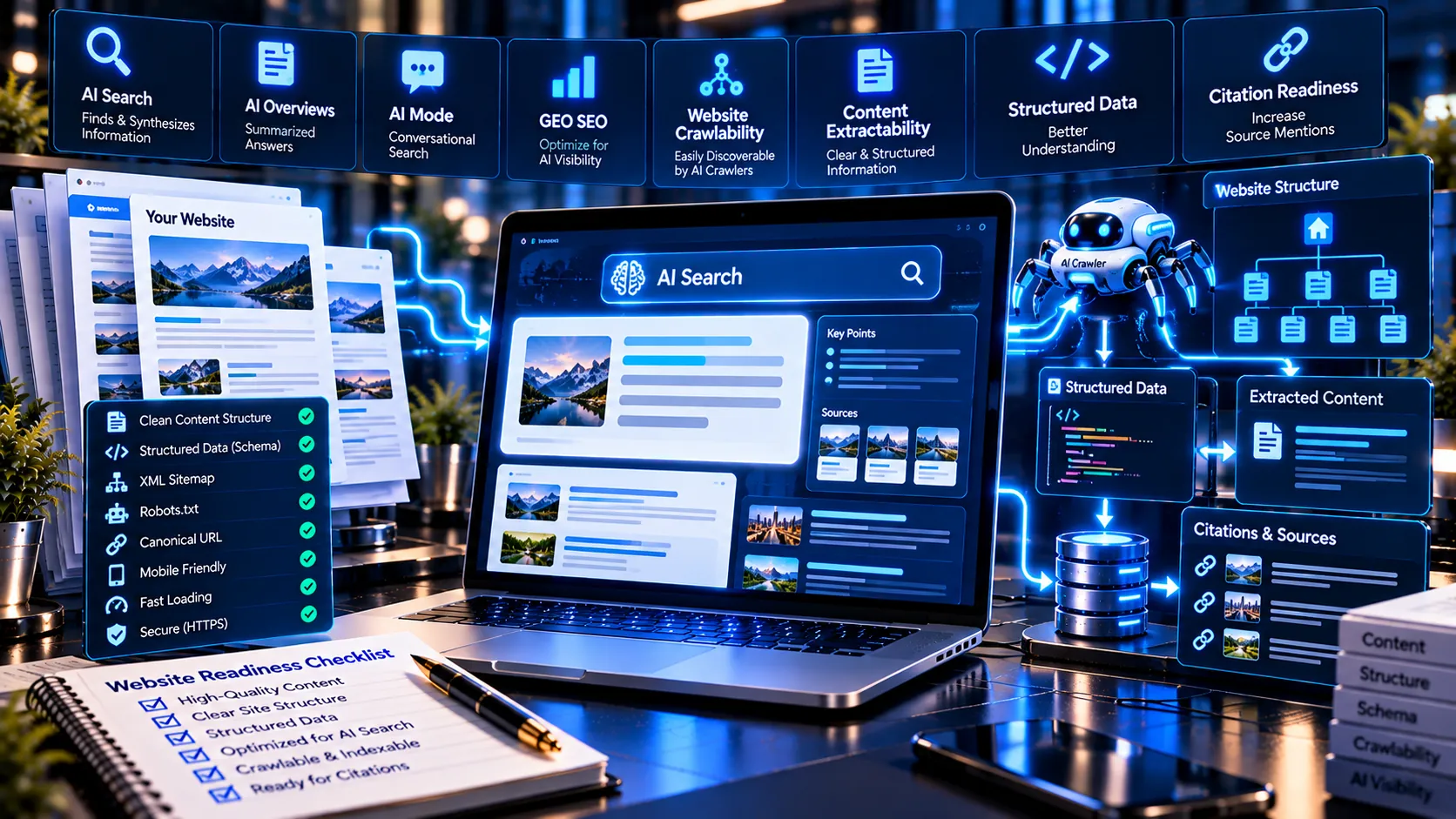
AI search is changing the way people discover information online. Google is now combining traditional search results with AI-generated answers, including AI Overviews and AI Mode, which means websites need to be accessible, understandable, useful, and easy for search systems to reference.
The good news is that preparing a website for AI search does not require a completely separate SEO strategy. Google continues to emphasize many of the same fundamentals that have always mattered: crawlability, indexability, helpful content, clear structure, strong page experience, and trustworthy information.
What is changing is the way search systems interpret, combine, and present information.
What Is AI Search?
AI search refers to search experiences where artificial intelligence helps understand a user’s question, explore related information, and generate a more direct answer.
Google’s AI Overviews and AI Mode are important examples. Instead of simply returning a traditional list of blue links, these experiences can synthesize information from multiple sources and provide links to relevant websites.
Google has also described how AI-powered search can use query fan-out, meaning a complex search may be broken into related searches to explore different aspects of a topic before generating a response.
This makes it increasingly important for your website to be technically accessible and its information easy to understand and extract.
AI Search Does Not Replace SEO
One of the biggest misconceptions about AI search is that websites now need a completely new form of SEO.
They do not.
Google’s current guidance makes it clear that the fundamentals of SEO remain relevant for generative AI features in Search. A page still needs to be crawlable, indexable, eligible to appear in search, and genuinely useful to people.
What AI search adds is another layer of interpretation. Search systems need to understand what your page is about, which questions it answers, what entities it refers to, and which parts of the content can provide useful information in an AI-generated response.
1. Make Sure Search Engines and AI Systems Can Crawl Your Website
Before worrying about GEO, AEO, AI citations, or AI Overviews, start with the basics: can search systems actually access your important pages?
A page that cannot be crawled or indexed has little opportunity to appear in traditional search or AI-powered search experiences.
Check your robots.txt rules, important page responses, redirects, canonical URLs, and indexability signals.
You can use the AI Crawler Access Analyzer to review whether important pages appear accessible to automated crawlers.
For a broader technical check, the AI Crawler Checker can help identify crawler-access issues that may affect discoverability.
2. Keep Your Sitemap Accurate
Your XML sitemap helps search engines discover URLs that you consider important.
A sitemap does not guarantee indexing, but an accurate sitemap gives search systems a cleaner map of your website.
Remove unnecessary URLs and make sure important pages are represented correctly.
The AI Sitemap Coverage Checker can help review sitemap coverage and identify potential gaps.
You can also use the AI Crawl Coverage Analyzer to examine crawl coverage across important URLs.
3. Review Your Robots.txt Rules
Robots.txt remains an important part of technical SEO because it controls which paths automated crawlers are instructed to access.
A poorly configured robots.txt file can unintentionally block resources or pages that you actually want discovered.
The AI Robots.txt Policy Analyzer can help you examine crawler directives and identify potentially important access problems.
Do not assume that blocking every AI-related crawler is automatically beneficial. Your decision should depend on your publishing goals, licensing considerations, and how you want your content to be discovered or used.
4. Make Your Content Easy to Extract and Understand
AI search systems need to understand the information contained on a page before they can use it effectively.
This is where content extractability becomes important.
Use clear headings, descriptive paragraphs, direct explanations, meaningful lists, tables where appropriate, and terminology that matches the subject you are discussing.
Avoid hiding important information behind unnecessary interface elements or creating pages where the main answer is difficult to identify.
The AI Content Extractability Checker can help evaluate whether important content is structured in a way that is easier to retrieve and interpret.
5. Answer Questions Directly
AI search often begins with questions rather than short keywords.
That means your content should answer important questions clearly instead of forcing readers to search through several paragraphs before finding the actual answer.
For example, if your page is about PDF compression, explain what PDF compression is, why someone would use it, what happens to quality, and how the process works.
The AI Answer Extractability Checker can help evaluate whether important answers are clearly presented within your content.
6. Build Strong Entity Clarity
AI search does not only interpret individual keywords. It also needs to understand entities, relationships, topics, organizations, products, people, places, and concepts.
For example, a page about a company should make it clear what the company is, what it offers, which industry it operates in, and how its products or services relate to the topic being discussed.
Use consistent names and terminology throughout your website.
The AI Entity Clarity Analyzer can help identify areas where a website’s entity signals may be unclear or inconsistent.
7. Use Structured Data Where It Actually Helps
Structured data can help Google understand the meaning and structure of your content.
It is not a magic ranking switch, and adding schema does not guarantee inclusion in an AI-generated answer.
The better approach is to use appropriate structured data when it genuinely represents the content on the page.
The AI Search Schema Readiness Checker can help review structured-data readiness for AI-oriented search visibility.
Keep the underlying visible content accurate as well. Structured data should describe the page, not contradict it.
8. Improve Citation Readiness
AI-generated search experiences can provide links to websites used as sources. This makes source quality and citation readiness increasingly relevant.
A useful page should make it easy to understand where information comes from, what claims are being made, and why the page is a useful source on that subject.
Use original information where possible, cite authoritative sources when appropriate, and avoid unsupported claims.
The AI Citation Readiness Checker can help evaluate whether your content contains signals that support clearer source interpretation.
The AI Citation Source Validator can also help validate source and citation information.
9. Strengthen Internal Linking
Internal links remain useful because they help users and search systems discover related content across your website.
Do not add dozens of links simply because you can. Link where the destination genuinely helps the reader understand the subject or continue a workflow.
Use descriptive anchor text rather than generic phrases such as “click here.”
A well-connected website also makes it easier to establish relationships between related topics, tools, categories, guides, and supporting resources.
10. Think Beyond One Search Query
Traditional SEO often starts with a keyword. AI search can begin with a much more complicated question.
A user might ask a question that contains several requirements at once. AI-powered search can explore related queries and sources before generating the response.
This means strong content should cover the real problem rather than repeating one keyword throughout the page.
For example, an article about choosing a document format could naturally explain compatibility, file size, editing requirements, security, conversion quality, and common use cases.
That is more useful than creating separate thin pages for every tiny keyword variation.
11. GEO Is About Being Useful, Not Finding a Magic Formula
Generative Engine Optimization, or GEO, has become a popular term for improving visibility in AI-powered search and answer systems.
The concept is useful, but it should not be treated as a collection of secret ranking tricks.
Google’s own guidance continues to emphasize useful, unique, trustworthy content and established SEO fundamentals.
There is no reliable shortcut where adding a specific number of headings, rewriting every paragraph into short chunks, or adding a particular file automatically makes a website appear in AI answers.
Good GEO starts with good information architecture, accessible content, clear answers, strong topical coverage, trustworthy sources, and a technically healthy website.
12. What About llms.txt?
The llms.txt file has received considerable attention in the AI-search and GEO community.
However, Google’s current guidance is important here: llms.txt is not required for Google Search and does not provide a direct Google Search ranking or visibility advantage.
That does not mean the concept is useless for every ecosystem. Website owners may choose to experiment with it for other AI systems or workflows, but it should not replace fundamental SEO work.
PKCapra also provides an llms.txt Validator & Analyzer and an llms.txt Quality Checker for websites that want to inspect this type of file.
13. Monitor Your AI Visibility
Preparing a website is only the first step. You also need to understand how your website is performing over time.
Google has introduced reporting and controls in Search Console related to generative AI search experiences, giving website owners more visibility into how their pages appear in these environments.
For a broader website-level diagnostic, the AI Visibility / GEO Platform can analyze areas such as crawlability, content extractability, entity clarity, citation readiness, structured data, robots.txt, sitemap signals, and llms.txt.
The AI Visibility Checker provides another focused way to review AI-search visibility signals.
14. Track Citations and Brand Mentions
Visibility is not only about whether your brand name appears. It can also matter which pages are referenced, which competitors appear alongside you, and which sources are repeatedly used.
Historical AI-answer samples can be useful for identifying patterns over time.
The AI Citation Monitoring Tool can help organize historical AI-answer snapshots, brand mentions, citation URLs, competitor mentions, source patterns, and visibility trends.
Remember that snapshot monitoring is different from having direct access to the internal ranking or citation systems of an AI provider.
15. Do Not Create Hundreds of AI-Generated Pages Just to Capture Search Queries
This is one of the biggest mistakes websites can make while trying to adapt to AI search.
Creating large numbers of low-value pages targeting every imaginable keyword variation does not create a strong topical resource.
Google’s current AI-search guidance specifically warns against producing large amounts of content simply to target search demand or query variations.
Instead, focus on pages that solve real problems and provide information that deserves to exist.
16. Make Your Content Worth Referencing
If you want other systems to reference your website, give them something worth referencing.
That could be original research, practical testing, unique data, detailed explanations, clear documentation, first-hand experience, useful tools, expert analysis, or genuinely better explanations of complicated subjects.
Simply rewriting information that already exists on hundreds of websites gives search systems little reason to prefer your page as a useful source.
17. AI Overviews Change the Search Journey
AI Overviews and AI Mode can change how users move through search results.
Instead of searching once, opening one page, and stopping, users can ask follow-up questions and explore different aspects of the same subject.
That means your content should support the complete information journey.
Answer the initial question, but also anticipate the practical questions a real reader is likely to ask next.
This is one reason comprehensive but focused content can be more useful than extremely short pages designed around a single keyword.
18. Common AI Search SEO Mistakes to Avoid
Blocking important crawlers without understanding the consequences: Review your access rules before making broad crawler restrictions.
Publishing large amounts of generic AI content: More pages do not automatically mean more useful visibility.
Keyword stuffing: Repeating AI-search-related terminology does not make a page more authoritative.
Adding schema that does not match visible content: Structured data should accurately describe the page.
Treating llms.txt as a ranking shortcut: It is not a replacement for technical SEO or useful content.
Believing third-party AI visibility scores are Google metrics: Independent tools can provide diagnostics, but they do not expose Google’s private ranking systems.
Ignoring traditional SEO: Crawlability, indexability, internal linking, content quality, and page experience still matter.
A Practical AI Search Readiness Checklist
Use this checklist when reviewing a website for AI search readiness:
✓ Important pages can be crawled
✓ Important pages are indexable
✓ Robots.txt does not accidentally block valuable content
✓ XML sitemap is accurate and maintained
✓ Canonical URLs are consistent
✓ Main content is visible and easy to understand
✓ Important questions receive direct answers
✓ Headings describe the actual subject of each section
✓ Entities and terminology are consistent
✓ Appropriate structured data is implemented correctly
✓ Important claims are supported by trustworthy sources
✓ Internal links connect genuinely related pages
✓ Content provides original value rather than simple rewriting
✓ Website performance and page experience are maintained
✓ Search Console is being monitored
✓ AI-search visibility is reviewed over time rather than judged from a single test
How PKCapra Can Help With AI Search Readiness
Preparing for AI search involves several connected areas rather than one single optimization.
PKCapra’s AI-focused tools are designed to let website owners inspect different parts of that workflow, from crawler access and sitemap coverage to content extractability, entity clarity, structured data, citation readiness, and AI visibility.
You can start with the AI Crawler Access Analyzer, review content with the AI Content Extractability Checker, inspect entity signals with the AI Entity Clarity Analyzer, and then use the AI Visibility / GEO Platform for a broader diagnostic.
The goal is not to chase an artificial “AI score.” The goal is to make your website technically accessible, genuinely useful, easy to understand, and strong enough to deserve visibility.
Frequently Asked Questions
Do I need a separate SEO strategy for AI Overviews?
Not a completely separate strategy. Google continues to emphasize established SEO fundamentals for its generative AI search features. The practical difference is that content may need to work well across more conversational and exploratory search journeys.
Does GEO replace SEO?
No. GEO is commonly used to describe optimization for generative search and answer systems, but traditional SEO fundamentals remain important for AI-powered search visibility.
Does llms.txt improve Google rankings?
Google’s current guidance does not say that llms.txt is required for Google Search or that it provides a direct ranking benefit. It may still be explored for other AI systems and workflows, but it should not replace core SEO work.
Can schema guarantee an AI Overview appearance?
No. Structured data can help search engines understand content, but it does not guarantee inclusion in an AI Overview or AI Mode response.
Should I create separate pages for every AI-search query?
No. Create pages when they serve a genuine user need and provide meaningful information. Creating large numbers of near-duplicate pages simply to capture query variations can reduce the overall quality of a website.
Can a third-party tool tell me exactly how Google ranks my website in AI search?
No. Third-party tools can provide useful diagnostics or observations, but they do not have access to Google’s private ranking systems or internal AI models.
Final Thoughts
Preparing for AI search in 2026 is less about discovering a secret GEO trick and more about building a website that is genuinely easy to access, understand, trust, and reference.
Start with technical fundamentals. Make your important pages crawlable and indexable. Keep your sitemap accurate. Review robots.txt. Structure your content clearly. Answer real questions. Strengthen entity clarity. Use appropriate structured data. Support important claims with trustworthy sources.
Then monitor what happens.
AI Overviews, AI Mode, conversational search, and query fan-out are changing the search journey, but the underlying principle remains familiar: websites that provide useful information and make that information accessible give search systems a better foundation to understand and surface their content.
That is the foundation of sustainable AI-search readiness.