
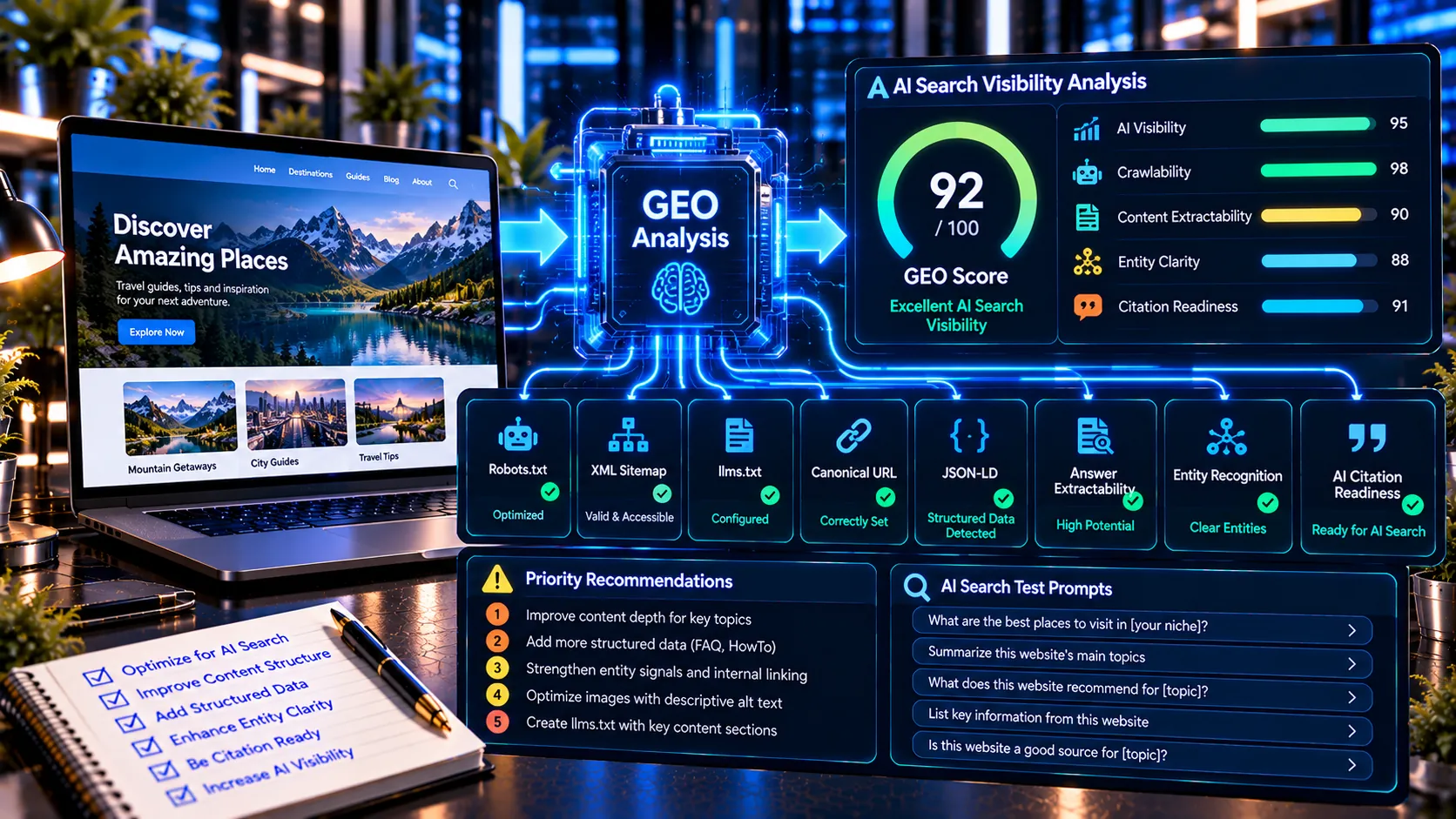
Measure how well your website is prepared for AI-powered search and answer engines with PKCapra’s AI Visibility / GEO Platform. Analyze important website signals related to crawlability, content extractability, entity clarity, citation readiness, structured data, sitemap configuration, robots.txt, llms.txt, and answer-focused content structure from one diagnostic interface.
AI search is increasingly becoming a separate discovery surface alongside traditional search. Current GEO research focuses on whether websites can be discovered, retrieved, understood, cited, and represented accurately inside AI-generated answers.
AI Visibility & GEO Diagnostic
Website Signals
Priority Actions
AI Visibility Test Prompts
Use these prompts in your preferred AI search engine for repeated manual or external monitoring. PKCapra does not run those engine queries in this diagnostic.
Methodology & limitations
What Is AI Visibility and GEO?
Generative Engine Optimization (GEO) refers to improving the way websites, brands, products, and information are discovered and represented by generative search and AI answer systems.
Traditional SEO often focuses on search-result visibility. GEO adds another layer: whether useful information from a website can be retrieved and used as evidence or a source in an AI-generated answer.
Research indicates that AI visibility is not a single stable ranking position. Results can vary between prompts, platforms, retrieval conditions, and repeated runs, which makes measurement more complex than conventional search rankings. arXiv
Analyze Your Website for AI Search Readiness
Enter a website URL and let PKCapra examine important technical and content signals that can influence how easily information can be discovered and interpreted.
The diagnostic can examine:
- Website accessibility
- Crawlability signals
robots.txt- XML sitemap availability
llms.txtsignals- Canonical URL
- Page title and meta description
- Heading structure
- Content length
- Content extractability
- Answer-oriented content structure
- Entity clarity
- Structured data
- JSON-LD
- External and source links
- Brand and topic signals
- Citation-readiness indicators
The result is designed to give you a practical technical and content-level view of your site’s AI-search preparation.
GEO Visibility Score
PKCapra combines multiple diagnostic signals into a GEO / AI Visibility Score out of 100.
The score is intended as a diagnostic benchmark rather than a prediction of how a particular AI engine will rank or recommend a website.
A high diagnostic score does not guarantee that ChatGPT, Google AI Overviews, Perplexity, Claude, Gemini, or another AI system will cite or recommend a website. AI retrieval and answer generation are dynamic and can change between queries and measurement runs. Google for Developers
Technical AI Visibility Signals
AI systems need access to web content before that content can potentially be retrieved and used.
PKCapra checks technical signals such as:
- Robots directives
- Sitemap availability
- Canonical configuration
- Page accessibility
- Crawl-related indicators
- Content structure
- Machine-readable metadata
- Structured data
- AI-oriented content signals
Google’s documentation confirms that content used in AI Overviews and AI Mode still depends on Search crawling and indexing systems. Google for Developers
Content Extractability
A page can contain useful information without presenting it in a format that is easy to retrieve and interpret.
The platform therefore examines signals such as:
- Clear definitions
- Descriptive headings
- Structured sections
- Direct answers
- Factual statements
- Lists and procedural steps
- Comparisons
- Relevant terminology
- Supporting links
- Content organization
Research into GEO citation behavior suggests that structured, semantically aligned pages containing extractable evidence can be important when AI systems select and use sources. arXiv
Entity Clarity
AI systems need to understand what a website, organization, product, person, service, or topic represents.
PKCapra examines signals that can help identify and clarify important entities, including:
- Brand or organization names
- Primary topics
- Descriptions
- Relevant terminology
- Structured data
- Consistent references
- Context surrounding important entities
Clear entity information can make website content easier to interpret as part of a broader information ecosystem.
Citation Readiness
Being discoverable is different from being cited.
AI-generated answers can retrieve many potential sources but may cite only a subset of them. Research on GEO therefore distinguishes between retrieval, citation selection, and the degree to which cited content actually contributes information to the generated answer. arXiv
PKCapra evaluates website-level signals associated with citation readiness, helping identify areas where source information could be clearer, better structured, or easier to reference.
robots.txt, Sitemap and llms.txt
Technical discovery files are important parts of a website’s machine-readable infrastructure.
PKCapra examines available signals around:
robots.txt- XML sitemap
- Sitemap accessibility
- Canonical URLs
llms.txt- Machine-readable site information
These checks help identify technical gaps that may deserve attention before deeper GEO work is attempted.
Structured Data and JSON-LD
Structured data can provide machine-readable context about a page and the entities it describes.
PKCapra checks for detectable structured-data signals such as JSON-LD and reports relevant findings as part of the broader GEO diagnostic.
Structured data should accurately represent visible page content and should not be treated as a shortcut for guaranteed AI citations or visibility.
AI Answer Extractability
AI answer systems frequently need concise pieces of information that can be incorporated into a response.
PKCapra looks for content patterns that can make information easier to extract, including:
- Question-and-answer structures
- Definitions
- Direct explanations
- Step-by-step information
- Comparisons
- Factual statements
- Clearly separated sections
- Supporting evidence
This complements conventional SEO by focusing on whether useful information is presented in an understandable and extractable form.
Priority Recommendations
After analyzing the website, PKCapra organizes detected issues into practical recommendations.
These can cover areas such as:
- Technical accessibility
- Content structure
- Entity clarity
- Citation readiness
- Structured data
- Sitemap configuration
robots.txtllms.txt- Answer extractability
- Content quality signals
This helps turn the diagnostic into an actionable GEO improvement plan rather than simply displaying a score.
AI Visibility Test Prompts
The platform can also generate example AI-search questions based on the analyzed website and its topic signals.
These prompts can be used for repeated testing across AI search platforms.
Because AI-generated answers can vary across runs and platforms, a single test should not be treated as a permanent visibility measurement. Research specifically recommends repeated measurements when evaluating GEO performance. arXiv
JSON Reports
PKCapra provides a structured JSON report containing the diagnostic information and findings.
This makes the results easier to:
- Archive
- Compare
- Process programmatically
- Share with technical teams
- Use in recurring audits
- Integrate into broader SEO workflows
Who Can Use the AI Visibility / GEO Platform?
The tool is useful for:
- SEO professionals
- Digital marketing agencies
- Website owners
- SaaS companies
- Publishers
- E-commerce businesses
- Local businesses
- Content teams
- Technical SEO specialists
- GEO consultants
- AI-search researchers
It can also be useful as a baseline diagnostic before implementing a broader AI-search optimization program.
AI Visibility Is Not the Same as an AI Ranking
PKCapra’s GEO score should not be interpreted as an official ranking from ChatGPT, Google, Perplexity, Claude, Gemini, or another AI system.
AI platforms use different retrieval systems, indexes, models, prompts, sources, and ranking processes. Visibility can therefore differ between platforms and between repeated searches. Current research describes GEO as a stochastic and partially observable process rather than a conventional fixed ranking system. arXiv
The purpose of PKCapra’s platform is to identify website-level readiness and improvement opportunities, not to promise a specific AI citation, recommendation, ranking, or traffic outcome.
Frequently Asked Questions
What is an AI Visibility / GEO Platform?
It is a diagnostic system that evaluates website signals relevant to visibility in AI-powered search and answer environments, including crawlability, content extractability, entity clarity, citation readiness, and structured information.
Does a high GEO score guarantee AI citations?
No. The score is a diagnostic indicator. AI-generated answers can vary by platform, query, retrieval process, and time. arXiv
Does PKCapra directly query ChatGPT?
The H11 diagnostic does not claim to directly measure your live position inside ChatGPT or another AI engine. It evaluates website-level GEO and AI-search readiness signals.
Does the tool replace SEO?
No. GEO complements traditional SEO. Crawlability, indexing, useful content, technical accessibility, and clear information architecture remain important foundations for AI-search visibility. Google’s documentation confirms that its AI Search features use web sources within the Search ecosystem. Google for Developers
What does the GEO score measure?
The score combines detected technical, content, extractability, entity, citation-readiness, and machine-readable website signals into a diagnostic score out of 100.
Can I use the tool for competitor websites?
You can analyze publicly accessible website URLs, subject to the site’s accessibility and the tool’s request limitations.
Does the tool require an OpenAI API key?
No. H11 is a website diagnostic tool and does not require an OpenAI API key for its core analysis.
Can I download the GEO analysis?
Yes. The tool provides a structured JSON report that can be saved for later review, comparison, or processing.
Should I measure AI visibility more than once?
Yes. AI-search results can vary between runs, prompts, and platforms. Repeated measurement provides a more useful picture than relying on a single observation.