
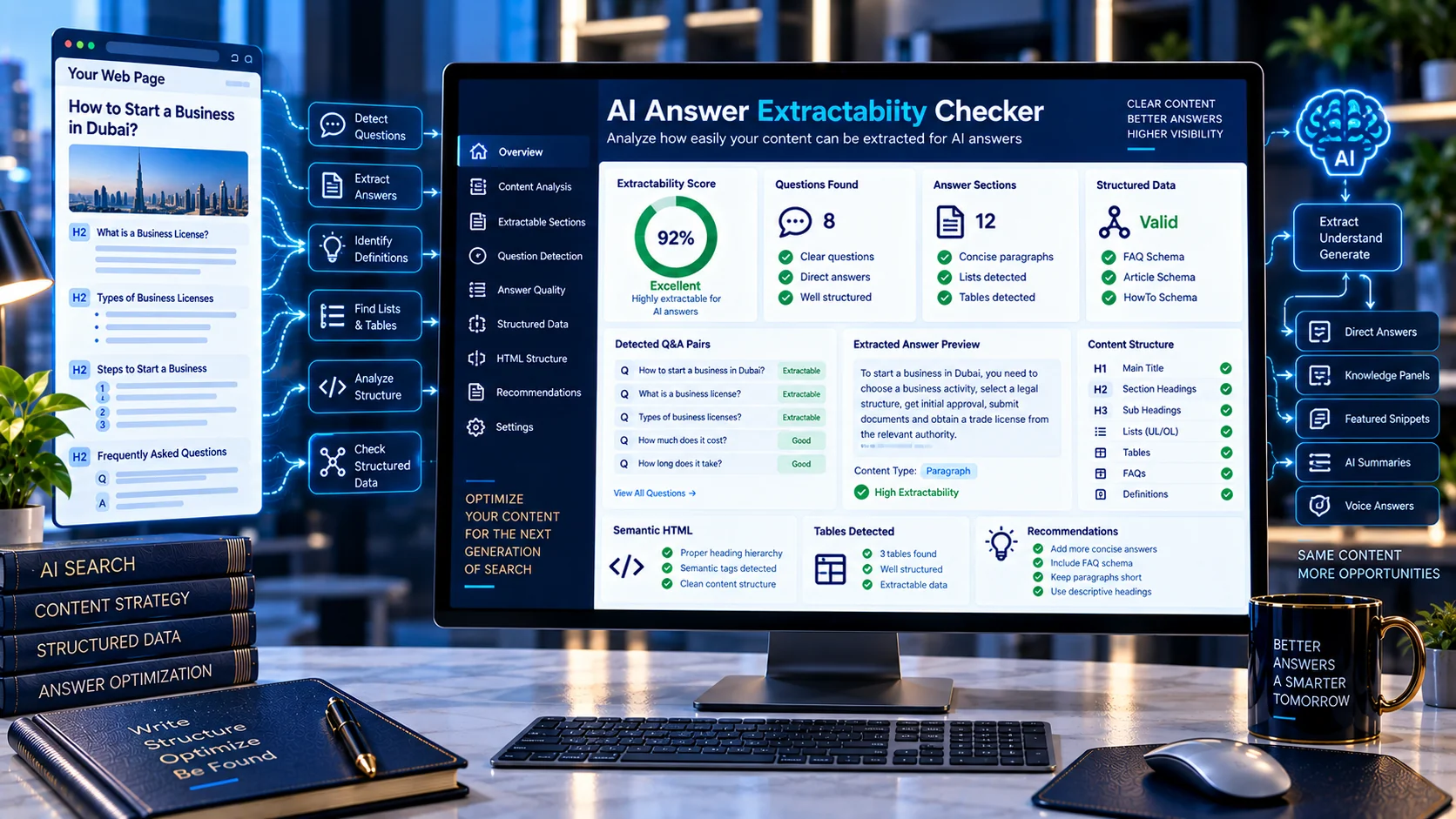
AI-powered search systems often need to identify concise, understandable passages before they can use information to formulate an answer. Pages that clearly organize definitions, explanations, direct answers, lists, and supporting details can be easier to interpret and extract.
PKCapra’s AI Answer Extractability Checker analyzes a public webpage for structural and content signals that may make information easier for automated answer systems to identify, quote, summarize, or reuse.
The tool is a diagnostic utility. It does not simulate a specific AI model and does not guarantee that any passage will be selected, quoted, summarized, or cited.
AI Answer Extractability Checker
Identify webpage passages and structural signals that can make information easier to isolate, summarize, or use as an answer component.
Check Whether Your Content Is Easy to Extract as an Answer
Enter a public webpage URL and analyze how its content is structured for answer-oriented extraction.
The checker identifies potentially answer-friendly passages and evaluates important page-level signals such as headings, paragraphs, lists, tables, semantic HTML, structured data, and extractable text.
This gives you a practical way to identify content that may need clearer organization or more direct explanations.
What the AI Answer Extractability Checker Analyzes
Direct-Answer Passages
The analyzer looks for passages that contain relatively direct informational statements.
These can include concise explanations, definitions, factual responses, and short answer-oriented sections.
Clear answers can be easier to identify than information buried inside long or highly complex paragraphs.
Definition-Style Content
Definitions are common answer patterns because they directly explain what a term, concept, product, process, or subject means.
The checker identifies definition-like structures and reports relevant passages that may be useful for further content review.
Question-Based Headings
Question-based headings can clearly indicate the information a following section is intended to answer.
The analyzer examines headings and identifies question-oriented structures that may help organize content around specific user questions.
Concise Paragraphs
Very long paragraphs can contain several different ideas, making individual answers harder to isolate.
The checker examines paragraph structure and identifies content that may benefit from clearer segmentation.
Answer-Friendly Sentences
The analyzer evaluates sentence-level characteristics that can help identify concise informational passages.
The goal is not to enforce a particular writing style, but to highlight sections where important information may be easier to isolate and understand.
Lists and Tables
Lists and tables can organize multiple related facts into clearly separated units.
The checker identifies available lists and tables as part of its broader answer-extractability assessment.
Heading Structure
The tool examines the page hierarchy, including:
- H1 headings
- H2 headings
- H3 headings
- Question-based headings
- Section organization
A logical heading hierarchy can make relationships between topics and answers easier to understand.
Semantic HTML
Semantic HTML provides structural meaning to webpage content.
The analyzer checks relevant semantic elements and considers them when evaluating the page’s overall extractability.
Extractable Text
The checker examines the text that can be retrieved from the webpage and determines whether meaningful content is available for analysis.
Pages that depend heavily on inaccessible or dynamically rendered content may provide incomplete results.
Structured Data
The analyzer detects available JSON-LD structured data and includes it as part of the broader page analysis.
Structured data can provide machine-readable context, although it does not guarantee that an AI system will extract or use a particular passage.
Hidden Content
The tool checks for signals that may indicate content is hidden or not normally available in the visible page structure.
This can help identify important information that may not be straightforward to retrieve or interpret.
Why Answer Extractability Matters
AI-powered search experiences can retrieve information from webpages and use relevant material when constructing responses.
For website owners, this creates an additional reason to organize important information clearly and make direct answers easy to locate.
Answer extractability is not about writing specifically for machines. It is about making useful information:
- Clear
- Specific
- Well organized
- Easy to identify
- Logically structured
- Directly responsive to questions
These qualities can benefit both human readers and automated systems.
Answer Extractability Is Not the Same as AI Visibility
A page can contain highly extractable passages without appearing in an AI-generated answer.
Actual retrieval and source selection depend on many factors, including:
- The user’s query
- Search-system retrieval
- Content relevance
- Source availability
- Competing information
- Search-system behavior
- Current information requirements
The AI Answer Extractability Checker therefore measures page-level structural and content signals rather than actual AI visibility.
How to Use the AI Answer Extractability Checker
1. Enter a Public Webpage URL
Enter the complete public URL of the webpage you want to analyze.
2. Start the Analysis
Run the checker so it can retrieve the publicly accessible content required for the analysis.
3. Review the Extractability Assessment
Review the overall diagnostic score and the individual findings identified on the page.
4. Examine Answer-Friendly Passages
Review the passages identified as potentially suitable for direct answers, definitions, explanations, or concise extraction.
5. Improve and Recheck
Where appropriate, make the content clearer or better structured and run the analysis again.
How to Interpret the Results
The answer-extractability score is a diagnostic indicator, not a ranking score or probability of appearing in an AI answer.
A high score does not guarantee that an AI system will use the content.
A low score does not mean that the page cannot be retrieved or cited.
The detailed findings are more useful because they show specific structural opportunities.
For example:
- Long paragraphs: Consider separating multiple ideas into focused sections.
- Weak question structure: Organize important information around clear user questions where appropriate.
- Buried answers: Move important explanations closer to the beginning of relevant sections.
- Weak heading hierarchy: Improve the logical organization of major topics and subtopics.
- Limited lists or tables: Use structured formats when they genuinely make information easier to understand.
- Limited semantic structure: Review the HTML organization of important content.
How to Make Content More Answer-Friendly
Answer-oriented content does not need to be artificial or repetitive.
A useful approach is to place the direct answer near the beginning of a relevant section and then provide supporting explanation underneath it.
For example, a section can follow this pattern:
Question or topic → direct answer → explanation → supporting details → relevant example
This structure can make important information easier for readers to scan and easier for automated systems to identify.
Answer Extractability and GEO
Generative Engine Optimization (GEO) involves preparing content for environments where AI systems may retrieve, summarize, or reference information.
Answer extractability is one part of this broader process.
Content can become easier to interpret when important information is presented through:
- Clear questions and answers
- Specific definitions
- Descriptive headings
- Short explanatory passages
- Structured lists
- Useful tables
- Supporting context
- Consistent terminology
The checker focuses specifically on the extractability layer rather than attempting to measure complete GEO performance.
Answer Extractability and Content Quality
Making content easy to extract should not mean reducing everything to short sentences or removing useful context.
A good webpage should still provide enough explanation for readers to understand the subject accurately.
Direct answers work best when they are followed by appropriate supporting information.
The objective is therefore clarity without sacrificing substance.
Important Limitations
The AI Answer Extractability Checker analyzes content available from the retrieved public webpage.
It cannot reproduce the proprietary retrieval, ranking, summarization, or reasoning process of every AI system.
Results can also be affected by:
- JavaScript rendering
- Dynamic content
- Bot protection
- Firewalls
- CDN behavior
- Authentication
- Rate limiting
- Server errors
- Content loaded after the initial HTML response
The tool does not guarantee AI extraction, citations, rankings, traffic, indexing, or visibility.
It also does not determine whether extracted information is factually correct.
Privacy and Processing
The checker is designed to analyze publicly accessible webpage information required for its diagnostic checks.
Do not submit private, authenticated, or sensitive URLs unless you understand the access and processing implications of the target page.
Frequently Asked Questions
What is an AI Answer Extractability Checker?
An AI Answer Extractability Checker analyzes webpage content and structure to identify passages and page signals that may make information easier for automated answer systems to identify, summarize, or quote.
Does the tool guarantee AI answers will use my content?
No. The tool provides a diagnostic assessment and cannot guarantee retrieval, extraction, citation, or visibility.
What types of content can be extractable?
Definitions, direct answers, explanations, factual statements, lists, tables, and other clearly structured informational passages can be easier to identify and extract.
Does the checker analyze headings?
Yes. It examines H1, H2, H3, and question-oriented headings as part of the page-structure analysis.
Does it analyze paragraphs?
Yes. Paragraph structure and text characteristics are included in the assessment.
Does it check lists and tables?
Yes. Lists and tables are detected and considered as part of the overall answer-extractability analysis.
Does it check semantic HTML?
Yes. The checker examines relevant semantic HTML structures.
Does it check structured data?
Yes. Available JSON-LD structured data is detected and included in the analysis.
Is answer extractability the same as citation readiness?
No. Answer extractability focuses on whether information is structurally easy to identify as an answer. Citation readiness focuses more broadly on sourceability, supporting sources, claims, attribution, and related signals.
Should every article be written as questions and answers?
No. Question-and-answer structures are useful when they naturally match the user’s information needs. Content should remain natural, useful, and appropriate for its subject.
Can I analyze any webpage?
The tool is designed for publicly accessible webpages that can be retrieved successfully. Pages requiring authentication or affected by technical access restrictions may produce incomplete results.
Continue Your AI Search Diagnostics
Use the AI Search Readiness Analyzer for a broader assessment of crawler access, indexability, canonical signals, sitemap information, content structure, structured data, metadata, and internal links.
For content accessibility and structural extraction, use the AI Content Extractability Checker.
For sourceability and citation-related signals, use the AI Citation Readiness Checker.