
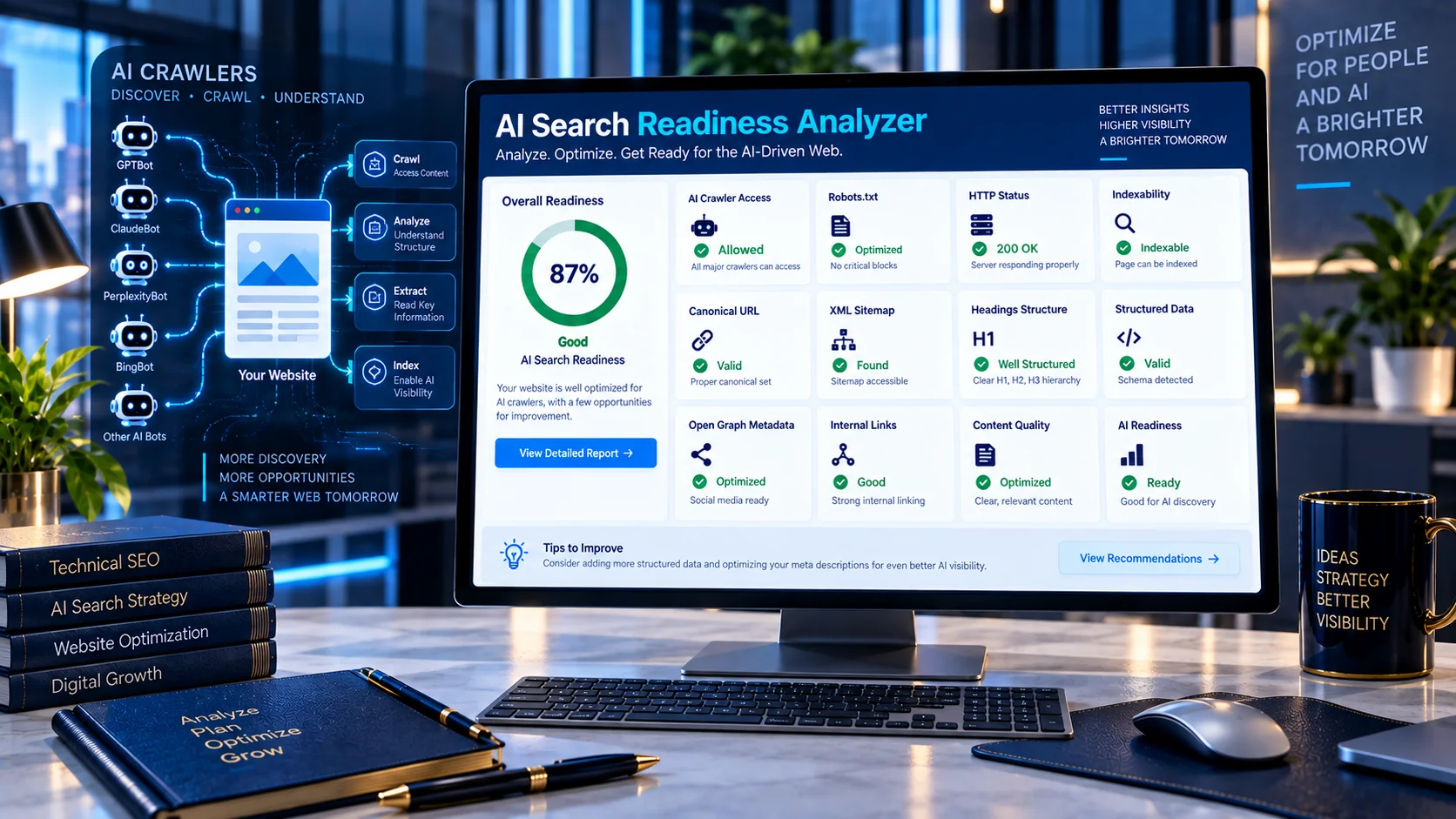
AI search systems need to discover, access, interpret, and understand webpage content before that content can potentially be used in search experiences or AI-generated answers. PKCapra’s AI Search Readiness Analyzer combines multiple technical and content-related signals into one practical diagnostic report.
Analyze a public webpage and review its crawler accessibility, indexability, canonical information, sitemap signals, content structure, structured data, metadata, internal links, and other factors that contribute to a technically accessible and machine-readable website.
The analyzer is a diagnostic tool. It does not predict rankings or guarantee inclusion, citations, or visibility in any particular search or AI system.
AI Search Readiness Analyzer
Review the technical signals that can make a public page easier for search engines and AI systems to crawl, understand, and retrieve.
Check Your Website’s AI Search Readiness
Enter a public webpage URL and run the analysis to get a consolidated view of important AI-search and technical SEO signals.
Instead of checking individual elements separately, the tool brings multiple readiness areas together so you can identify potential technical problems and decide what should be investigated next.
What the AI Search Readiness Analyzer Checks
AI Crawler Accessibility
The analyzer examines crawler-related access signals and helps identify potential restrictions that could prevent automated systems from accessing a webpage.
Crawler access is an important technical foundation because a system cannot reliably process content that it cannot retrieve.
HTTP Accessibility
The tool checks the webpage’s HTTP response and basic accessibility information.
A page that returns an unexpected response, cannot be fetched successfully, or is affected by access controls may require investigation before other readiness signals can be interpreted reliably.
Indexability and Noindex Signals
Indexability provides important context for search readiness.
The analyzer checks relevant robots meta and noindex signals so you can identify whether the page contains directives that may restrict search indexing.
Canonical URL
Canonical information helps search engines understand which URL represents the preferred version of a page when multiple URLs can represent similar or duplicate content.
The analyzer detects the available canonical URL and includes it in the readiness assessment.
Sitemap Signals
Sitemaps provide machine-readable URL discovery information.
The analyzer checks available sitemap-related signals and considers them alongside other crawl and indexing information. This can help identify situations where URL discovery and page accessibility should be investigated together.
Heading and Content Structure
Well-structured content makes a webpage easier to inspect and understand.
The analyzer examines important page structure such as:
- H1 headings
- H2 headings
- H3 headings
- Paragraph content
- Main content areas
- Semantic HTML
- Extractable text
The goal is not to assign a universal ideal structure, but to identify useful signals and potential structural weaknesses.
Structured Data
Structured data provides machine-readable information about webpage content and entities.
Google describes structured data as a standardized format that can help its systems understand content and classify pages.
The analyzer detects available JSON-LD structured data and includes its presence in the overall readiness assessment.
Page Metadata and Open Graph Signals
The analyzer also reviews relevant page metadata and Open Graph information.
These signals can provide additional context about a webpage and are useful when reviewing the technical completeness of a page.
Internal Links
Internal links connect pages within a website and help establish relationships between different areas of the site.
The analyzer examines available internal-link signals as part of the broader readiness assessment.
Why AI Search Readiness Matters
AI search does not eliminate the importance of technical website fundamentals.
Search systems still need to access webpages, process their content, understand page structure, and interpret available information. Google’s current documentation continues to emphasize crawlability, indexing, structured data, canonicalization, and sitemap-related technical considerations across its search systems.
AI Search Readiness Analyzer brings these types of signals together into a practical diagnostic workflow.
AI Search Readiness Is More Than Robots.txt
A website can allow a crawler through robots.txt and still have other technical problems.
For example, a page may be accessible but have:
- An accidental noindex directive
- Missing canonical information
- Weak heading structure
- Limited structured data
- Poor internal linking
- Incomplete metadata
- Content that is difficult to extract
- Unexpected HTTP behavior
That is why a broader readiness assessment can be more useful than checking a single technical signal.
How to Use the AI Search Readiness Analyzer
1. Enter a Public URL
Enter the full URL of the webpage you want to analyze.
2. Start the Analysis
Run the analyzer and allow it to retrieve the publicly accessible webpage information required for the checks.
3. Review the Readiness Assessment
Review the overall assessment and individual technical signals detected on the page.
4. Investigate Warnings
Look at warnings, missing signals, restrictions, and other findings that may require technical investigation.
5. Fix and Recheck
Make appropriate website changes and run the analysis again to verify the updated page.
How to Interpret the Results
The overall readiness score should be treated as a diagnostic indicator, not as a search ranking score.
A lower result does not automatically mean that a page cannot appear in search results or AI-generated answers. Likewise, a higher result does not guarantee rankings, indexing, citations, recommendations, or visibility.
The individual findings are often more valuable than the number itself because they show which areas may require attention.
For example:
- Crawler access issue: Review robots.txt and server accessibility.
- Noindex signal: Confirm whether the directive is intentional.
- Canonical issue: Review canonical implementation and URL variants.
- Weak content structure: Improve the organization and hierarchy of important content.
- Missing structured data: Determine whether relevant structured data would accurately describe the page.
- Limited internal links: Add useful contextual links where appropriate.
AI Search Readiness and GEO
Generative Engine Optimization (GEO) is broader than a single technical checklist.
Technical accessibility, crawlability, content structure, entity information, structured data, and source clarity can all form part of the wider process of making website content easier for automated systems to discover and interpret.
AI Search Readiness Analyzer focuses specifically on the technical and structural readiness layer. It does not attempt to measure actual AI citation frequency or simulate every AI search engine.
AI Search Readiness vs. AI Visibility
These are different concepts.
AI search readiness asks whether important technical and structural signals are available and accessible.
AI visibility asks whether a particular AI or search system actually surfaces, cites, summarizes, or recommends the website for specific queries.
A technically strong webpage can still receive different visibility across different systems and queries.
The analyzer therefore should be used as a technical diagnostic rather than a visibility predictor.
Common AI Search Readiness Problems
A website may require further investigation when it has issues such as:
- Automated crawler restrictions
- Failed or unexpected HTTP responses
- Accidental noindex directives
- Missing canonical information
- Weak heading hierarchy
- Poorly structured content
- Missing or incomplete structured data
- Limited semantic HTML
- Weak internal linking
- Inaccessible or difficult-to-extract content
- Incomplete page metadata
Identifying these issues gives website owners a practical starting point for technical improvements.
Important Limitations
AI Search Readiness Analyzer evaluates the information that can be retrieved from the requested public webpage. It cannot reproduce every possible crawler environment, search engine process, or AI model behavior.
Results may be affected by:
- JavaScript rendering
- Server-side rendering
- CDNs
- Firewalls
- Bot protection
- Rate limiting
- Authentication
- Geographic restrictions
- Dynamic content
- Temporary server errors
The tool does not guarantee search indexing, rankings, AI citations, AI recommendations, or visibility.
Structured data itself also does not guarantee enhanced search appearances. Google explicitly notes that structured-data implementation does not guarantee that a corresponding search feature will appear.
Privacy and Processing
The analyzer is designed to inspect publicly accessible webpage information required for its technical checks.
Do not submit private or authenticated URLs unless you understand the access and processing implications of the target website.
Frequently Asked Questions
What is an AI Search Readiness Analyzer?
An AI Search Readiness Analyzer is a technical diagnostic tool that evaluates webpage signals related to accessibility, crawlability, indexability, content structure, structured data, metadata, and other machine-readable website characteristics.
Does AI Search Readiness replace traditional SEO?
No. AI search readiness builds on many established technical SEO principles rather than replacing them.
Does a high readiness score guarantee AI citations?
No. A readiness score is a diagnostic measurement and cannot guarantee citations, rankings, recommendations, or visibility.
Does the analyzer check robots.txt?
Yes. Crawler-access and robots-related signals are included in the combined readiness analysis.
Does it check noindex directives?
Yes. Relevant robots meta and noindex signals are examined.
Does it check canonical URLs?
Yes. The analyzer detects available canonical information on the analyzed webpage.
Does it check structured data?
Yes. The analyzer detects available JSON-LD structured data and includes its presence in the report.
Does it check internal links?
Yes. Internal-link signals are included as part of the broader website readiness assessment.
Can I analyze any webpage?
The tool is designed for publicly accessible webpages that can be successfully retrieved. Pages protected by authentication, aggressive bot protection, network restrictions, or other access controls may produce incomplete results.
How often should I run an AI search readiness check?
Run the analysis after significant technical changes such as a website redesign, robots.txt update, indexing changes, structured-data implementation, URL migration, or major content restructuring.
Combine AI Readiness With Technical SEO Checks
AI search readiness is easier to understand when reviewed alongside traditional technical website diagnostics.
For broader crawl and indexing analysis, use the Indexability / Crawlability Analyzer. To investigate robots directives separately, use the Robots.txt Analyzer, while the XML Sitemap Analyzer can help examine sitemap structure and URLs.
For a focused structured-data review, use the Schema Markup / Structured Data Analyzer.
If you specifically want to examine whether webpage content is accessible and structurally extractable for automated systems, use the AI Content Extractability Checker.