
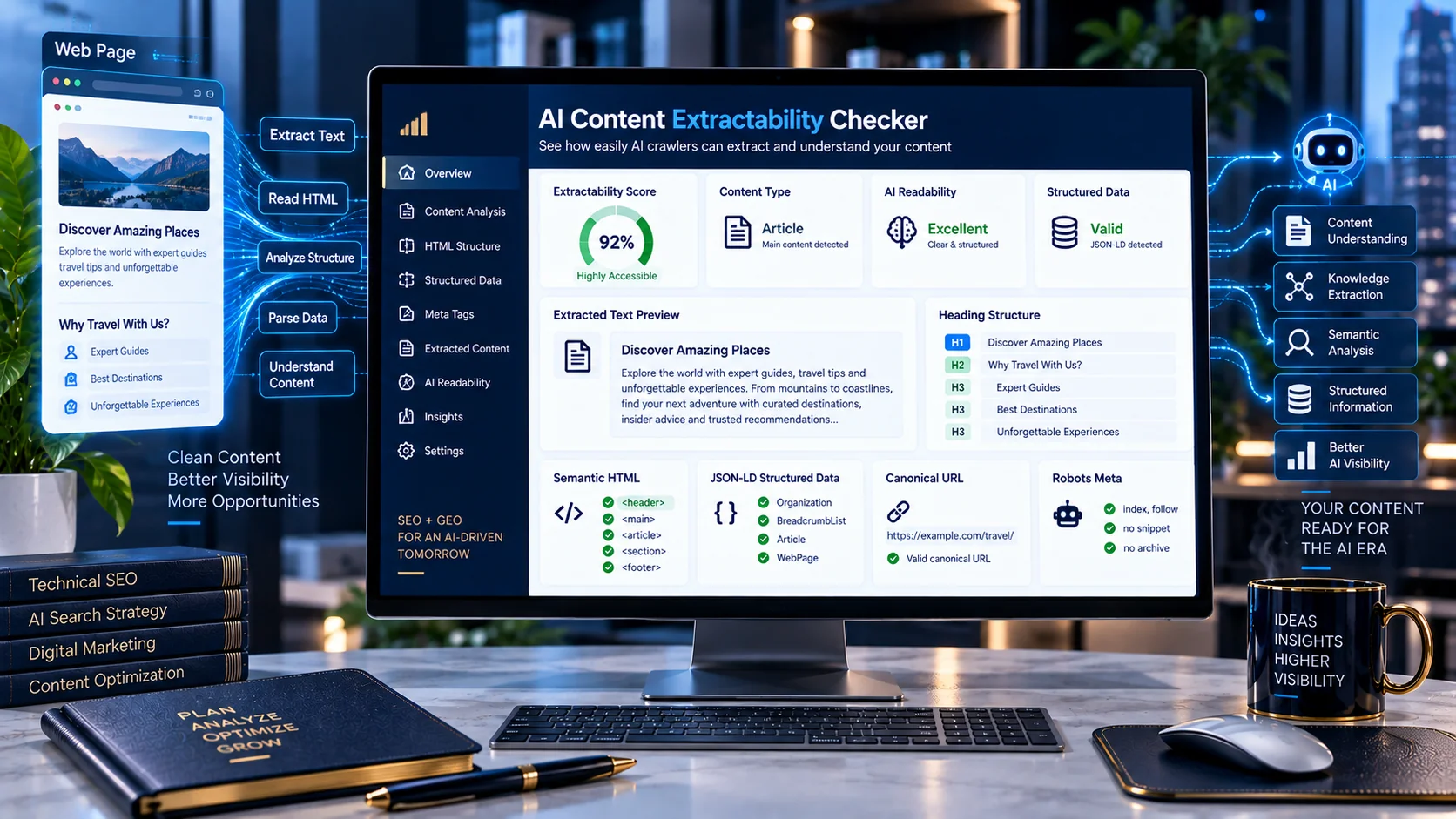
AI Content Extractability Checker helps you determine whether important content on a webpage is accessible, structured, and technically extractable by automated systems such as search crawlers and AI-oriented web crawlers.
A page can be publicly accessible and still be difficult for automated systems to interpret if important information is hidden behind client-side rendering, poorly structured HTML, embedded media, or unclear content boundaries. Google also recommends checking how crawlers see a page and notes that pages should be accessible rather than blocked by robots.txt, noindex, or login requirements.
AI Content Extractability Checker
Check whether important page content is publicly retrievable and presented in a structure that is easier for automated systems to parse and extract.
Check Whether Your Page Content Is AI-Extractable
Enter a public webpage URL and let PKCapra inspect the HTML structure and content signals that can affect automated content extraction.
The analyzer examines the page for important elements such as:
- Main and article content
- Extractable text
- Word count
- H1, H2, and H3 structure
- Paragraph content
- Semantic HTML
- JSON-LD structured data
- Canonical URL
- Robots meta directives
noindexsignals- Hidden content
- Iframes
- Images and missing alt attributes
- Content previews
- Potential client-side rendering issues
The goal is not to predict whether an AI system will cite or rank a page. Instead, the tool focuses on whether important information is technically present and structured in a way that automated systems can process.
Why Content Extractability Matters for AI Search
AI search systems need to retrieve and interpret webpage content before that information can potentially contribute to an answer.
OpenAI states that OAI-SearchBot can be used to discover public web content for ChatGPT search, and that websites should not block the crawler when they want their content to be discoverable and clearly surfaced.
Crawler access is only the first step, however. Once a page can be fetched, its actual HTML structure and content delivery still matter.
A page whose important information exists directly in accessible HTML is generally easier for automated systems to process than one where critical information depends heavily on interactive JavaScript, images, embedded documents, or other presentation layers.
What the AI Content Extractability Checker Analyzes
Main and Article Content
The analyzer looks for common containers used to identify the primary content of a webpage.
Clear content boundaries can help distinguish the main article or information from navigation, sidebars, menus, footer elements, and other page components.
This is especially useful for long pages where the visible webpage contains a large amount of supporting interface content around the actual answer or article.
Extractable Text
The tool measures the text that can be extracted from the returned HTML and provides a content preview.
This helps identify situations where a page appears visually complete in a browser but the server-delivered HTML contains little meaningful text.
Heading Structure
The analyzer checks H1, H2, and H3 elements to provide a quick view of the page’s structural hierarchy.
Clear headings can help divide a long page into meaningful sections and make individual topics easier to identify.
Google’s search documentation also emphasizes structured page information and uses structured data and page content to understand what a page represents.
Paragraph Content
Important information should normally be available as actual text rather than being embedded exclusively inside images, graphics, or other non-text presentation elements.
The analyzer checks extracted paragraph content so you can identify pages where the textual layer may be unusually thin.
Semantic HTML
Semantic elements such as main, article, section, and related structural elements can provide useful boundaries around page content.
The analyzer reports relevant semantic structures it finds so you can see whether your page provides recognizable content containers.
JavaScript and Client-Side Content
Some websites depend heavily on JavaScript to insert or render important page content.
If critical information is unavailable in the HTML returned to a crawler, automated systems may have difficulty processing that information.
Google documents that its systems can render JavaScript, but it also recommends ensuring that important content and structured data are accessible to its crawlers and that pages can be properly inspected.
AI crawler behavior is not necessarily identical to Google Search’s rendering pipeline, so server-delivered, cleanly structured content remains a useful technical consideration for AI search readiness.
Structured Data
The analyzer detects JSON-LD structured data present in the page HTML.
Structured data provides machine-readable information about webpage entities and content types. Google describes structured data as a standardized way to provide information about a page and classify its content.
Structured data should complement visible page content rather than being treated as a replacement for useful, accessible content.
Canonical URL
The analyzer checks whether a canonical URL is present.
Canonical information can help search systems understand which URL represents the preferred version of substantially similar pages.
Robots Meta and Noindex Signals
A page can be technically reachable while still containing directives that affect indexing or search visibility.
The analyzer checks robots meta information and identifies noindex signals so you can review them alongside the page’s extractability.
Google specifically notes that pages used with its structured-data and search systems should be accessible and not blocked by robots.txt, noindex, or login requirements.
Hidden Content
The analyzer looks for content that may be hidden through HTML attributes or styling patterns.
Hidden content should not be confused with every legitimate interactive component. Some hidden elements are normal parts of modern websites, so the results should be interpreted in context.
Images and Alt Attributes
Images can provide important information, but text that exists only inside an image is not equivalent to normal HTML text.
The analyzer identifies images and missing alt attributes to help you review whether important visual content has an appropriate textual representation.
How to Use the AI Content Extractability Checker
1. Enter a Public Page URL
Enter the full URL of the webpage you want to analyze.
2. Run the Analysis
Start the checker and allow it to retrieve the page’s publicly accessible HTML.
3. Review the Extracted Content
Examine the detected text, content containers, headings, paragraphs, and content preview.
4. Check Technical Signals
Review robots directives, canonical information, structured data, semantic elements, hidden content, images, and other reported signals.
5. Investigate Potential Problems
If important content is missing from the extracted HTML or appears difficult to identify structurally, investigate the page’s rendering and content-delivery implementation.
How to Interpret the Results
A strong extractability result generally means the page provides substantial readable content through its HTML and has recognizable structural signals.
A review result does not automatically mean that a page is inaccessible to AI systems. It indicates that one or more technical or structural characteristics deserve further investigation.
For example, a page may contain excellent written content but still require review if that content is primarily injected after page load.
Similarly, the presence of structured data does not automatically make a page extractable. Structured data, semantic HTML, visible text, page accessibility, and content organization serve different purposes.
AI Content Extractability Is Different From AI Crawler Access
A crawler must first be able to reach a page before its content can be analyzed.
That’s why content extractability should be considered alongside crawler accessibility and robots.txt policies.
If you want to check whether major AI crawlers can access your website, use the AI Crawler Access Analyzer when its verified page URL is available.
You can also inspect your site’s crawler rules with the Robots.txt Analyzer, while the AI Robots.txt Policy Analyzer focuses specifically on AI crawler-specific Allow and Disallow policies.
For broader website crawlability, the Indexability / Crawlability Analyzer provides additional technical diagnostics.
Content Extractability and GEO
Generative Engine Optimization involves more than adding keywords or creating content specifically for AI systems.
A technically accessible page should also communicate information clearly through its actual content structure.
Useful practices include:
- Put important information in accessible HTML text.
- Use descriptive section headings.
- Keep related information within clear content sections.
- State important facts directly rather than hiding them inside decorative elements.
- Use semantic HTML where appropriate.
- Keep structured data consistent with visible page content.
- Avoid making critical information dependent entirely on interactive widgets.
- Make important pages accessible to the crawlers you intend to serve.
These practices can improve the technical clarity of a page without attempting to manipulate a particular AI system.
Important Limitations
The checker analyzes the HTML and technical signals available from the public webpage it retrieves.
It does not simulate every AI search engine, crawler, browser, rendering environment, or retrieval system.
A strong extractability result does not guarantee AI citations, rankings, visibility, inclusion in generated answers, or traffic.
Likewise, a review result does not necessarily mean that an AI system cannot understand the page.
Real-world crawler behavior can also be affected by robots.txt, WAF rules, CDN protection, rate limiting, authentication, HTTP responses, JavaScript rendering, and other infrastructure controls. OpenAI specifically notes that crawler access can be affected by robots.txt, firewalls, CDN configuration, bot mitigation, authentication, JavaScript challenges, and rate limiting.
Privacy and Processing
The analyzer works with the public webpage URL you provide and retrieves the page’s accessible HTML for analysis.
You do not need to upload your website files or provide WordPress administrator access.
Do not submit private, authenticated, or confidential URLs to a public analysis tool.
Frequently Asked Questions
What is AI content extractability?
AI content extractability describes how easily important webpage information can be identified and processed from the page’s accessible HTML structure and content.
Why is content extractability important for AI search?
AI systems need to retrieve and interpret webpage information before it can potentially contribute to an answer. Clear, accessible content structure can make important information easier for automated systems to identify and process.
Does structured data guarantee AI citations?
No. Structured data can help machines understand page information, but it does not guarantee AI citations, rankings, visibility, or inclusion in generated answers. Google describes structured data as a way to provide information about and classify page content, not as a guarantee of search appearance.
Can JavaScript affect content extractability?
Yes. If important content is only inserted or made available after client-side JavaScript execution, its accessibility can depend on the crawler or rendering environment. Checking the returned HTML can therefore reveal potential content-delivery issues.
What is the difference between crawlability and extractability?
Crawlability concerns whether a crawler can reach and retrieve a page. Extractability concerns what meaningful information the crawler can identify and process after retrieving it.
Does this tool check my entire website?
No. The analyzer evaluates the specific public webpage URL that you submit.
Can a page be crawlable but poorly extractable?
Yes. A crawler may successfully retrieve a page while the returned HTML contains little meaningful text, unclear content boundaries, or important information that depends on other rendering mechanisms.
How can I improve content extractability?
Make important information available as accessible HTML text, use clear headings and semantic structure, keep important content out of inaccessible presentation layers, maintain consistent structured data, and ensure that important pages are not unintentionally blocked by technical access or indexing directives.