
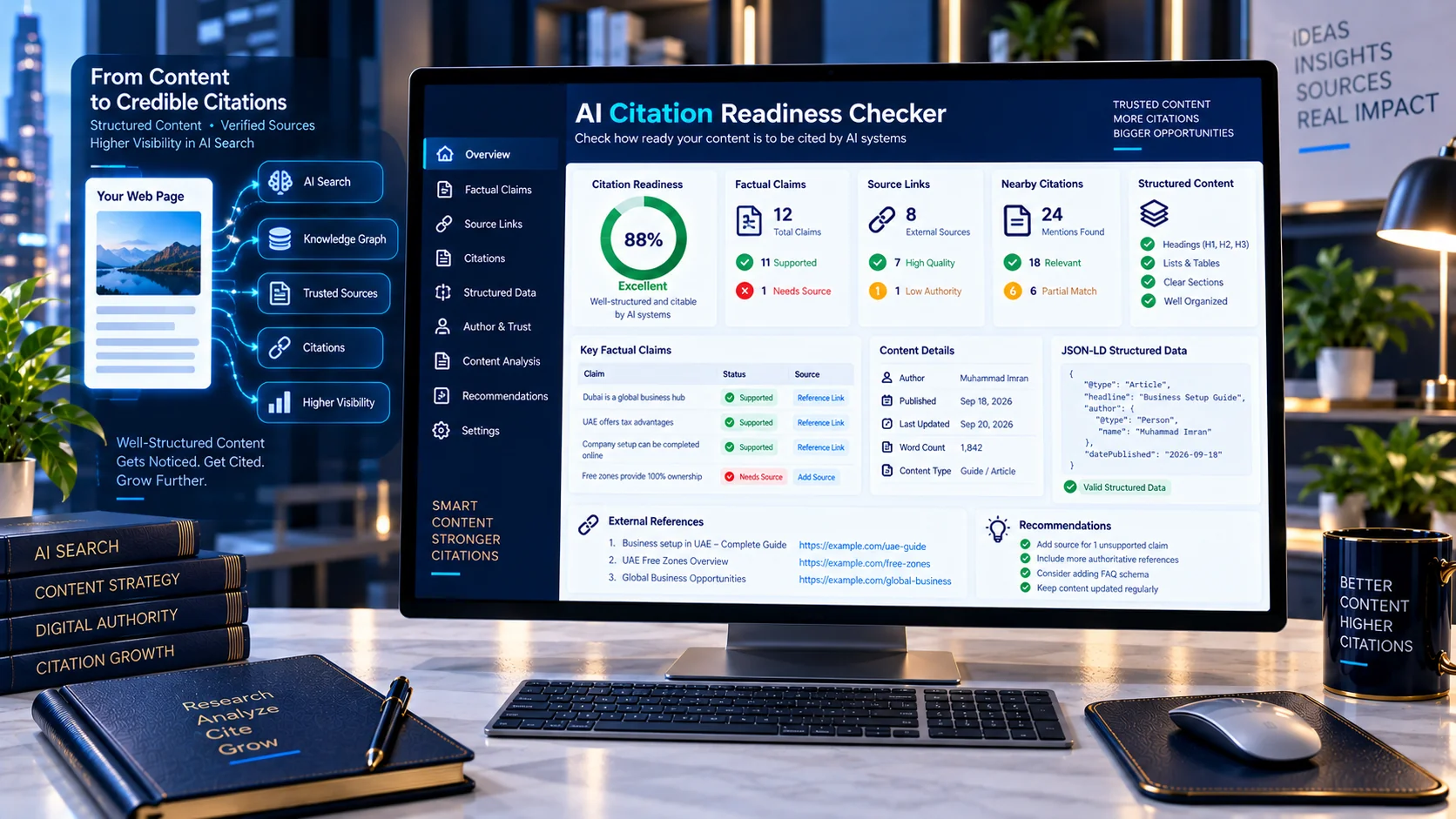
AI-powered search systems can provide answers using information gathered from webpages and other online sources. For a website to become a useful potential source, its content needs to communicate clear claims, supporting information, understandable structure, and traceable sources.
PKCapra’s AI Citation Readiness Checker analyzes a public webpage for signals that can make its content easier to evaluate and potentially use as a source. The tool examines claims, supporting links, page structure, source signals, content organization, metadata, and other citation-related characteristics.
This is a diagnostic tool, not a guarantee of AI citations, rankings, visibility, or inclusion in any particular AI search system.
AI Citation Readiness Checker
Analyze whether a public webpage contains observable sourceability signals such as explicit claims, clear structure, supporting links, source sections, dates, and citation-friendly content.
Check Your Page’s AI Citation Readiness
Enter a public webpage URL to examine how clearly the page presents information that could potentially be evaluated and referenced by AI-powered search systems.
The checker brings several sourceability signals together so you can identify areas that may make a page easier or harder to interpret as a potential information source.
AI search systems can provide answers with links to relevant web sources, making source attribution an important part of modern search experiences. OpenAI, for example, describes ChatGPT search as providing answers with links to relevant web sources.
What the AI Citation Readiness Checker Analyzes
Explicit Claims and Statements
The checker looks for content containing identifiable factual or informational statements.
Clear claims are easier to review than vague statements because a potential source relationship can be evaluated against a specific piece of information.
The tool does not determine whether a claim is factually correct. It identifies structural signals that can help you review how claims are presented.
Supporting Sources
The analyzer looks for links and other source signals that may provide supporting evidence for the information presented on the page.
Supporting sources can make important claims more traceable and give readers a way to investigate the underlying information.
Source Proximity
Where supporting information appears relative to a claim can matter for human readability and source evaluation.
The checker therefore examines whether relevant source links or source-related signals appear near the content they may support.
Citation-Friendly Content Structure
Well-organized content can make individual facts, explanations, and supporting evidence easier to identify.
The analyzer reviews structural elements such as:
- Headings
- Paragraphs
- Lists
- Tables
- Question-based sections
- Content blocks
- Supporting links
External Source Links
The checker identifies external links and evaluates relevant characteristics of those links.
This can help you distinguish pages that provide supporting references from pages that primarily make unsupported informational statements.
Nofollow and Link Attributes
The tool also examines relevant link attributes, including nofollow and related directives.
These attributes can provide additional technical context when reviewing how a webpage links to external sources.
Publication and Freshness Signals
For information that can change over time, freshness can be an important part of source evaluation.
The checker reviews available publication, modification, and related page signals when they are exposed in the webpage.
Author and Attribution Signals
The analyzer checks for available author-related and attribution signals that can provide additional context about who created or published the information.
These signals do not independently establish expertise or factual accuracy, but they can contribute useful context during content review.
Structured Data
The checker detects available JSON-LD structured data and other relevant machine-readable signals.
Structured data can provide additional information about a page and its content, although its presence does not guarantee search features or AI citations.
Extractable Content
The tool examines whether important webpage content is accessible in the retrieved HTML and structurally available for analysis.
If important information is hidden behind inaccessible rendering, authentication, or other technical barriers, citation-readiness analysis may be incomplete.
Why AI Citation Readiness Matters
AI search experiences increasingly provide users with answers accompanied by sources and links. OpenAI’s current documentation describes web search as a way to retrieve current information and provide cited answers, while also recommending that users review linked sources to verify important information.
For publishers and website owners, this creates an additional reason to make important information clear, traceable, and well structured.
Citation readiness is therefore not simply about adding more links. It involves presenting useful information in a way that makes claims, supporting evidence, context, and source relationships understandable.
Citation Readiness Is Not the Same as AI Visibility
A page can have strong citation-friendly characteristics without actually being cited by an AI system.
AI citation behavior depends on many factors outside the control of a webpage, including:
- The user’s query
- Search-system retrieval
- Source selection
- Content relevance
- Source availability
- Competition between sources
- Search engine or AI system behavior
- Current information requirements
The AI Citation Readiness Checker therefore evaluates page-level sourceability signals, not actual citation frequency.
How to Use the AI Citation Readiness Checker
1. Enter a Public Webpage URL
Enter the complete public URL of the page you want to analyze.
2. Start the Analysis
Run the checker and allow it to retrieve the publicly accessible webpage content required for the analysis.
3. Review the Citation Readiness Results
Review the overall diagnostic score together with the individual findings detected on the page.
4. Examine Claims and Supporting Sources
Look for informational claims that do not have clear supporting sources or where source relationships are difficult to identify.
5. Improve and Recheck
Improve the page where appropriate, then run the checker again to review the updated citation-readiness signals.
How to Interpret the Results
The citation-readiness score is a diagnostic indicator, not an AI ranking or citation probability.
A high score does not guarantee that an AI system will cite the page.
A lower score does not mean that the page cannot be cited.
The individual findings are more important than the score alone because they identify specific areas that may deserve review.
For example:
- Weak claim support: Review whether important factual statements have appropriate supporting sources.
- Limited source proximity: Make source relationships clearer where appropriate.
- Poor structure: Organize information into clearly defined sections.
- Missing author signals: Consider whether appropriate authorship or attribution information should be provided.
- Limited freshness information: Add accurate publication or update information where relevant.
- Weak extractability: Review whether important content is accessible in the page HTML.
Clear Claims and Reliable Sources
Citation readiness should not encourage adding citations simply for SEO purposes.
Sources should genuinely support the information being presented.
For example, if a page states a specific statistic, date, technical specification, research finding, or regulatory fact, the supporting source should actually substantiate that statement.
Source quality also matters. OpenAI’s guidance notes that AI-generated answers can contain incorrect information and recommends verifying important information using reliable sources.
The goal should therefore be useful, traceable information, rather than simply increasing the number of external links.
AI Citation Readiness and Content Quality
Citation-friendly content should still be written primarily for people.
Useful pages generally benefit from:
- Clear explanations
- Specific claims
- Accurate information
- Appropriate source attribution
- Logical organization
- Descriptive headings
- Useful examples
- Transparent methodology
- Relevant supporting evidence
The checker can help identify structural opportunities, but it cannot judge every aspect of editorial quality or factual accuracy automatically.
AI Citation Readiness and GEO
Generative Engine Optimization (GEO) involves preparing content for environments where AI systems may retrieve, summarize, or reference information.
Citation readiness is one component of this broader area.
A citation-ready page should make it reasonably easy to determine:
- What the page is saying
- Which claims are important
- Where supporting evidence comes from
- Who published the information
- When information was published or updated
- How different sections relate to the main topic
These signals can improve transparency and make content easier for people and automated systems to evaluate.
Important Limitations
The AI Citation Readiness Checker analyzes signals that can be detected from the publicly retrieved webpage.
It cannot reproduce the internal retrieval, ranking, reasoning, or source-selection process of every AI search system.
Results may also be affected by:
- JavaScript rendering
- Dynamic content
- Bot protection
- Firewalls
- CDN behavior
- Authentication
- Rate limiting
- Server errors
- Missing metadata
- Content loaded after the initial HTML response
The tool does not guarantee AI citations, search rankings, traffic, indexing, or visibility.
It also does not independently verify the truthfulness of every claim or the editorial quality of every source.
Privacy and Processing
The checker is designed to analyze publicly accessible webpage information required for its diagnostic checks.
Do not submit private, authenticated, or sensitive URLs unless you understand the access and processing implications of the target page.
Frequently Asked Questions
What is an AI Citation Readiness Checker?
An AI Citation Readiness Checker analyzes webpage signals that can make information easier to identify, evaluate, and potentially use as a source in AI-powered search experiences.
Does citation readiness guarantee an AI citation?
No. Citation readiness is a technical and content diagnostic. It cannot guarantee citations, rankings, visibility, or inclusion in an AI-generated answer.
Does the tool check external sources?
Yes. The checker examines external source links and related sourceability signals on the analyzed webpage.
Does it check whether claims have supporting sources?
It identifies claim and supporting-source signals that can help you review whether important information is appropriately supported. It does not independently fact-check every claim.
Does it check source proximity?
Yes. The analyzer examines the relationship between content and nearby source signals where these can be identified from the page.
Does it check author information?
Yes. Available author and attribution signals are included in the analysis.
Does it check publication dates?
The checker looks for available publication and modification signals that can provide context about content freshness.
Does structured data improve citation readiness?
Structured data can provide machine-readable information about a page, but its presence does not guarantee AI citations or enhanced search visibility.
Should every page contain external citations?
No. External sources should be used when they genuinely support claims or provide useful additional information. Adding irrelevant links simply to increase citation signals is not the purpose of the tool.
Can I use the checker for any webpage?
It is designed for publicly accessible webpages that can be retrieved successfully. Authentication, bot protection, network restrictions, JavaScript-dependent content, or server errors may limit the analysis.
Improve Your AI Search and Content Diagnostics
Use the AI Search Readiness Analyzer for a broader technical assessment covering crawler access, indexability, canonical signals, sitemap information, content structure, structured data, metadata, and internal links.
For focused content accessibility analysis, use the AI Content Extractability Checker to examine whether important webpage information is accessible and structurally extractable.
For traditional crawl and indexing diagnostics, the Indexability / Crawlability Analyzer can provide a separate technical assessment.