
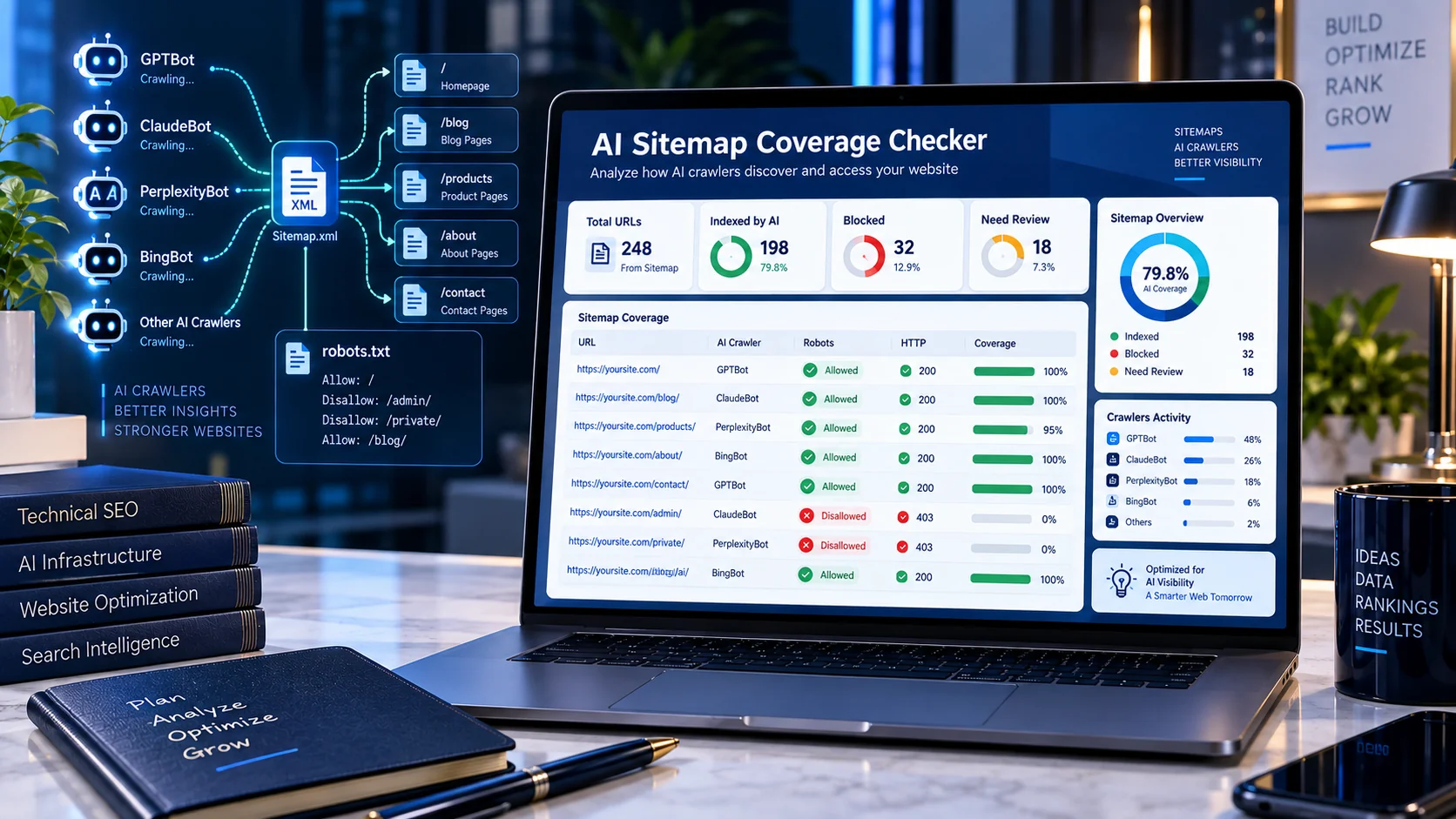
AI Sitemap Coverage Checker helps you understand whether the URLs published through your XML sitemap are accessible to major AI crawlers according to your website’s robots.txt rules.
As AI search and answer engines increasingly rely on web content, technical crawl accessibility has become an important part of AI visibility and GEO readiness. A sitemap can tell crawlers which URLs you want them to discover, but sitemap inclusion alone does not mean that every crawler is permitted to access those URLs.
PKCapra’s AI Sitemap Coverage Checker brings these signals together so you can identify potential gaps between your sitemap and AI crawler access policies.
AI Sitemap Coverage Checker
Discover a site's XML sitemaps and check how sampled sitemap URLs are covered by robots.txt rules for major AI crawlers.
Check AI Crawler Coverage Across Your Sitemap
Enter your website URL and let the analyzer discover available XML sitemaps. The tool can inspect sitemap declarations from robots.txt and common sitemap locations, including sitemap indexes containing multiple sitemap files.
You can choose how many sitemap URLs to sample and compare their crawler access rules against major AI crawler user agents.
The analyzer currently checks:
- OAI-SearchBot
- GPTBot
- Claude-SearchBot
- ClaudeBot
- PerplexityBot
- Google-Extended
Google-Extended is handled differently from conventional HTTP crawler user agents because Google documents it as a robots.txt product token rather than a separate HTTP user-agent string.
What the AI Sitemap Coverage Checker Examines
Sitemap Discovery
The analyzer first looks for sitemap URLs declared through robots.txt and checks common sitemap locations when appropriate.
A robots.txt file can contain one or more absolute Sitemap: declarations pointing to sitemap files or sitemap index files.
This makes sitemap discovery an important first step when evaluating whether your published URL structure is accessible to AI crawlers.
Sitemap Indexes and Nested Sitemaps
Large websites commonly use sitemap indexes instead of placing every URL inside one XML sitemap.
The analyzer can follow discovered sitemap indexes and inspect their referenced sitemap files, allowing you to evaluate URL coverage across a broader sitemap structure rather than checking only one sitemap file.
AI Crawler Robots.txt Rules
For each supported AI crawler, the tool evaluates the applicable robots.txt rules against sampled sitemap URLs.
This helps identify situations where a URL appears in your sitemap but its path is restricted for a particular AI crawler.
Robots.txt uses User-agent, Allow, and Disallow directives to define crawler access rules, with the applicable rule determined by the crawler and matching path.
URL-Level Coverage
A sitemap URL can be individually reviewed against the selected crawler policies.
The results can show whether a sampled URL is:
- Allowed
- Blocked
- Affected by a crawler-specific rule
- Covered differently across AI crawlers
This makes it easier to find URL patterns that may need further technical investigation.
Sitemap and HTTP Accessibility
The analyzer also checks whether discovered sitemap resources and sampled URLs return usable HTTP responses.
This is useful because sitemap inclusion and robots permissions are only part of the technical picture. A URL can be listed in a sitemap while still returning an error, redirecting unexpectedly, or being affected by another access-control layer.
Why AI Sitemap Coverage Matters for GEO
Generative Engine Optimization is not only about writing content for search engines. Technical accessibility also matters because AI systems need to discover and retrieve publicly accessible web content before that content can potentially be considered by their systems.
A clean sitemap provides structured URL discovery, while robots.txt communicates crawler access preferences. These two signals should therefore be reviewed together rather than treated as completely separate technical SEO tasks.
For example, if an important article appears in your XML sitemap but its URL is disallowed for a particular AI crawler, the sitemap’s presence does not override that crawl restriction.
Anthropic has also documented that its general-purpose crawler follows robots.txt instructions provided by website operators.
How to Use the AI Sitemap Coverage Checker
1. Enter Your Website URL
Enter the public URL of the website you want to analyze.
2. Select the Sample Size
Choose how many sitemap URLs you want the analyzer to inspect. Available sample sizes include 10, 20, 30, and 50 URLs.
3. Run the Analysis
Start the checker and allow it to discover your sitemap structure and evaluate the selected URLs against supported AI crawler policies.
4. Review Crawler Coverage
Compare the results across OAI-SearchBot, GPTBot, Claude-SearchBot, ClaudeBot, PerplexityBot, and Google-Extended.
5. Investigate Blocked or Partial Coverage
If important sitemap URLs are blocked for a crawler, review the corresponding robots.txt directives and your wider technical access configuration before making changes.
How to Read the Results
A strong coverage result generally means that sampled sitemap URLs are accessible according to the applicable crawler rules.
A blocked result indicates that a crawler’s robots.txt policy prevents access to the affected path.
A mixed result can occur when different AI crawlers have different robots.txt policies. For example, a URL may be allowed for one crawler while being disallowed for another.
This distinction is important because there is no single universal “AI crawler” policy. Website owners can define different rules for different user agents.
Sitemap Coverage Is Not the Same as AI Visibility
Being present in an XML sitemap does not guarantee that a page will appear in AI-generated answers, AI search results, citations, or recommendations.
Similarly, allowing a crawler through robots.txt does not guarantee crawling, indexing, retrieval, citation, or inclusion in any particular AI system.
The checker is designed to identify technical crawl-access signals, not to predict whether an AI system will use or cite your content.
Google also states that Google-Extended does not affect a site’s inclusion in Google Search or act as a Google Search ranking signal.
Important Technical Limitations
Robots.txt is only one part of a website’s access environment. CDN rules, web application firewalls, authentication, server configuration, rate limiting, network restrictions, redirects, HTTP errors, and other controls can affect whether a real crawler can successfully retrieve a URL.
A robots.txt check therefore should be treated as a technical diagnostic rather than proof of actual crawler identity or guaranteed future crawling behavior.
The analyzer also works with a sample of sitemap URLs rather than necessarily testing every URL on a very large website. Use the sample results to identify patterns and areas that deserve deeper investigation.
Privacy and Processing
The analyzer works with publicly accessible website URLs and technical crawler-access information needed to perform the analysis.
It does not require you to upload your website content or provide access to your WordPress dashboard.
Avoid entering private, authenticated, or restricted URLs into a public website analysis tool.
Related Website Crawl and Sitemap Tools
AI crawl coverage is easier to understand when sitemap, robots.txt, and indexability signals are reviewed together. If you are investigating broader crawl and indexing issues, the Indexability / Crawlability Analyzer can help examine technical crawl and indexability signals.
You can also use the Robots.txt Analyzer to inspect your robots.txt directives separately, while the XML Sitemap Analyzer can help examine sitemap structure and URLs in greater detail.
For websites with complex internal navigation, the Internal Links & Crawl Path Analyzer can provide additional insight into how pages are connected and discovered.
Frequently Asked Questions
What is an AI Sitemap Coverage Checker?
An AI Sitemap Coverage Checker evaluates URLs discovered through a website’s XML sitemap against robots.txt rules for major AI crawlers. It helps identify URLs that may be blocked or treated differently by different AI crawler policies.
Does an XML sitemap allow AI crawlers to access my pages?
No. A sitemap helps communicate URL discovery, but it does not override robots.txt restrictions or other technical access controls.
Which AI crawlers does this tool check?
The checker currently evaluates OAI-SearchBot, GPTBot, Claude-SearchBot, ClaudeBot, PerplexityBot, and Google-Extended.
Why is Google-Extended different from the other crawlers?
Google documents Google-Extended as a product token used in robots.txt rather than a separate HTTP user-agent string. It provides publishers with a way to manage how crawled content may be used for certain Gemini and Vertex AI purposes.
Does allowing an AI crawler guarantee that my content will appear in AI answers?
No. Crawler access is only one technical prerequisite. AI systems can use additional discovery, retrieval, indexing, relevance, quality, and system-specific processes.
How many sitemap URLs should I check?
For an initial diagnostic, a smaller sample can quickly reveal obvious access problems. Larger samples can provide broader coverage across a bigger sitemap, especially when your site contains many different URL types.
Can this tool replace a full technical SEO audit?
No. It is specifically focused on sitemap discovery and AI crawler coverage. For broader technical diagnostics, combine it with crawlability, robots.txt, XML sitemap, indexability, structured data, and internal-link analysis.