
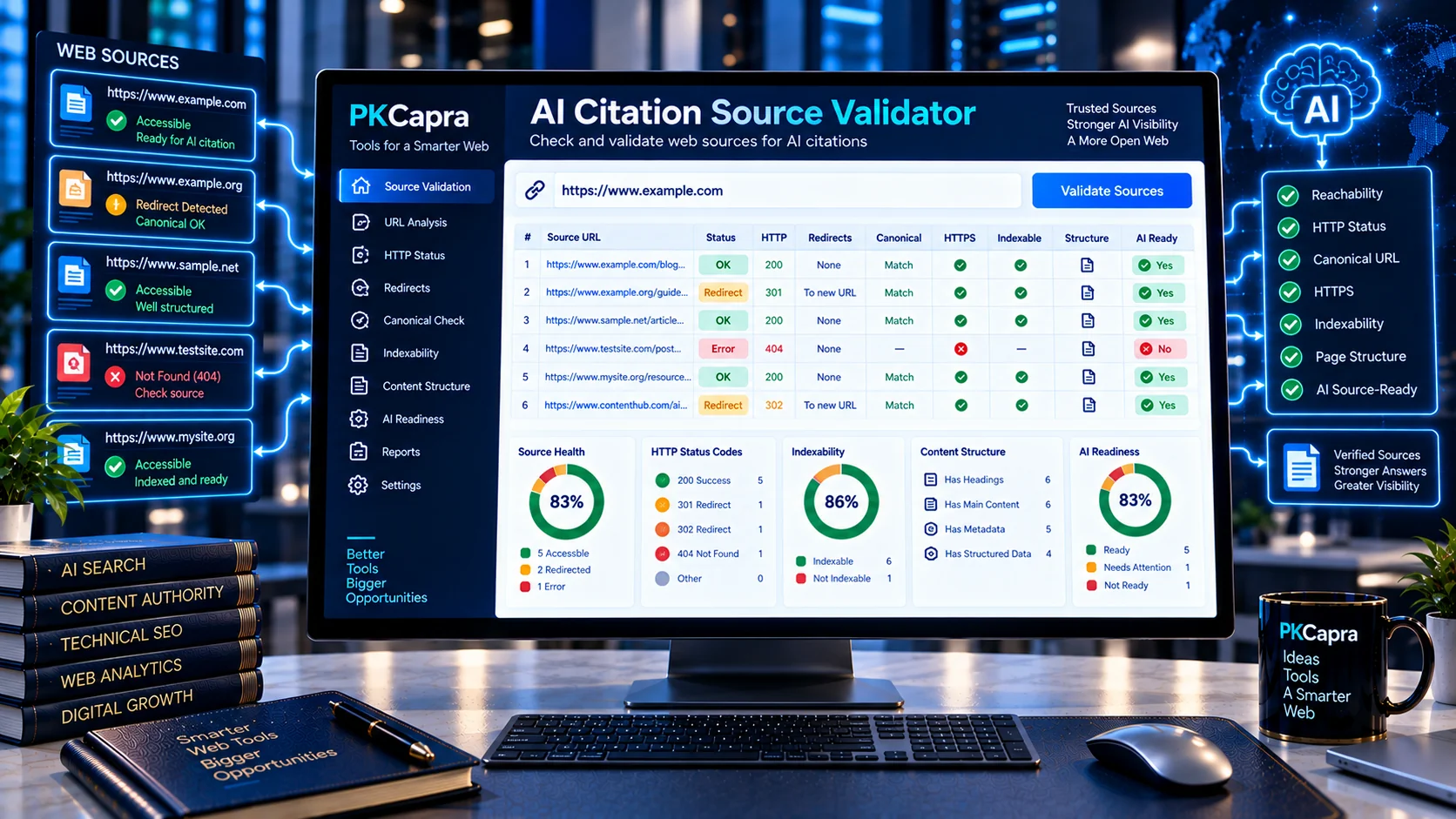
Validate cited web sources before relying on them for AI search, research, content, and citation workflows. PKCapra’s AI Citation Source Validator checks whether cited URLs are reachable, technically accessible, canonical, indexable, and structurally suitable for source-based content.
AI Citation Source Validator
Validate cited URLs for reachability, canonical signals, indexability and source-ready page structure.
Only public URLs should be tested. Private, local, loopback, reserved-network and authenticated destinations are rejected. The tool validates technical source signals; it does not verify factual truth, editorial quality or whether an AI system will cite a source.
Validate Cited URLs for AI Source Readiness
A citation is only useful if the referenced URL can be accessed and understood reliably. The AI Citation Source Validator lets you check multiple cited URLs and identify technical problems that may affect their usefulness as web sources.
Enter your cited URLs, run the validation, and review the results for HTTP accessibility, redirects, HTTPS, canonical signals, indexability, page structure, extractable content, and other source-readiness indicators.
The tool provides technical evidence about each URL without claiming that a page is factually accurate, authoritative, or guaranteed to be cited by an AI system.
What the AI Citation Source Validator Checks
URL Reachability and HTTP Status
The validator checks whether each submitted URL can be reached and reports the HTTP response status. This helps identify inaccessible, missing, redirected, or server-error URLs.
Redirect Behavior
Redirect chains can change the final destination of a citation. The validator examines redirect behavior and reports the resulting URL so you can identify citations that no longer point directly to the expected resource.
HTTPS and Secure URLs
The validator checks whether the submitted source uses HTTPS. Secure URLs are useful when maintaining technically consistent and trustworthy citation references.
Canonical URL Signals
Canonical information can indicate which URL a page identifies as its preferred version. The validator checks for canonical signals and compares them with the tested URL where possible.
Indexability and Noindex Signals
The tool checks relevant page-level signals such as noindex directives. These signals can help identify pages that may have restrictions affecting search and source discovery.
Page Title and Content Structure
The validator examines basic page structure, including the title and heading signals such as H1 and H2 elements. Clear structure can make a source easier to inspect and understand.
Extractable Content
The tool checks for accessible page content and structural elements such as main or article containers. This helps identify pages where meaningful content may be technically difficult to extract.
JSON-LD and Structured Data
The validator detects JSON-LD structured data where present. Structured data can provide additional machine-readable context about a page.
Source-Ready Signal
The report combines the technical checks into a source-readiness diagnostic. This is a technical assessment rather than a guarantee of factual quality, authority, ranking, or AI citation.
How to Use the AI Citation Source Validator
- Enter one or more cited web URLs.
- Submit the URLs for validation.
- Review the HTTP status, redirects, HTTPS and canonical information.
- Check indexability, page structure, content extraction and structured-data signals.
- Review the issues and source-readiness findings for each URL.
Using multiple URLs at once can help you audit a citation list, reference set, research document, or collection of sources more efficiently.
Why Validate AI Citation Sources?
AI-assisted research and content workflows often depend on external web sources. A citation may look correct while the underlying page has changed, moved, become inaccessible, introduced a redirect, or developed technical indexing and content-access issues.
Technical source validation helps separate “the URL exists” from “the URL is technically usable as a web source.”
The validator can therefore be useful when reviewing:
- AI-generated research references
- Website citation lists
- Content research sources
- Reference pages
- Editorial source collections
- AI-search optimization workflows
- GEO and AEO research
- Documentation references
- External links used to support factual claims
AI Citation Validation vs. Citation Readiness
These are related but different checks.
The AI Citation Readiness Checker evaluates whether a webpage contains citation-friendly signals such as explicit claims, nearby sources, content structure, references, and other sourceability indicators.
The AI Citation Source Validator focuses on the individual URLs themselves. It checks whether cited sources are technically reachable and examines important page-level signals.
For broader website diagnostics, the AI Search Readiness Analyzer combines multiple AI-search and technical signals into a wider readiness assessment.
AI Citation Sources and Technical SEO
Citation-source validation overlaps with several established technical SEO concepts.
A source can have useful content but still present technical issues involving:
- HTTP accessibility
- Redirects
- Canonical URLs
- Noindex directives
- Page structure
- Content extraction
- Structured data
- Secure URL usage
For deeper technical checks, you can also use PKCapra’s Indexability & Crawlability Analyzer and HTTP Header Security Analyzer.
Important Limitations
The AI Citation Source Validator provides technical diagnostics. It does not determine whether a source is factually correct, authoritative, trustworthy, unbiased, or appropriate for a particular claim.
It also does not guarantee that an AI search engine or answer system will cite a URL.
A technically accessible page can still contain inaccurate information, outdated information, weak evidence, or content that is unsuitable for a specific research question.
HTTP responses and page content can also change after a validation has been performed.
Privacy and Processing
URLs submitted to the validator are processed to perform the requested technical checks. The tool is designed to validate public web resources and includes protections against requests to private or restricted network addresses.
Do not submit confidential URLs, private intranet addresses, credentials, tokens, or other sensitive information.
Frequently Asked Questions
What does an AI Citation Source Validator do?
It checks cited URLs for technical source-readiness signals such as reachability, HTTP status, redirects, HTTPS, canonical information, indexability, page structure, extractable content, and structured data.
Can it verify whether a citation is factually correct?
No. The validator checks technical characteristics of the cited webpage. It does not independently verify the truth of claims published on that page.
Can it tell me whether an AI will cite my source?
No. AI citation behavior depends on the specific system, query, retrieval process, ranking, content and other factors. The validator provides technical diagnostics rather than citation guarantees.
Can I validate multiple URLs?
Yes. The tool is designed to validate multiple cited URLs in a single workflow, making it useful for reference lists and source collections.
Does a redirect automatically mean a citation is bad?
No. A redirect is a technical signal that should be reviewed. A permanent redirect to the intended canonical resource may be normal, while unexpected or excessive redirects can require investigation.
Why is canonical URL information important?
A canonical URL can indicate the preferred version of a page. Comparing the submitted citation URL with the page’s canonical signal can help identify URL-version inconsistencies.
Does JSON-LD guarantee that a source is AI-ready?
No. JSON-LD is only one technical signal. Source readiness also depends on accessibility, indexability, content structure, extractable content, and other factors.
Continue Your AI Citation and Search Diagnostics
After validating individual citation sources, you can continue with related PKCapra tools: