
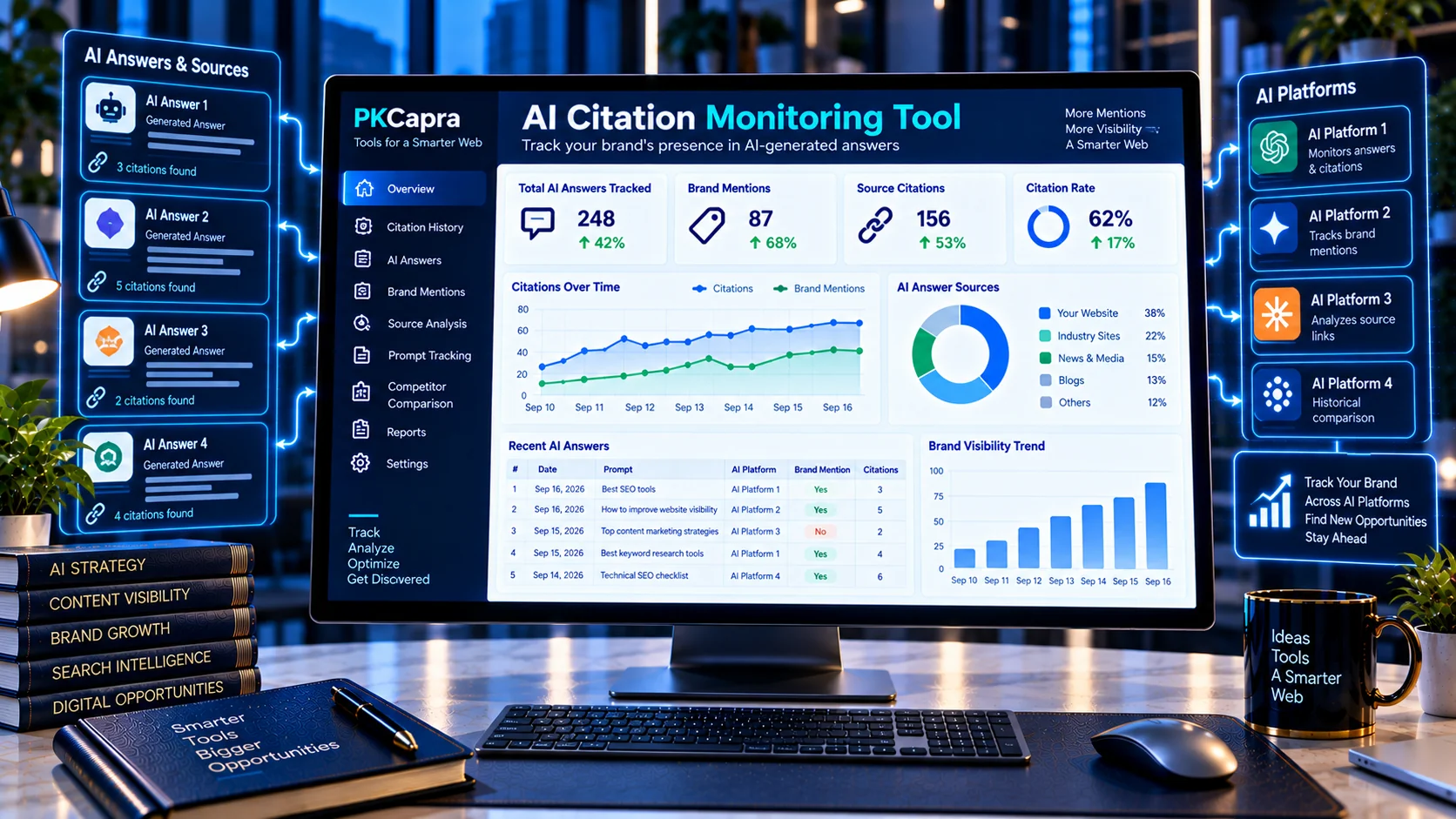
Monitor AI citation and mention patterns over time with PKCapra’s AI Citation Monitoring Tool. Record AI-generated answer snapshots, track your brand, website, or entity, compare historical results, and identify changes in citation and mention rates across your collected data.
AI Citation Monitoring Tool
Turn repeated AI-answer snapshots into a structured citation and mention monitoring report for a brand, website, product or entity.
Use only AI-answer samples you are authorized to analyze. Supplied text is sent to the PKCapra WordPress endpoint for deterministic parsing; it is not sent to an external AI provider by this tool.
Monitor AI Citations and Mentions Over Time
AI citations can change as prompts, answers, sources, and AI systems change. A single AI answer provides only a snapshot, while repeated observations can reveal patterns within your own collected data.
The AI Citation Monitoring Tool provides a structured way to record those observations and compare citation and mention signals across multiple monitoring records.
Enter your target, add your AI-answer observations, record the relevant platform and prompt information, and review the historical monitoring results.
What the AI Citation Monitoring Tool Tracks
Brand, Website, or Entity
Define the target you want to monitor, such as a brand name, website, company, product, or other identifiable entity.
AI Platform or Source
Record the AI system or source associated with each observation. This helps keep monitoring records organized when results come from different AI environments.
Search Prompt
Store the prompt or question used to generate each monitored answer. Consistent prompt tracking makes historical comparisons easier.
Mention Detection
The monitoring record can identify whether the target was mentioned in the submitted AI answer.
Citation Detection
Track whether a citation or source reference associated with the target was detected in the submitted answer.
Mention Rate
The tool calculates the proportion of monitored records in which the target was detected as a mention.
Citation Rate
Citation-related observations can be analyzed separately from direct mentions, helping distinguish between being named in an answer and appearing as a referenced source.
Historical Trend
Multiple records can be reviewed together to identify changes across your monitoring period.
First vs. Latest Comparison
The tool can compare earlier and later observations to help identify changes within your collected monitoring sample.
How to Use the AI Citation Monitoring Tool
- Enter the brand, website, or entity you want to monitor.
- Add an AI-answer observation with its platform and prompt information.
- Record the answer and relevant citation or mention information.
- Add additional observations over time.
- Review mention rates, citation signals, historical trends, and monitoring findings.
For meaningful comparisons, try to keep important testing conditions consistent when repeating the same monitoring prompt.
Why Monitor AI Citations Over Time?
AI-generated answers can vary between prompts and across different points in time. Monitoring repeated observations gives you a structured record instead of relying on isolated screenshots or individual searches.
The tool can be useful for:
- AI search research
- Generative search monitoring
- GEO workflows
- Brand visibility research
- Citation research
- Content strategy analysis
- Competitor research
- AI-answer experiments
- Historical AI citation tracking
AI Citation Monitoring vs. AI Visibility Checking
These tools address related but different workflows.
The AI Visibility Checker focuses on analyzing a submitted collection of AI answers to determine whether a target appears within that sample.
The AI Citation Monitoring Tool is designed around repeated observations. It lets you record monitoring data over time and compare historical records.
For technical validation of individual cited sources, use the AI Citation Source Validator.
AI Citations and Mentions Are Different Signals
A brand mention does not necessarily mean that the brand’s website was cited.
For example, an AI answer may name a company without providing a source URL. Conversely, an answer may include a source URL without prominently mentioning the brand in the response text.
Keeping these signals separate makes historical monitoring more useful and avoids treating every mention as a citation.
How to Build a Useful Monitoring Dataset
The quality of historical comparisons depends on the consistency of your monitoring records.
For more useful results:
- Use consistent prompts when measuring changes.
- Record the AI platform for every observation.
- Keep dates associated with each monitoring record.
- Monitor multiple relevant prompts rather than one question.
- Separate direct mentions from citations.
- Record meaningful changes in the answer or source.
- Compare similar testing conditions over time.
A larger and more consistent sample can provide more context than a single isolated result.
Understanding Monitoring Results
A higher mention rate within your collected records means the target was detected in a larger proportion of those submitted observations.
A higher citation rate means citation signals were detected more frequently within the monitored sample.
These measurements describe your recorded dataset. They are not universal measurements of how frequently every AI system cites or mentions the target.
Historical changes should therefore be interpreted in the context of the prompts, platforms, dates, and answer samples included in the monitoring dataset.
AI Citation Monitoring and AI Search Readiness
Citation monitoring can be combined with technical website analysis.
The AI Search Readiness Analyzer evaluates broader technical and content signals related to AI search readiness.
The AI Citation Readiness Checker focuses on citation-friendly content signals.
The AI Answer Extractability Checker examines whether content contains passages that are structurally suitable for answer extraction.
Together, these tools can provide different perspectives on AI-search infrastructure and observed citation behavior.
Important Limitations
The AI Citation Monitoring Tool does not automatically access or continuously monitor AI platforms.
Monitoring results depend on the AI answers and records supplied to the tool. The tool does not have access to private platform ranking systems, internal retrieval systems, training data, or proprietary citation algorithms.
Historical rates therefore represent the submitted monitoring sample, not a universal citation or visibility percentage.
AI answers can also change because of prompts, model versions, search context, location, personalization, source availability, and other factors.
Privacy and Processing
The tool processes the monitoring information and AI-answer data that you provide.
No direct AI platform account access is required for the monitoring workflow.
Avoid entering confidential conversations, credentials, private customer information, or other sensitive data.
Frequently Asked Questions
What is an AI Citation Monitoring Tool?
It is a tool for recording and analyzing AI citation and mention observations over time. PKCapra’s tool lets you organize monitoring records and compare historical results.
Does it automatically monitor ChatGPT or other AI platforms?
No. It analyzes monitoring records that you provide rather than continuously querying AI platforms.
Can I track mentions and citations separately?
Yes. Direct mentions and citation signals are treated as separate monitoring indicators.
Can I monitor a brand over multiple dates?
Yes. Add multiple dated observations to build a historical monitoring dataset.
Does the tool provide a universal AI citation rate?
No. Its rates are calculated from the monitoring records submitted to the tool.
Can I monitor different prompts?
Yes. Recording the prompt associated with each observation helps you compare results across different questions and search intents.
Does a citation prove that the source is accurate?
No. Citation detection only identifies a citation or source signal. It does not independently verify the factual accuracy or authority of the cited source.
Can I use the tool for competitor monitoring?
Yes. You can use comparable monitoring records to analyze citation and mention patterns for different brands or entities.
Continue Your AI Citation and Visibility Diagnostics
Continue with related PKCapra tools: