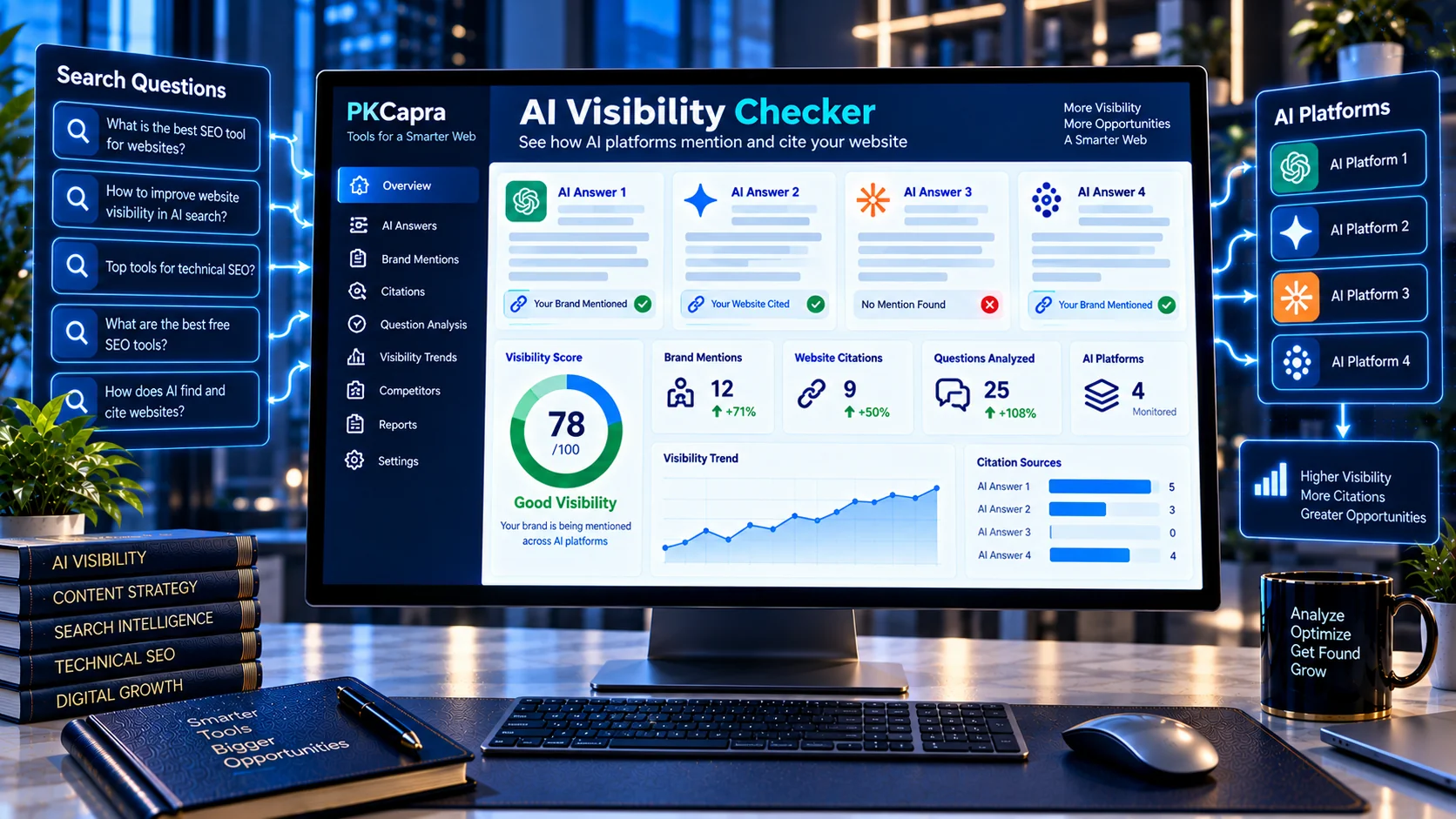
Measure how consistently a brand, website, or entity appears in AI-generated answers with PKCapra’s AI Visibility Checker. Analyze a set of AI answers to identify mentions, citations, visibility patterns, detected excerpts, and basic visibility signals without requiring direct access to an AI platform’s internal data.
AI Visibility Checker
Measure whether your brand, website or entity appears in AI-generated answers you have collected.
Paste only content you are authorized to analyze. The tool performs local text analysis through PKCapra's server-side request and does not call an external AI provider.
What Does an AI Visibility Checker Help You Understand?
An AI visibility checker helps website owners investigate how their website, content, or brand may be represented in AI-powered search and answer experiences. AI visibility can include brand mentions, references to published pages, and whether useful information from a website is available to support an answer. Use the checker’s displayed findings to identify areas for review—not as a guarantee that an AI system will mention or cite a page.
What Is AI Visibility?
AI visibility describes whether and how a brand, website, or piece of content appears in responses generated by AI-powered search and answer systems. It is related to search visibility, but it is not identical to traditional rankings or organic traffic.
A page can rank in conventional search results without being cited in a generated answer. A brand can also be discussed in an AI response without its website being linked as a source. These outcomes depend on the platform, query, available sources, retrieval process, and response generation.
Brand Mentions
Whether a business, product, organization, or website is named in an AI-generated response.
Source Citations
Whether a response links to or identifies a page as supporting information for its answer.
Answer Relevance
Whether the information associated with your brand or page is relevant to the user’s question and intent.
AI Visibility vs. Traditional SEO
Traditional SEO and generative engine optimization (GEO) overlap in important ways. Both benefit from accessible pages, useful content, clear organization, and trustworthy information. Their measurement methods, however, are not interchangeable.
| Area | Traditional SEO | AI Visibility / GEO |
|---|---|---|
| Primary observation | Search result presence and organic performance | Mentions, source references, and presence in generated answers |
| Common signals | Indexing, relevance, links, content quality, technical accessibility | Accessible sources, clear answers, entity context, evidence, and relevance |
| Typical measurements | Rankings, impressions, clicks, organic sessions | Observed mentions, citations, referral visits, and answer coverage |
| Result consistency | Can vary by location, device, query, and search features | Can also vary by model, platform, prompt, source set, and response |
| Optimization approach | Improve discoverability, relevance, and user experience | Build on SEO foundations and make information easy to access, understand, and verify |
Important: GEO is not a replacement for technical SEO or useful content. There is no universal markup, wording pattern, or optimization technique that guarantees inclusion in every AI answer.
How to Use an AI Visibility Checker
Use the checker according to the fields and instructions displayed in its interface. After reviewing the output, connect the findings to specific pages and improvements on your website.
Choose the Website or Brand
Identify the domain, brand, or subject you want to investigate. Use a consistent name and website address when comparing results.
Run the Available Check
Enter the information requested by the tool and start the check using its on-page controls.
Review the Findings
Read each result and its explanation. Distinguish a technical issue from an observation about content or visibility.
Prioritize Relevant Pages
Identify pages that answer important customer or audience questions and review their accessibility, clarity, and evidence.
Make Focused Improvements
Update unclear explanations, missing context, outdated facts, weak page structure, or technical barriers where confirmed.
Recheck and Compare
Repeat comparable checks over time. Record the date, platform, query, and conditions so differences can be interpreted properly.
How to Interpret AI Visibility Results
A checker result is most useful when it leads to a clear next step. Avoid treating a single score or observation as a complete measure of your website’s performance across every AI search platform.
| Finding or Observation | What to Investigate | Possible Next Step |
|---|---|---|
| Brand information is unclear | Whether pages consistently explain the brand, products, and services | Improve descriptive copy and entity context |
| Important content is difficult to access | HTTP responses, crawl directives, rendering, and page availability | Investigate confirmed technical barriers |
| Answers lack supporting detail | Definitions, evidence, examples, and relevant source material | Make the page more complete and useful |
| Information is inconsistent | Names, product details, dates, claims, and facts across pages | Correct outdated or conflicting information |
| No citation observed in a test | Query relevance, source availability, platform behavior, and test conditions | Record the observation and investigate; do not assume a permanent exclusion |
Interpret scores carefully. If the tool displays a score, status, or recommendation, use the tool’s own explanation of that result. A score is not a direct measurement of ranking, traffic, or guaranteed AI citation probability unless the methodology explicitly establishes that relationship.
Ways to Improve Your Website’s AI Search Readiness
These practices support accessible, understandable, and useful website content. They can improve the quality of your site’s information foundation, but they do not guarantee that an AI platform will select or cite a particular page.
1. Make Important Pages Accessible
- Ensure important pages return an appropriate HTTP response.
- Review robots.txt rules and page-level indexing directives.
- Check that essential content is available to supported crawlers.
- Keep internal links functional and navigation understandable.
2. Write Clear, Direct Answers
- Explain the main subject near the beginning of the relevant section.
- Use descriptive headings that accurately represent the content.
- Define specialized terms when the intended audience may not know them.
- Separate different questions instead of combining unrelated topics.
3. Support Claims with Reliable Information
- Use primary sources or authoritative references where appropriate.
- Distinguish facts, opinions, examples, and recommendations.
- Update information that changes over time.
- Avoid unsupported claims, fabricated statistics, and exaggerated promises.
4. Strengthen Entity and Brand Context
- Use consistent names for your organization, products, and services.
- Explain what each product or service does and who it serves.
- Keep relevant business information consistent across your website.
- Use structured data only when it accurately describes visible page content.
5. Maintain Useful Page Structure
- Use semantic headings, paragraphs, lists, and tables appropriately.
- Make important content easy to read on mobile and desktop.
- Provide meaningful internal links to related explanations and tools.
- Remove unnecessary repetition that makes the page harder to understand.
How to Measure AI Visibility Over Time
AI visibility is not represented by one universally accepted metric. Use a combination of observations and website analytics, and document how each measurement was collected.
| Measurement | What It Can Tell You | Limitation |
|---|---|---|
| Brand mentions | Whether a brand appeared in a defined set of responses | Results depend on the prompts and platforms tested |
| Source citations | Whether a page was referenced in observed answers | A citation in one response does not establish broad visibility |
| Referral visits | Visits attributed to identifiable AI or answer-platform sources | Attribution may be incomplete or unavailable |
| Search impressions and clicks | Organic search exposure and visits reported by search analytics | These are not direct measures of all AI-generated answers |
| Relevant query coverage | How often your content is observed for a defined group of questions | The query set must be consistent and representative |
For meaningful comparisons, keep the query set, target brand, page, platform, and observation date consistent. Report the method alongside the result rather than presenting an isolated number without context.
Common AI Visibility Mistakes
Confusing Rankings with Citations
A conventional search position and an AI source citation are different observations. Measure them separately.
Expecting Guaranteed Mentions
No website optimization can guarantee that every AI system will mention a brand or select a particular source.
Optimizing for a Single Test
One prompt or response may not represent other users, queries, platforms, or future system behavior.
Publishing Content Without Evidence
Repeating keywords or making broad claims does not replace accurate, useful information that supports the reader’s task.
Ignoring Technical Accessibility
Helpful content still needs to be reachable and understandable. Review confirmed crawl, response, and rendering problems.
Treating Every Score as a Ranking
A diagnostic score should be interpreted using its documented criteria, not assumed to predict search or AI placement.
Related PKCapra AI and SEO Tools
AI visibility is influenced by several aspects of website readiness. These related tools can help you investigate specific areas of your site’s content and technical setup.
AI Visibility Checker FAQs
What is an AI visibility checker?
An AI visibility checker is a tool used to investigate how a website, brand, or content may appear in AI-powered search and answer experiences. The exact checks and outputs depend on the implementation of the specific tool.
How is AI visibility different from SEO?
SEO focuses on improving a website’s discoverability and performance in search engines. AI visibility focuses on observations such as brand mentions and source references in AI-generated responses. The two areas overlap, but their measurements are not identical.
Does a high AI visibility score guarantee citations?
No. A score or diagnostic result cannot guarantee that an AI platform will mention or cite your website. Responses can vary with the query, platform, available sources, and system behavior.
Can a website be visible in AI answers without a citation?
Yes. An AI response may mention a brand or summarize information without linking to the brand’s website. A mention and a source citation should be recorded as separate observations.
Does traditional SEO still matter for AI search?
Yes. Technical accessibility, useful content, clear page organization, and relevant information remain important website foundations. AI visibility work should complement—not replace— sound SEO practices.
How often should I check AI visibility?
Use a consistent schedule that suits your website and reporting needs. Compare similar queries and platforms over time, and record the date and testing conditions for each observation.
Can structured data guarantee that AI systems use my content?
No. Structured data can help describe information on a page when implemented correctly, but it does not guarantee indexing, ranking, inclusion in generated answers, or citation.
What should I do if my website is not cited?
First, confirm that the test was relevant and repeatable. Review whether the page is accessible, answers the query clearly, and supports its claims with useful information. A missing citation in one response is not proof that your website is permanently excluded from AI search.
Is AI visibility the same on every AI search platform?
No. Different platforms may use different sources, retrieval methods, ranking systems, and response-generation processes. Results from one platform should not be treated as a universal measure of visibility on all others.
What is GEO?
GEO stands for Generative Engine Optimization. It describes practices aimed at making content useful, accessible, and understandable in generative search and answer experiences. GEO does not provide a guaranteed method for obtaining AI citations.
Build a Stronger Website Information Foundation
Use the AI Visibility Checker to begin your review, then investigate technical accessibility, content clarity, and citation readiness with relevant PKCapra tools.
Explore PKCapra AI Tools