
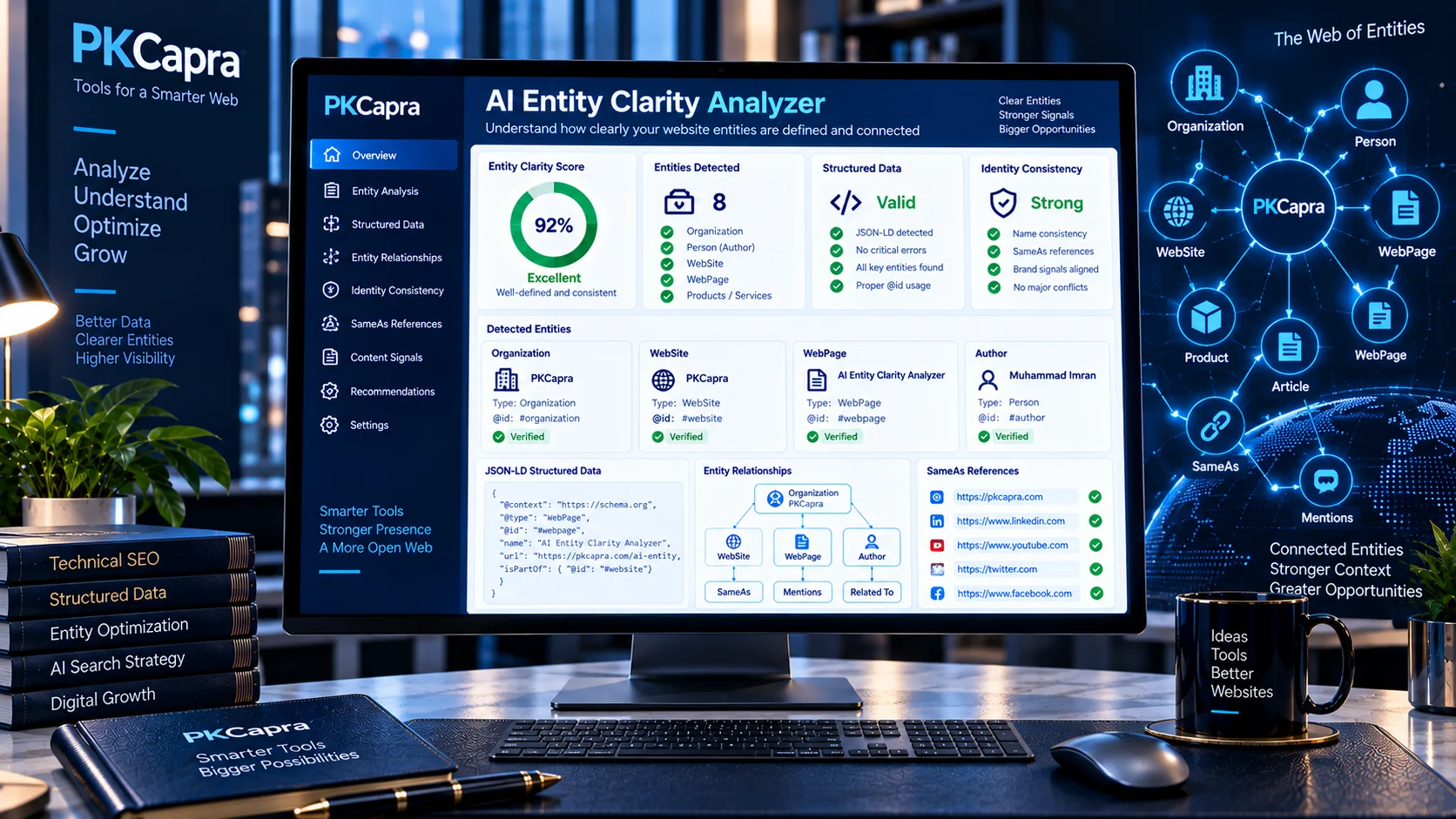
AI systems need to understand what a website, organization, person, brand, and other important entities represent. The AI Entity Clarity Analyzer helps identify whether your webpage presents clear and consistent entity signals that machines can interpret.
Enter a public webpage URL to analyze structured identity signals, entity relationships, organization information, authorship, and related machine-readable data.
AI Entity Clarity Analyzer
Analyze whether a webpage clearly identifies its main organization, people, topics, and relationships using visible content, metadata, links, and structured data.
What the AI Entity Clarity Analyzer Checks
Organization and Brand Identity
The analyzer looks for signals that help identify the organization, website, or brand represented by the page. Consistent naming and clear organization information can make the site’s identity easier for automated systems to interpret.
Person and Author Signals
Where author information is available, the analyzer checks relevant person and authorship signals that can help distinguish the people associated with published content.
Structured Data Entities
The analyzer examines JSON-LD structured data and identifies entity information such as:
- Organization
- Person
- WebSite
- WebPage
- Publisher
- Author
- About
- Main entity relationships
It also checks whether structured data contains usable entity relationships and whether JSON-LD blocks can be parsed successfully.
Entity Identifiers and Relationships
Entity clarity is not only about naming an entity. Relationships between entities can also provide important context.
The analyzer checks signals such as @id, entity references, publisher relationships, author relationships, and other structured connections that can help establish which entities belong together.
SameAs Identity Signals
The tool checks sameAs references where available. These links can connect an organization, person, or brand with relevant external profiles or identity references.
Organization Naming Consistency
The analyzer reviews important page and structured-data signals for potential naming inconsistencies. Multiple conflicting organization names or unclear brand references can make machine interpretation more difficult.
Website and Webpage Context
The analyzer checks WebSite and WebPage structured-data context to determine whether the page clearly belongs to a particular website and whether its identity signals are connected coherently.
Open Graph Identity Signals
Open Graph metadata can provide additional context about a page and its website identity. The analyzer checks relevant metadata such as site-name information where available.
Page Topic and Entity Alignment
The tool compares page-level signals such as the title and H1 with available structured entity information to identify potential mismatches or ambiguity.
Why Entity Clarity Matters for AI Search
AI-powered search and answer systems need to interpret more than individual keywords. They may need to understand who published information, what organization operates a website, which brand a page represents, and how different entities are related.
Clear entity signals can provide additional machine-readable context around your content.
Entity clarity is particularly useful when a website contains:
- Multiple brands
- Multiple authors
- Company information
- Personal author profiles
- Local business information
- Product or service entities
- Publisher information
- Organization profiles
- External identity references
The analyzer helps identify potential clarity issues so you can review the underlying page and structured data.
Entity Clarity Is More Than Adding Schema
Adding structured data does not automatically make an entity unambiguous.
A page can contain JSON-LD while still having unclear or inconsistent identity signals. For example, organization names may differ across page content and structured data, author relationships may be incomplete, or multiple entities may be presented without clear relationships.
The AI Entity Clarity Analyzer therefore looks at entity signals in context rather than treating the mere presence of schema as sufficient.
How to Use the AI Entity Clarity Analyzer
- Enter the public URL of the webpage you want to analyze.
- Start the entity clarity analysis.
- Review the detected organization, person, website, webpage, and related entity signals.
- Check the structured relationships and identity references reported by the tool.
- Review warnings and recommendations for potential ambiguity or missing context.
Use a publicly accessible URL so the analyzer can retrieve the page and inspect its machine-readable signals.
How to Interpret the Entity Clarity Score
The analyzer provides a 0–100 diagnostic score designed to summarize the entity clarity signals detected on the analyzed page.
A higher score indicates that more of the expected entity and relationship signals were detected.
A lower score does not necessarily mean that a page cannot appear in search results or be understood by AI systems. It indicates that the analyzer found areas where entity identity or relationships may need additional review.
Always examine the individual findings rather than relying only on the numerical score.
Common Entity Clarity Problems
Several issues can make entity interpretation less clear, including:
- Inconsistent organization names
- Missing organization information
- Weak author identification
- Missing or unclear publisher relationships
- Incomplete
@idrelationships - Missing
sameAsreferences where appropriate - Conflicting structured-data entities
- Multiple organizations without clear relationships
- Invalid JSON-LD
- Weak WebSite or WebPage context
- Page title and entity information that do not clearly align
Fixing an issue should be based on the actual website structure and the type of entity being represented.
AI Entity Clarity and GEO
Generative Engine Optimization (GEO) involves improving the discoverability, interpretation, and usefulness of website information across AI-powered search and answer experiences.
Entity clarity is one technical component of that broader picture.
A clearly identified organization, publisher, author, or website does not guarantee AI visibility or citations. However, consistent machine-readable identity signals can provide useful context for systems processing webpage information.
For broader technical AI-search analysis, you can also use the AI Search Readiness Analyzer and AI Citation Readiness Checker.
Combine Entity Clarity With Content and Technical Analysis
Entity information works alongside other technical and content signals.
For example, the AI Content Extractability Checker can help examine whether important page content is accessible and structurally extractable, while the AI Answer Extractability Checker focuses on passages that may be easier for answer systems to identify and summarize.
For traditional technical SEO, you can also review your website with the Schema Markup Structured Data Analyzer and Indexability & Crawlability Analyzer.
Important Limitations
The AI Entity Clarity Analyzer is a diagnostic tool. Its score and findings are based on signals that can be observed from the analyzed public webpage.
Entity clarity does not guarantee:
- Search-engine rankings
- AI citations
- Inclusion in AI-generated answers
- Entity recognition by every search or AI system
- Knowledge-graph inclusion
- Increased website traffic
Different search engines and AI systems can interpret the same webpage differently.
Privacy and Processing
The analyzer works with a public webpage URL so it can inspect the page’s accessible HTML, metadata, structured data, and related identity signals.
Do not submit private, authenticated, or sensitive URLs that you do not want processed.
Frequently Asked Questions
What is an AI Entity Clarity Analyzer?
An AI Entity Clarity Analyzer evaluates webpage signals that help machines understand organizations, people, brands, websites, and relationships between entities.
Why is entity clarity important for AI search?
Clear entity information can provide machine-readable context about who operates a website, who authored content, and how different entities are related.
Does entity clarity guarantee AI citations?
No. Entity clarity is only one part of how AI search and answer systems process web content. It does not guarantee citations, visibility, rankings, or inclusion in generated answers.
Does the tool check JSON-LD?
Yes. The analyzer examines available JSON-LD structured data and relevant entity relationships.
What does sameAs mean in structured data?
sameAs can be used to indicate that an entity is represented by another relevant external identity or profile. The analyzer checks for these signals where they are present.
What is an entity relationship?
An entity relationship describes how two or more entities are connected, such as an author being associated with an article, a publisher operating a website, or an organization being associated with a brand.
Can I use the analyzer for any website?
You can analyze a publicly accessible webpage that the tool can retrieve. Private or restricted pages may not be accessible for analysis.
Is the score a Google ranking score?
No. The 0–100 score is a PKCapra diagnostic measure based on detected entity clarity signals. It is not a Google ranking score or an official AI-search score.
Continue Your AI Search Diagnostics
Entity clarity is one part of a broader AI-search technical foundation. After reviewing entity signals, you can examine overall readiness with the AI Search Readiness Analyzer, content accessibility with the AI Content Extractability Checker, citation-oriented signals with the AI Citation Readiness Checker, and answer-friendly content structure with the AI Answer Extractability Checker.