Analyze Your Website’s AI Search Schema Readiness
The AI Search Schema Readiness Checker helps you evaluate whether a webpage presents clear, consistent, and machine-readable structured data and page signals.
Analyze a public webpage to review JSON-LD validity, schema types, important properties, entity relationships, canonical information, page metadata, and other signals that can help machines interpret webpage content.
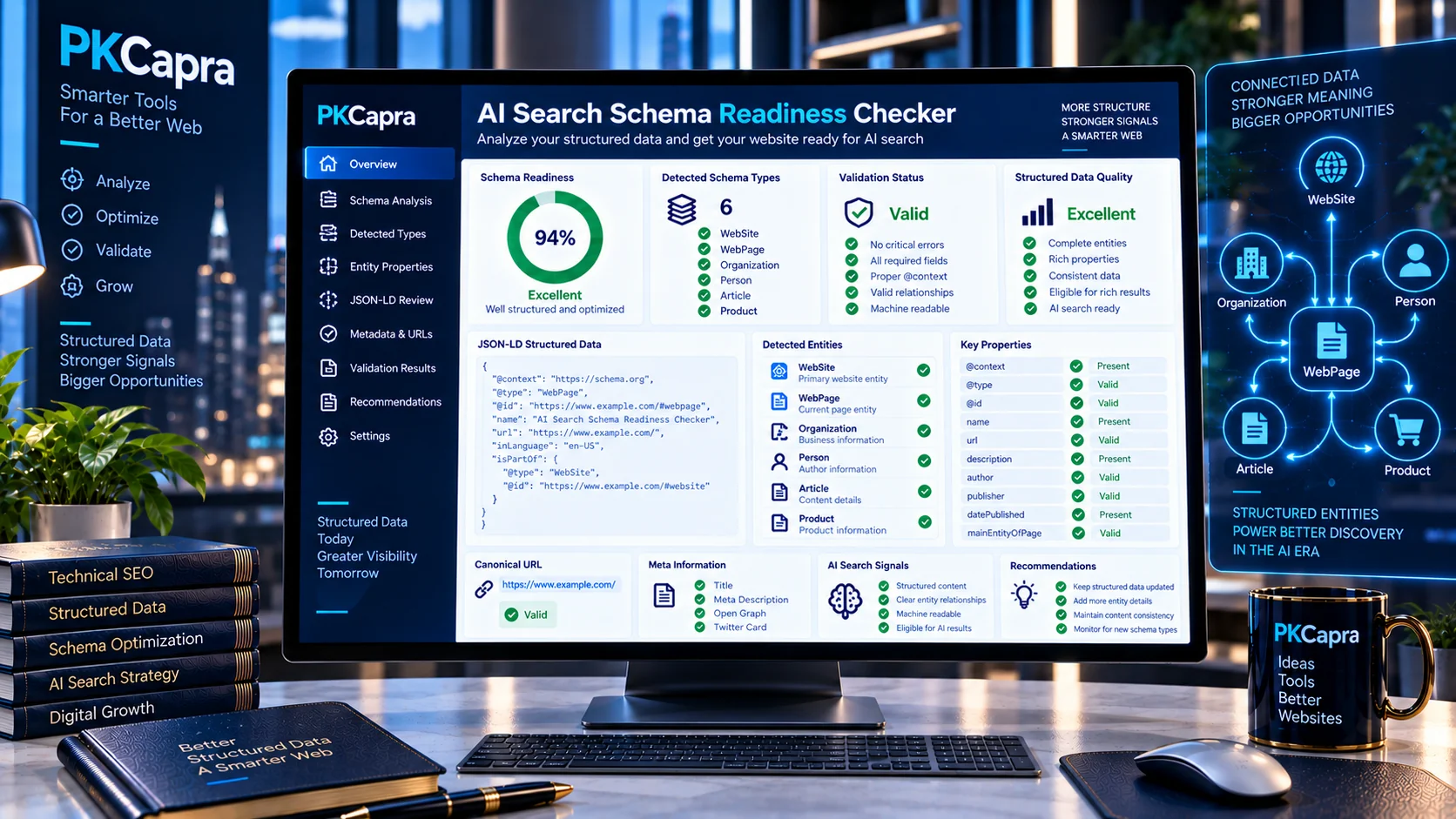
AI Search Schema Readiness Checker
Analyze whether a webpage clearly identifies its main structured data, schema types, properties, and page signals using visible content, metadata, links, and structured data.
What the AI Search Schema Readiness Checker Analyzes
JSON-LD Validity
The checker examines JSON-LD structured data found in the webpage and identifies whether the available blocks can be parsed successfully.
It can help identify problems such as:
- Invalid JSON-LD
- Missing or unclear structured-data context
- Incomplete structured-data blocks
- Multiple structured-data blocks that require review
Schema Types
The tool identifies schema types present in the analyzed page and reviews the structured-data context around those types.
Depending on the page, this may include entities such as:
- Organization
- Person
- WebSite
- WebPage
- Article
- Product
- LocalBusiness
- Other Schema.org types
The goal is to make the available structured-data signals easier to review rather than assuming that every schema type is appropriate for every page.
Required and Context Signals
Structured data is more useful when important contextual information is present and logically connected.
The checker reviews relevant context and property signals to identify areas that may require attention.
Entity Properties and Relationships
The analyzer examines entity properties and relationships within structured data.
This can include signals such as:
@id- Entity URLs
- Author relationships
- Publisher relationships
- About relationships
- Main entity relationships
- Other connected structured-data properties
These relationships can help provide additional context around what a webpage represents.
Canonical and Page Metadata
The checker also reviews relevant page-level signals, including canonical information and metadata that can provide additional context about the analyzed URL.
Machine-Readable Page Signals
Structured data works alongside other webpage signals. The analyzer therefore considers relevant machine-readable information available in the fetched HTML rather than treating schema markup as an isolated element.
Why Schema Readiness Matters for AI Search
Modern search and AI systems process information from webpages using multiple signals. Structured data can provide explicit machine-readable context about entities, pages, organizations, products, articles, and other content types.
A technically valid schema implementation does not guarantee rankings, AI citations, or visibility. However, reviewing structured data can help website owners identify inconsistencies, missing context, and implementation issues.
The AI Search Schema Readiness Checker provides a diagnostic way to review these signals on a public webpage.
Schema Readiness Is More Than Adding JSON-LD
Simply adding JSON-LD does not automatically make a page well structured.
A webpage may contain structured data while still having:
- Invalid JSON-LD
- Incomplete properties
- Weak entity relationships
- Conflicting signals
- Missing contextual information
- Poor alignment between page information and structured data
The checker is designed to help identify these areas for further review.
How to Use the AI Search Schema Readiness Checker
- Enter the public URL of the webpage you want to analyze.
- Start the schema readiness check.
- Allow the analyzer to retrieve and inspect the webpage.
- Review detected schema types, JSON-LD signals, properties, relationships, and page-level information.
- Review the diagnostic findings and address relevant issues on your website.
Use a publicly accessible webpage URL so the analyzer can retrieve the HTML required for analysis.
How to Interpret the Results
The tool provides a diagnostic assessment based on observable structured-data and machine-readable page signals.
Review the individual findings rather than relying only on the overall diagnostic result.
A page can have valid JSON-LD while still requiring improvements to its entity relationships, properties, contextual information, or other page signals.
Similarly, the absence of a particular schema type does not automatically mean that a webpage is technically incorrect. Structured data should reflect the actual content and entities represented by the page.
AI Search Schema and Entity Understanding
Schema and entity clarity are closely related.
The AI Entity Clarity Analyzer focuses specifically on whether organizations, people, brands, websites, and related entities are presented clearly and consistently.
The AI Search Schema Readiness Checker provides a broader review of structured-data and machine-readable schema signals that contribute to that context.
Using both diagnostics can help identify whether structured data and entity identity signals are aligned.
AI Search Schema and Technical SEO
Structured data is one part of a broader technical SEO system.
A webpage also needs to be accessible, indexable, and technically understandable. You can use the Indexability & Crawlability Analyzer to review crawl and indexability signals.
For broader structured-data analysis, the Schema Markup Structured Data Analyzer can provide an additional technical review of schema markup.
For overall AI-search technical readiness, use the AI Search Readiness Analyzer.
AI Search Schema and GEO
Generative Engine Optimization (GEO) involves improving how website information can be discovered, interpreted, and used across AI-powered search and answer experiences.
Structured data can provide machine-readable context about a webpage and its entities, but it should not be treated as a guarantee of AI visibility or citations.
Schema readiness is therefore best considered as one component of a broader technical and content strategy.
Common Schema Readiness Problems
Common areas that may require review include:
- Invalid JSON-LD
- Missing structured-data context
- Incomplete entity properties
- Unclear entity relationships
- Missing
@idreferences - Conflicting structured-data information
- Weak page-level context
- Canonical inconsistencies
- Schema information that does not clearly correspond with the visible page
- Multiple structured-data blocks that require closer review
Not every finding requires the same solution. Review each issue against the actual content and purpose of the webpage before changing its structured data.
Important Limitations
The AI Search Schema Readiness Checker evaluates observable signals in the HTML retrieved from the submitted public URL.
It does not determine:
- How a specific AI system understands a website
- Whether a page will receive AI citations
- Search-engine rankings
- AI-search visibility
- Knowledge-graph inclusion
- Whether a particular schema type will generate enhanced search features
Different search engines and AI systems can process the same webpage differently.
Privacy and Processing
The checker analyzes a public webpage URL and the machine-readable information available from the fetched HTML.
Do not submit private, authenticated, or sensitive URLs that you do not want processed.
Frequently Asked Questions
What is an AI Search Schema Readiness Checker?
It is a diagnostic tool that reviews structured data and related webpage signals that can help machines interpret webpage content and entities.
Does the checker validate JSON-LD?
Yes. The tool examines JSON-LD found in the fetched HTML and reviews its validity and contextual signals.
What schema types can it detect?
It can identify schema types present in the analyzed structured data, including common types such as Organization, Person, WebSite, WebPage, Article, Product, and LocalBusiness when they are present.
Does schema markup guarantee better AI visibility?
No. Structured data is only one source of machine-readable information and does not guarantee AI citations, rankings, visibility, or inclusion in generated answers.
Should every webpage use the same schema?
No. Structured data should accurately represent the actual content and entities on the specific webpage.
What is @id used for?
@id can provide an identifier for an entity within structured data and can help connect related structured-data objects.
Can schema and visible content conflict?
Yes. If structured data describes information that does not correspond with the actual webpage, it may require review. Structured data should accurately represent the content and entities present on the page.
Is the tool a Google schema validator?
No. It is a PKCapra diagnostic tool for reviewing observable structured-data and machine-readable webpage signals.
Can I analyze any website?
The tool is designed for publicly accessible webpages that can be retrieved by the analyzer. Private or restricted URLs may not be accessible.
Continue Your AI Search Diagnostics
After checking schema readiness, continue with the AI Entity Clarity Analyzer for entity identity and relationship signals.
You can also use the AI Content Extractability Checker to examine whether important page content is accessible and structurally extractable, the AI Citation Readiness Checker to review sourceability signals, and the AI Answer Extractability Checker to analyze answer-friendly content structure.