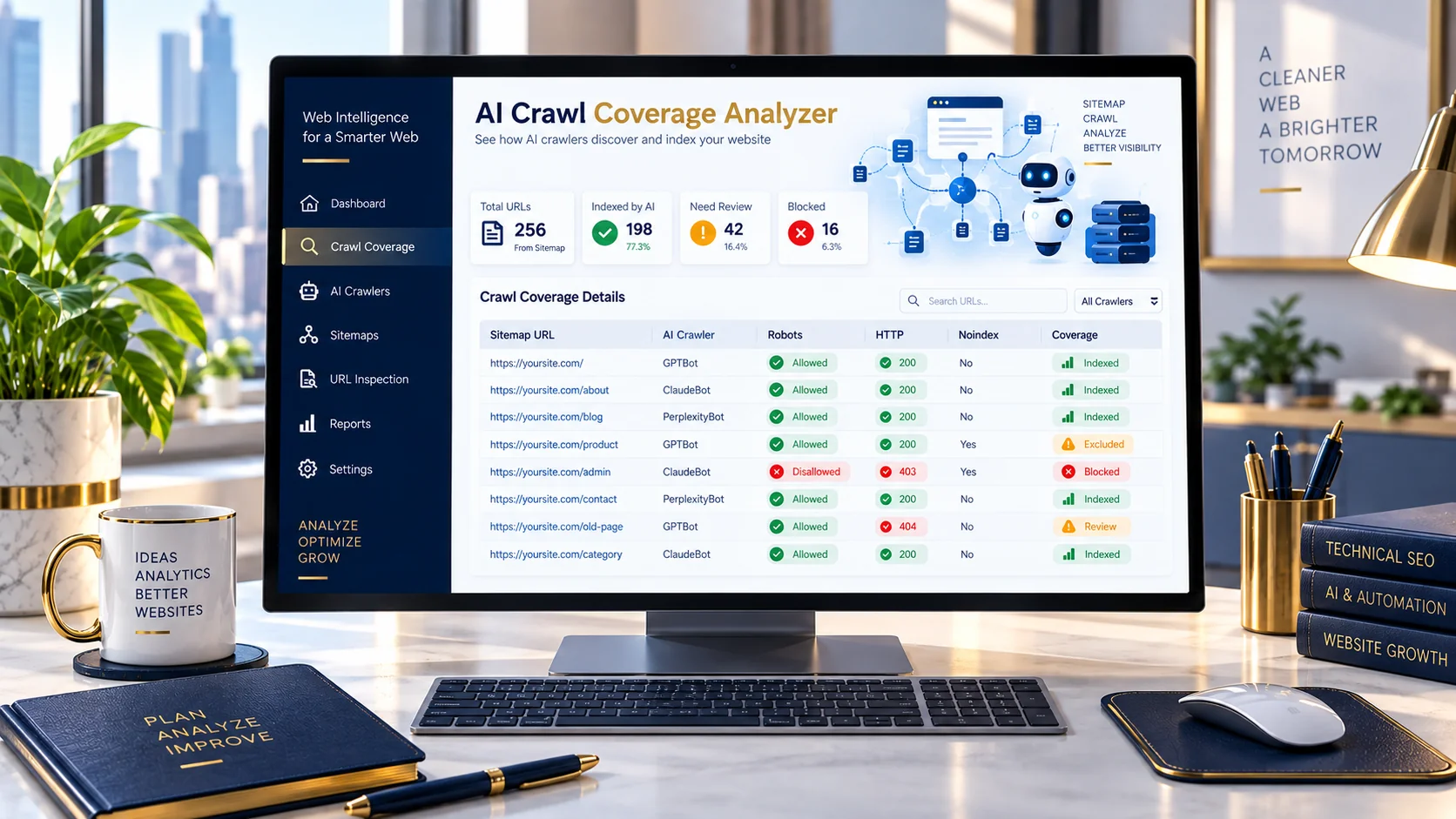
Compare sitemap URLs with robots.txt rules, observed HTTP responses and noindex signals to identify potential AI crawler coverage issues.
AI Crawl Coverage Analyzer
Compare sitemap URLs with crawler rules, HTTP access and noindex signals for a selected AI crawler.
What Does an AI Crawl Coverage Analyzer Help You Understand?
An AI Crawl Coverage Analyzer helps website owners examine how much of their important website content may be reachable and discoverable by AI-related crawlers. Crawl coverage is about access and discovery—not a guarantee that a page has been indexed, cited, or used in an AI answer. Use the results as a practical starting point for reviewing URLs, crawl paths, sitemap entries, and access rules.
What Is AI Crawl Coverage?
AI crawl coverage describes the extent to which relevant pages on a website can be discovered and accessed by crawlers associated with AI-powered search, answer engines, or content retrieval systems. The exact meaning depends on the crawler, its purpose, and the evidence used to measure coverage.
URL Discovery
Can a crawler find the page through links, a sitemap, or another discovery path?
Crawl Access
Can the crawler request the URL without being blocked by relevant access rules or technical restrictions?
Content Availability
Does the response make the intended page content available, rather than returning an error, redirect, or empty response?
Important distinction: A page being crawlable does not automatically mean it is indexed or cited. Crawl access, search indexing, retrieval, and citation are separate stages.
Which Website Signals Can Affect Crawl Coverage?
Crawl coverage is influenced by several technical and structural factors. Reviewing these signals helps you understand why some URLs may be easier to discover or access than others.
| Signal | Why It Matters | What to Review |
|---|---|---|
| Internal links | Links provide paths for discovering pages. | Important URLs, orphan pages, and link depth. |
| XML sitemap | A sitemap can help communicate the URLs you consider important. | Valid URLs, canonical consistency, and sitemap accessibility. |
| Robots.txt | Robots rules can restrict crawler access to URL paths. | Applicable user-agent groups and disallow rules. |
| HTTP response | Responses affect whether a crawler can retrieve the intended resource. | Status codes, redirects, server errors, and response behavior. |
| Canonical URL | Canonical signals help identify a preferred version of similar pages. | Canonical targets and duplicate URL variants. |
| Page directives | Robots meta tags and X-Robots-Tag can provide indexing instructions. | Page-level directives and HTTP header rules. |
| Content rendering | Important content should be available in a form the crawler can process. | JavaScript dependencies, blocked resources, and rendered output. |
These signals are useful for diagnosis, but no single one proves that every AI crawler will access a page. Different crawlers may use different user agents, policies, infrastructure, and retrieval methods.
How to Review AI Crawl Coverage
Use a consistent process to identify important URLs, inspect access conditions, and prioritize technical improvements.
Define Your Important URL Set
Start with key landing pages, useful articles, product pages, or other resources that should be discoverable. A sitemap can help organize this list, but it should not be treated as a complete record of every URL on the website.
Check Discovery Paths
Confirm that important pages have relevant internal links and are not isolated from the site’s navigation or content structure. Review links from category pages, related articles, and other meaningful pages.
Review Crawler Access Rules
Inspect robots.txt and any relevant server or page-level directives. Check the rules for the specific crawler you are evaluating; a rule for one user-agent group may not apply to another in the same way.
Check Responses and Redirects
Verify that important URLs resolve to the intended content. Investigate unexpected redirects, access errors, server errors, and inconsistent URL versions.
Compare Coverage Findings
Look for patterns among URLs that appear accessible, blocked, missing, redirected, or otherwise inconsistent. Confirm findings against the source data and your site’s actual configuration before making changes.
Prioritize Useful Fixes
Focus first on important pages with clear technical barriers. Correct accidental restrictions, improve internal discovery, resolve broken URLs, and keep sitemap entries aligned with preferred canonical URLs.
Crawl Coverage vs. Indexing vs. AI Citations
These terms describe different outcomes. Understanding the difference prevents crawl findings from being mistaken for proof of search visibility or AI citation performance.
| Concept | Main Question | What It Does Not Prove |
|---|---|---|
| Crawl coverage | Can the crawler discover or access the URL? | That the page is indexed or cited. |
| Search indexing | Has a search engine included the page in its index? | That the page will rank or appear for every query. |
| AI retrieval | Can a system retrieve or use the content for a particular task? | That every AI platform uses the same retrieval process. |
| AI citation | Is the source referenced in an answer or response? | That crawl access alone guarantees a citation. |
Do not interpret a coverage percentage in isolation. A high percentage may still hide missing high-value pages, while a lower percentage may include URLs that are intentionally excluded. Evaluate the URL set, exclusions, and evidence behind the result.
Why Important Pages May Have Low or Unclear Coverage
When a page does not appear in a crawl review, investigate the underlying reason rather than assuming a single cause.
Blocked URL Paths
A robots.txt rule may prevent a crawler from requesting a section that contains important public content.
Weak Internal Linking
Pages with few internal links can be harder to discover through normal site navigation and crawl paths.
Outdated Sitemap Entries
Removed, redirected, non-canonical, or inaccessible URLs can make sitemap-based reviews less useful.
Unexpected HTTP Responses
Server errors, access restrictions, and redirect chains can interfere with retrieving the intended page.
Duplicate URL Variants
Parameters, trailing slashes, protocol versions, and host variations may create multiple versions of similar content.
Content Not Easily Retrieved
Important information hidden behind complex rendering or unavailable resources may be harder for some crawlers to process.
Improve Crawl Coverage Without Creating Unnecessary URLs
- Keep important public pages linked from relevant site sections.
- Use a current XML sitemap containing preferred, canonical URLs.
- Review robots.txt rules before blocking entire content directories.
- Use redirects consistently when URLs change.
- Resolve broken internal links and avoid unnecessary redirect chains.
- Keep page-level robots directives consistent with your indexing goals.
- Make essential page content available in accessible HTML where practical.
- Separate intentional exclusions from unexpected crawl problems.
- Use server logs or platform-specific reporting when actual crawler visits need to be confirmed.
Crawl management is not about making every URL available. Utility pages, duplicate variants, private areas, search-result URLs, and other low-value or restricted resources may have legitimate reasons to remain outside a preferred crawl set.
Continue Your Website Crawl and AI Search Checks
Use these related tools to review specific parts of your site’s crawlability, access rules, sitemap structure, and AI search readiness.
AI Crawl Coverage Analyzer FAQs
What is an AI Crawl Coverage Analyzer?
It is a website analysis utility intended to help examine crawl-related coverage signals for AI-focused crawlers or discovery workflows. Interpret its findings according to the inputs and checks provided by the tool.
Does crawl coverage mean my pages are indexed?
No. Crawl coverage concerns discovery or access. Indexing is a separate process, and a page may be crawlable without being included in a search engine’s index.
Does being crawlable guarantee an AI citation?
No. Crawl access does not guarantee retrieval, selection as a source, or citation in an AI-generated answer. Those outcomes depend on additional systems and conditions.
Can robots.txt affect AI crawler coverage?
Yes. Robots.txt can provide crawl directives for user agents. Check the relevant user-agent group and understand that robots rules are crawl instructions, not access-control or security mechanisms.
Does an XML sitemap guarantee that every listed URL will be crawled?
No. A sitemap helps communicate URL information, but it does not guarantee crawling, indexing, or ranking. URLs should also be accessible and consistent with your site’s preferred versions.
Why might a page be missing from a crawl coverage report?
Possible reasons include weak discovery paths, access rules, unexpected responses, redirects, URL mismatches, or limitations in the data being analyzed. Confirm the cause using the relevant URL and technical evidence.
Should every URL on my website be crawlable?
Not necessarily. Focus on important public content. Duplicate URLs, private areas, low-value parameter pages, and other intentionally excluded resources may not belong in your target crawl set.
How can I verify that an AI crawler actually visited my website?
Where available, review server access logs or crawler-specific reporting. Verify crawler identity carefully rather than relying only on a user-agent string, which can be spoofed.
How often should I review crawl coverage?
Review it after major site changes, URL migrations, robots.txt updates, sitemap changes, or significant publishing activity. A regular technical review can also help detect issues before they affect important pages for an extended period.