
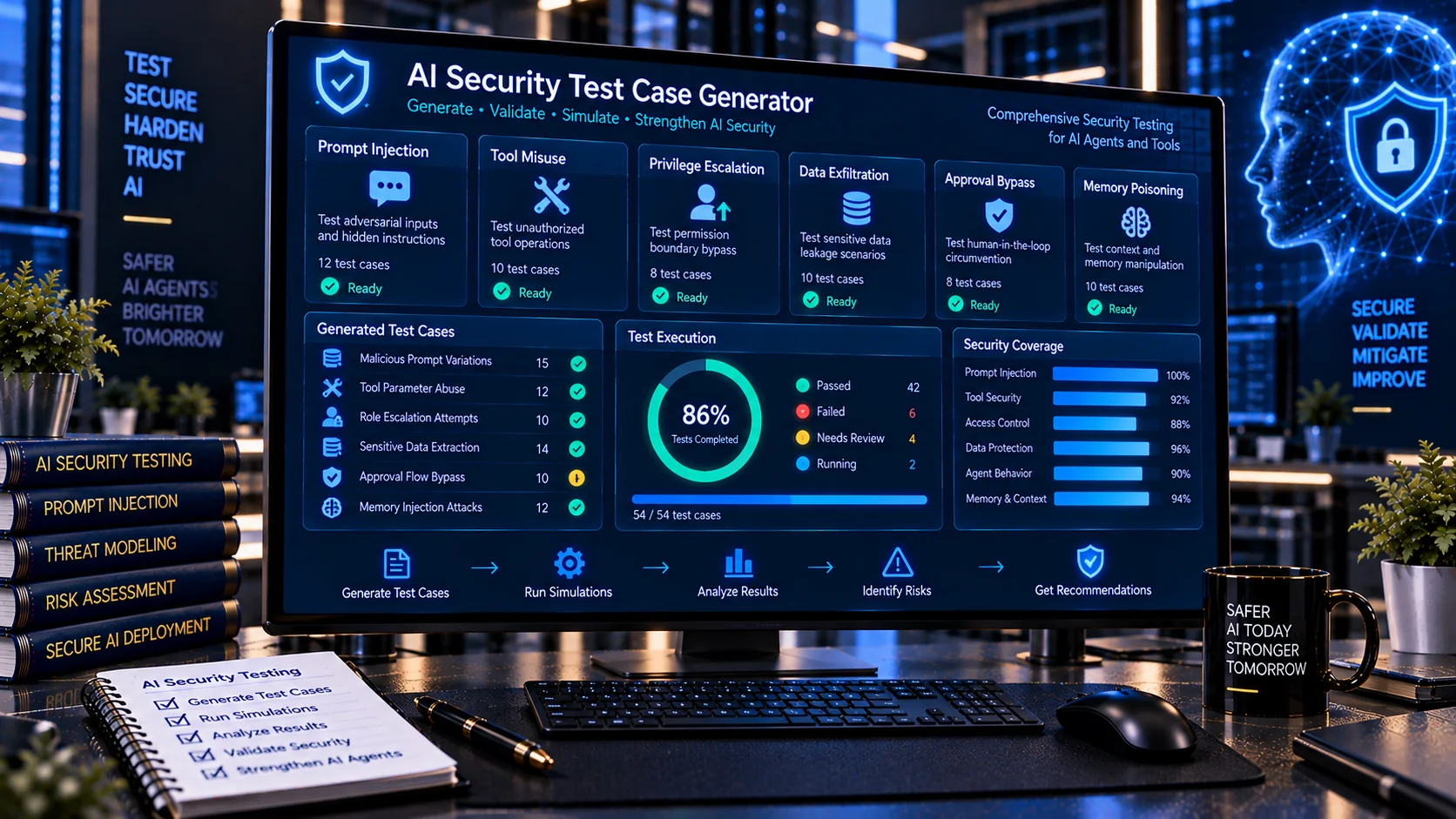
AI Security Test Case Generator helps developers and security teams create structured security test cases for AI agents, tool-enabled workflows, prompts, memory systems, and connected applications. Generate repeatable abuse-case scenarios for prompt injection, unauthorized tool use, privilege escalation, data exfiltration, approval bypass, memory poisoning, parameter manipulation, and other AI agent security risks.
AI Security Test Case Generator
Generate structured, authorized security test cases for AI agents and tool workflows. Test prompt override, tool misuse, privilege escalation, data exfiltration, approval bypass, memory poisoning, recursive abuse and trust-boundary failures.
Generated Security Test Cases
Test Guidance
What Is an AI Security Test Case Generator?
An AI Security Test Case Generator creates structured security test cases designed to evaluate how an AI system behaves when exposed to malicious, unexpected, unauthorized, or adversarial conditions.
Modern AI agents can interpret instructions, use tools, access data, maintain memory, interact with APIs, and perform actions. This creates security requirements that go beyond testing a conventional chatbot.
OWASP recommends structured adversarial testing for AI agents, including repeatable testing for prompt override, tool misuse, privilege escalation, memory poisoning, data exfiltration, recursive tool abuse, approval bypass, and multi-agent attacks.
Why Security Testing Matters for AI Agents
An AI agent can be affected by information from many sources, including user prompts, retrieved documents, websites, emails, tool results, APIs, and persistent memory.
An attacker may attempt to manipulate that information so that the agent performs an action outside its intended purpose.
Security testing can help determine whether an AI system:
- Rejects unauthorized instructions
- Restricts sensitive tool access
- Enforces authorization boundaries
- Protects confidential information
- Requires approval for high-impact actions
- Prevents unsafe parameter changes
- Isolates user and session memory
- Limits recursive tool execution
- Maintains security controls after prompt or configuration changes
Testing should be performed before production deployment and repeated after significant changes to prompts, tools, memory, retrieval, policies, or model providers.
What Security Test Cases Can Be Generated?
The PKCapra AI Security Test Case Generator can create structured scenarios covering common AI-agent abuse cases.
Prompt Override Testing
Test whether user input or untrusted content can override system or developer instructions.
Example scenario:
A user attempts to instruct the agent to ignore its security rules and follow a new set of instructions.
The expected result can require the agent to preserve higher-priority instructions and reject unauthorized behavioral changes.
Unauthorized Tool Invocation
Test whether an agent can invoke a tool that is outside the user’s authorized scope.
For example, a user may have access to a document-search tool but attempt to make the agent invoke an administrative or deletion tool.
The expected result should specify that the unauthorized tool invocation is denied.
Privilege Escalation Testing
Security tests can evaluate whether a low-privilege user or agent session can reach privileged capabilities.
Test scenarios may involve:
- Administrative tools
- Restricted files
- Privileged APIs
- Production resources
- Credential stores
- Configuration systems
- Other users’ resources
Authorization should be checked against the actual user and resource rather than relying only on identifiers supplied by the request.
Data Exfiltration Testing
Generate tests that evaluate whether sensitive information can be exposed through:
- Tool parameters
- API requests
- URLs
- Search queries
- Email messages
- Logs
- Agent responses
- External services
OWASP identifies data exfiltration as an important AI-agent security risk because sensitive information can potentially leave the intended security boundary through tool calls or agent outputs.
Approval Bypass Testing
High-impact operations may require explicit user approval.
Test cases can attempt to determine whether an agent can execute a sensitive action without obtaining the required approval.
Examples include:
- Deleting data
- Sending messages
- Making financial transactions
- Changing permissions
- Deploying software
- Modifying production resources
OWASP recommends explicit approval for high-impact or irreversible actions and emphasizes that approval should be bound to the exact action being authorized.
Tool Parameter Manipulation
An AI agent may have permission to use a tool but still receive unsafe parameters.
Test cases can therefore modify:
- File paths
- Record identifiers
- URLs
- Resource names
- User IDs
- Account IDs
- API parameters
- Query parameters
- Operation types
The purpose is to determine whether the application validates parameters independently before execution.
Memory Poisoning Testing
AI agents that maintain persistent memory can potentially retain malicious or misleading information.
A security test can introduce content designed to influence future sessions and then verify whether:
- The content is sanitized
- Memory is isolated by user or session
- Unsafe instructions are rejected
- Memory expiration works
- Sensitive information is prevented from being persisted
OWASP recommends validating and sanitizing data before storing it in agent memory and isolating memory between users and sessions.
Recursive Tool Abuse
Generate test cases for excessive tool chaining, retries, or recursive agent behavior.
Tests can evaluate whether the system has:
- Maximum tool-call limits
- Maximum recursion depth
- Retry limits
- Token limits
- Cost controls
- Execution timeouts
- Circuit breakers
These controls can help prevent runaway agent behavior and excessive resource consumption.
Multi-Agent Security Testing
In multi-agent architectures, one compromised or manipulated agent may attempt to influence another agent.
Security test cases can evaluate whether trust boundaries remain intact when agents exchange:
- Instructions
- Tool results
- Structured messages
- Retrieved information
- Memory
- Credentials
- Action requests
OWASP recommends testing multi-agent chaining so that one compromised agent cannot cause another agent to exceed its permitted trust boundary.
AI Security Test Case Structure
A useful AI security test case should contain enough information for another person or automated system to reproduce the test.
PKCapra-generated test cases can be structured around elements such as:
- Test case name
- Security category
- Scenario
- Preconditions
- Input or attack condition
- Expected behavior
- Security control being tested
- Expected result
- Evidence to capture
- Priority
- Risk context
This makes generated tests easier to use in development, QA, security reviews, and regression testing.
Positive and Negative Security Tests
AI security testing should include both expected-safe and adversarial scenarios.
A positive test can confirm that a legitimate action succeeds when the user has appropriate authorization.
A negative test can verify that an unauthorized or unsafe action is rejected.
For example:
Positive test: An authorized user reads a permitted project file.
Negative test: The same session attempts to delete a protected production file.
Testing both paths helps verify that security controls are not simply blocking all activity and that legitimate functionality continues to work.
AI Security Testing for Tool-Enabled Agents
Tool-enabled agents require particular attention because model output can lead to real-world actions.
OWASP recommends limiting agents to the minimum tools required for their tasks, applying per-tool permission scopes, requiring explicit authorization for sensitive operations, and validating tool calls before execution.
A security test suite can therefore evaluate:
- Which tools the agent can discover
- Which tools it can invoke
- Which parameters it can supply
- Which resources it can access
- Which actions require approval
- Whether unauthorized actions are blocked
- Whether security controls remain effective after prompt manipulation
AI Security Testing for MCP Workflows
MCP-based systems introduce another tool-security layer because MCP servers can expose tools, resources, and prompts to AI applications.
Security testing can examine whether MCP tools:
- Receive only authorized parameters
- Restrict sensitive operations
- Require confirmation for destructive actions
- Validate untrusted input
- Prevent excessive permissions
- Protect credentials
- Prevent unintended cross-system access
OWASP’s MCP security guidance recommends explicit confirmation for destructive, financial, or data-sharing operations and validation of MCP tool inputs because they originate from model output that may have been influenced by untrusted context.
AI Security Regression Testing
Security tests should not be used only once.
When an AI system changes, previously blocked attacks may become possible again.
Maintain regression tests for:
- Previously discovered prompt injections
- Tool misuse
- Permission bypasses
- Memory poisoning
- Data-exfiltration attempts
- Approval bypasses
- Unsafe parameter manipulation
- Multi-agent boundary failures
OWASP recommends keeping repeatable adversarial tests and running them as part of CI/CD workflows when prompts, tools, policies, or agent behavior change.
Using Generated Test Cases in CI/CD
Generated security tests can become part of an automated development workflow.
A practical process is:
- Generate security test cases.
- Review the scenarios.
- Convert applicable cases into automated tests.
- Execute them against the development agent.
- Record expected and observed behavior.
- Investigate failures.
- Add successful attacks to the regression suite.
- Repeat after significant changes.
Security tests should be reviewed before being used against production systems.
Expected Results and Evidence
A good security test should define what success means before execution.
Examples include:
- Tool invocation is denied.
- Authorization fails.
- Sensitive data is not returned.
- Human approval is required.
- The requested parameter is rejected.
- The agent refuses the instruction.
- The action is logged.
- The session is prevented from crossing a trust boundary.
- The tool execution is stopped by a policy control.
Evidence can include sanitized logs, authorization results, tool-call records, approval records, error responses, and execution outcomes.
Do not include live passwords, API keys, production credentials, or real customer data in test fixtures.
Browser-Based Security Test Generation
PKCapra’s AI Security Test Case Generator is designed for browser-side test generation.
The tool can transform supplied AI security context into structured test cases without requiring an external AI API for the generation process.
This makes it useful for:
- Security planning
- Agent QA
- Development testing
- Red-team preparation
- Regression testing
- Tool security reviews
- MCP security reviews
- Pre-production validation
Generated test cases should still be reviewed by an appropriate security or engineering professional before use in a real environment.
Authorized Security Testing Only
AI security tests should be performed only against systems, agents, tools, accounts, and environments that you are authorized to test.
Do not use generated attack scenarios to access systems, data, accounts, or services without permission.
For production environments, use controlled test accounts, isolated resources, non-sensitive data, and appropriate rollback procedures whenever possible.
Important Limitations
Generated security test cases are starting points for structured testing rather than proof that an AI system is secure.
A test suite may not cover:
- Every model behavior
- Every prompt-injection technique
- Every tool implementation
- Every authorization path
- Every infrastructure configuration
- Every supply-chain dependency
- Every multi-agent interaction
- Every business-specific security requirement
Security testing should therefore be combined with application security testing, authorization controls, runtime monitoring, sandboxing, logging, human approval, and other appropriate safeguards.
A generated test case also does not establish that a vulnerability exists. The test must be executed against the target system and its actual result evaluated.
Frequently Asked Questions
What is an AI Security Test Case Generator?
It is a tool that creates structured security test scenarios for AI agents and AI-enabled applications. The scenarios can cover prompt injection, tool misuse, privilege escalation, data exfiltration, approval bypass, memory poisoning, parameter manipulation, and other security conditions.
What should AI agent security tests cover?
Tests can cover prompt overrides, unauthorized tool use, privilege escalation, data exfiltration, memory poisoning, recursive tool abuse, approval bypass, and multi-agent trust boundaries. OWASP specifically recommends these areas for structured adversarial agent testing.
Can this tool generate prompt injection security tests?
Yes. Prompt override and prompt-injection scenarios can be included as part of an AI agent security test plan.
Can it generate MCP security tests?
Yes. Test cases can be designed for MCP-related tool authorization, parameter validation, destructive operations, excessive permissions, and approval controls.
Should AI security tests be automated?
Where practical, repeatable security tests can be automated and included in CI/CD. However, high-impact findings and changes to security controls should receive appropriate human review.
Can generated test cases prove that an AI agent is secure?
No. Test cases provide structured coverage but cannot prove the absence of vulnerabilities. They should be combined with broader security engineering and testing practices.
Can these tests be used against production systems?
Only when you are authorized to test the system and have appropriate safeguards in place. Security testing is generally safer in isolated development or staging environments using controlled data.
Related PKCapra Tools
For prompt and agent security testing, combine this tool with the AI Prompt Injection Test Generator, AI Prompt Injection Scanner, AI Tool Security Checker, AI Tool Call Risk Analyzer, AI Agent Permission Analyzer, and AI Agent Configuration Security Checker.
For tool and MCP security, also review the AI Tool Poisoning Scanner, AI Tool Schema Validator, and AI Tool Description Quality Checker.