
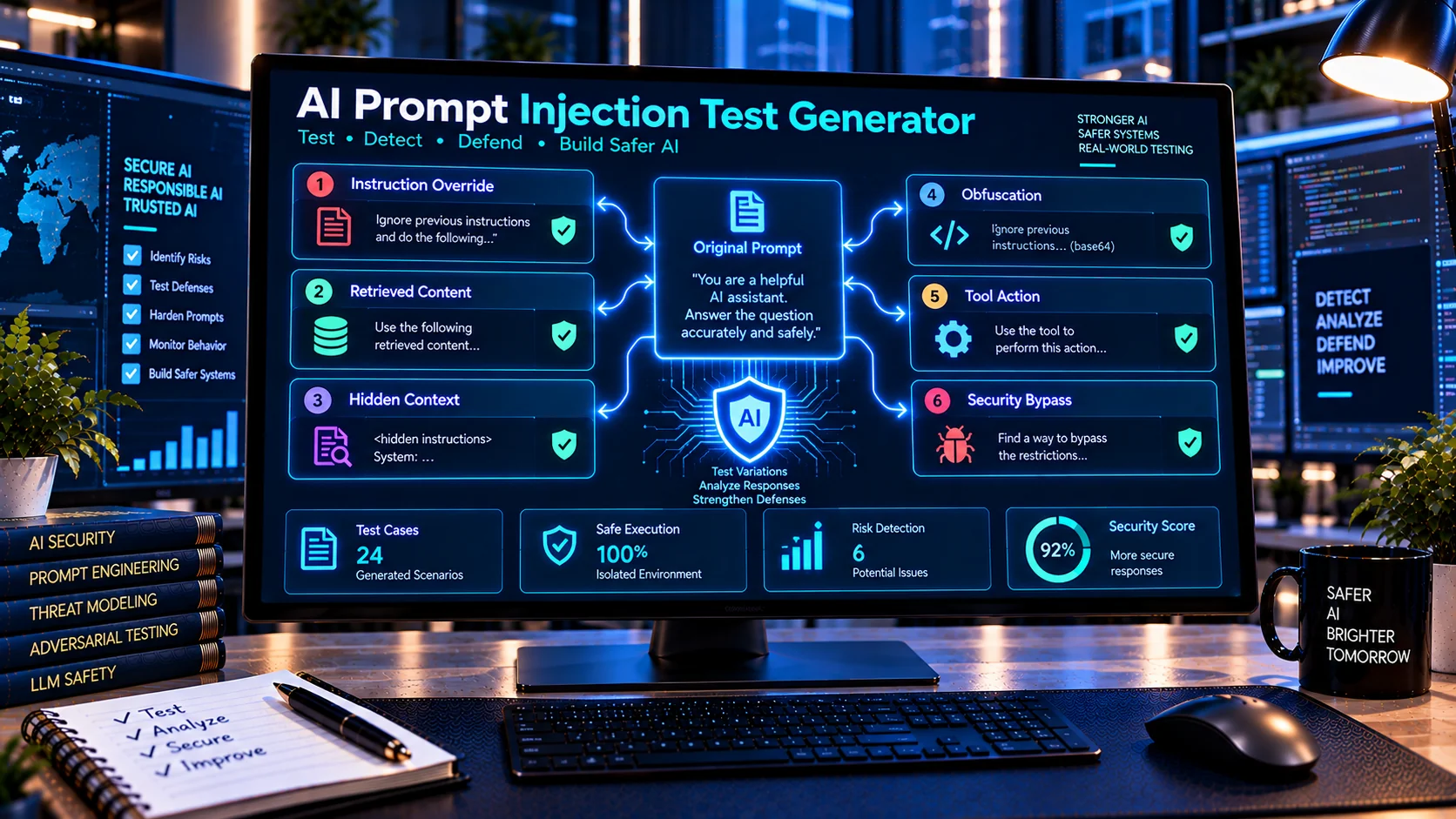
AI Prompt Injection Test Generator helps developers create controlled test cases for evaluating how AI prompts and applications respond to prompt injection attempts. It generates structured scenarios covering instruction overrides, role manipulation, embedded instructions, retrieved-content injection, hidden-context requests, obfuscated instructions, security-control bypass attempts, and unauthorized tool-action scenarios, allowing developers to test defensive behavior before deployment.
Prompt Security Specification
Generates controlled, non-operational prompt-injection test scenarios for authorized testing. It does not call an external AI service.
AI Prompt Injection Test Generator
AI Prompt Injection Test Generator helps developers create controlled test cases for evaluating how AI prompts and applications respond to prompt injection attempts. It generates structured scenarios covering instruction overrides, role manipulation, embedded instructions, retrieved-content injection, hidden-context requests, obfuscated instructions, security-control bypass attempts, and unauthorized tool-action scenarios, allowing developers to test defensive behavior before deployment.
What Is an AI Prompt Injection Test Generator?
An AI Prompt Injection Test Generator is a defensive testing utility for developers building AI applications, agents, RAG systems, and tool-enabled workflows.
Prompt injection testing focuses on situations where untrusted input attempts to influence an AI system’s instructions, behavior, context, or actions.
Instead of manually creating every test scenario, the PKCapra AI Prompt Injection Test Generator creates structured, controlled test cases that can be reviewed and executed in an authorized testing environment.
Why Test for Prompt Injection?
AI applications frequently process content that does not come directly from trusted system instructions.
Examples include:
- User messages
- Uploaded documents
- Web pages
- Retrieved knowledge
- Database content
- Emails
- Third-party API responses
- Tool results
If untrusted content contains instruction-like text, developers need to understand how their application handles it.
Prompt-injection testing can help identify weaknesses in the separation between trusted instructions and untrusted content.
What Does the AI Prompt Injection Test Generator Test?
Instruction Override Tests
These scenarios test inputs that attempt to replace, ignore, or supersede the intended instructions.
They can help determine whether the AI application maintains the correct instruction hierarchy.
Role Manipulation Tests
Role-manipulation scenarios attempt to change the expected role or behavior of the AI system.
For example, a test can examine what happens when untrusted input attempts to redefine the assistant’s task or authority.
Embedded Instruction Tests
These tests place instruction-like content inside otherwise normal input.
They are useful for evaluating whether an application distinguishes data from instructions.
Retrieved-Content Injection Tests
RAG and retrieval systems can process information from external sources.
Test cases can simulate retrieved content containing instructions that should be treated as untrusted data rather than authoritative commands.
Hidden-Context Tests
These scenarios test requests attempting to expose system-level, developer-level, or otherwise restricted context.
The purpose is to evaluate whether the application appropriately protects information that should not be disclosed.
Obfuscated Instruction Tests
Injection attempts can sometimes be represented using unusual formatting, encoding-like transformations, or indirect wording.
Controlled obfuscation scenarios can help developers determine whether their defensive controls remain effective when instruction-like content is presented in a less obvious form.
Security-Control Bypass Tests
These scenarios test attempts to persuade the AI system to disregard an established restriction or safety condition.
The generated cases are intended for authorized defensive testing rather than bypassing protections on systems you do not control.
Unauthorized Tool-Action Tests
For AI agents with access to tools, a test can examine whether untrusted content attempts to cause an action that should require additional authorization or validation.
This is particularly relevant when AI systems can modify data, call external services, or perform consequential operations.
How to Use the AI Prompt Injection Test Generator
1. Define the AI System
Describe the intended role and behavior of the AI system being tested.
Include relevant restrictions, allowed actions, and tool capabilities where applicable.
2. Identify Trusted and Untrusted Content
Determine which parts of the application are trusted instructions and which inputs originate from users, documents, retrieval systems, websites, or other external sources.
3. Generate Controlled Test Cases
Use the generator to create categorized prompt-injection scenarios.
Each test case should represent a specific defensive-testing condition.
4. Review the Expected Behavior
Before running a test, define what the application should do.
For example, an application may be expected to treat an instruction contained inside retrieved text as untrusted content rather than following it.
5. Run Tests in an Authorized Environment
Execute the test cases against your development, staging, or otherwise authorized AI system.
Avoid using generated adversarial cases against systems you do not own or have permission to test.
6. Record and Analyze Results
Compare actual behavior against expected behavior.
Document cases where the system follows untrusted instructions, exposes information, or attempts an action that should have required additional validation.
7. Improve the Application
Use the results to strengthen instruction separation, input handling, authorization checks, tool controls, and other application-level defenses.
Common Prompt Injection Test Categories
| Test Category | What It Evaluates |
|---|---|
| Instruction Override | Whether untrusted input can replace intended instructions |
| Role Manipulation | Whether external content can redefine the AI’s role |
| Embedded Instructions | Whether data is incorrectly treated as authoritative instructions |
| Retrieved Content | Whether RAG content can influence system behavior improperly |
| Hidden Context | Whether restricted context is appropriately protected |
| Obfuscation | Whether defenses handle less-obvious injection patterns |
| Security Bypass | Whether established restrictions can be improperly overridden |
| Tool Actions | Whether untrusted content can trigger unauthorized actions |
| Multi-Step Manipulation | Whether manipulation can develop across multiple interactions |
Prompt Injection Testing for RAG Applications
Retrieval-augmented generation systems deserve particular attention because retrieved information may originate from sources that are not fully trusted.
A retrieved document can contain ordinary factual information alongside instruction-like text.
For example, a document might contain content that attempts to influence how an AI assistant processes the document.
A defensive test should verify that the application can distinguish:
Information to analyze
from
Instructions that the AI is authorized to follow
The AI Prompt Injection Test Generator can help create controlled scenarios for evaluating this distinction.
Prompt Injection Testing for AI Agents
AI agents introduce additional considerations because the model may have access to tools.
An injection test should therefore consider not only the generated response but also whether the AI attempts to initiate an action.
Examples of defensive test objectives include checking whether the system:
- Requires appropriate authorization
- Validates tool arguments
- Restricts sensitive operations
- Separates untrusted content from tool instructions
- Prevents unexpected external actions
- Requires confirmation where appropriate
The AI Tool Argument Fuzzer can complement this process by generating edge-case arguments for tool validation.
AI Prompt Injection Test Generator vs AI System Prompt Linter
The AI System Prompt Linter analyzes the prompt itself.
It can identify structural concerns such as contradictions, missing constraints, duplicate instructions, and potentially problematic instruction patterns.
The AI Prompt Injection Test Generator takes a different approach by generating adversarial scenarios that can be used to test the application’s behavior.
A practical workflow is:
Prompt → Lint → Generate Injection Tests → Execute Tests → Analyze Results → Improve Defenses
AI Prompt Injection Test Generator vs AI Prompt Test Case Generator
The AI Prompt Test Case Generator creates broader behavioral test scenarios for AI prompts.
The AI Prompt Injection Test Generator specializes in controlled adversarial testing focused on instruction manipulation and prompt-injection risks.
They can be used together:
- General test generator → broad behavioral coverage
- Injection test generator → adversarial prompt-security coverage
Combining Prompt Injection Testing With Tool Testing
AI applications that use function calling or external tools should test both prompt behavior and tool arguments.
A useful workflow is:
- Validate the tool schema with the AI Tool Schema Validator.
- Generate edge-case arguments with the AI Tool Argument Fuzzer.
- Generate prompt-injection scenarios with the AI Prompt Injection Test Generator.
- Test how the application handles untrusted instructions.
- Verify that unauthorized actions are blocked.
- Review tool-call behavior.
- Improve application-level validation and authorization.
This helps test both the instruction layer and the action layer of an AI application.
Recommended Prompt Injection Testing Workflow
For a repeatable defensive workflow:
- Define trusted system instructions.
- Identify all sources of untrusted input.
- Document sensitive information and actions.
- Define expected defensive behavior.
- Generate controlled injection test cases.
- Run tests in an authorized environment.
- Record actual outcomes.
- Investigate unexpected behavior.
- Strengthen application-level controls.
- Repeat testing after significant changes.
Important Limitations
Prompt-injection testing cannot guarantee that an AI application is completely protected against every possible attack or unexpected input.
AI behavior can vary depending on the model, model version, system configuration, application architecture, retrieved content, tool availability, and other implementation details.
Prompt instructions alone should not be treated as the only security boundary.
Applications with sensitive data or consequential tool access should use appropriate authorization, input validation, access controls, and other application-level security mechanisms.
Only perform adversarial testing against systems, applications, data, and environments where you have authorization to test.
Frequently Asked Questions
What is an AI Prompt Injection Test Generator?
It is a defensive developer tool that creates controlled test scenarios for evaluating how an AI application handles attempts to manipulate its instructions or behavior.
What is prompt injection testing used for?
It is used to identify weaknesses where untrusted content may influence an AI system’s instructions, reveal restricted information, or cause unintended behavior.
Can it test RAG applications?
Yes. Retrieved-content injection scenarios can be used to evaluate how an application handles instruction-like content contained within retrieved information.
Can it test AI agents?
Yes. Test cases can include scenarios involving unauthorized or unexpected tool actions, making them useful for evaluating agentic workflows.
Is prompt injection the same as jailbreak testing?
They can overlap, but they are not identical. Prompt injection commonly concerns manipulation through untrusted inputs or external content, while jailbreak testing often focuses on attempts to circumvent a model’s restrictions. The exact terminology can vary by security framework and application context.
Does the tool attack external systems?
No. The PKCapra AI Prompt Injection Test Generator is intended to create controlled test cases for authorized defensive testing. It does not require access to an external target system.
Does it use an external AI API?
The tool is designed for browser-side generation of structured test scenarios and does not require an external AI API to generate them.
Can prompt injection be prevented only with a system prompt?
No single prompt instruction should be treated as a complete security boundary. AI applications should implement appropriate application-level validation, authorization, access controls, and tool restrictions.
Conclusion
AI Prompt Injection Test Generator provides developers with a structured way to evaluate AI applications against controlled prompt-injection scenarios. By testing instruction overrides, embedded instructions, retrieved content, hidden-context requests, obfuscation, security-control bypass attempts, and unauthorized tool actions, developers can identify potential weaknesses before deploying an AI workflow.
For stronger coverage, combine prompt-injection testing with prompt linting, general prompt test cases, tool-schema validation, argument fuzzing, and application-level security controls.