
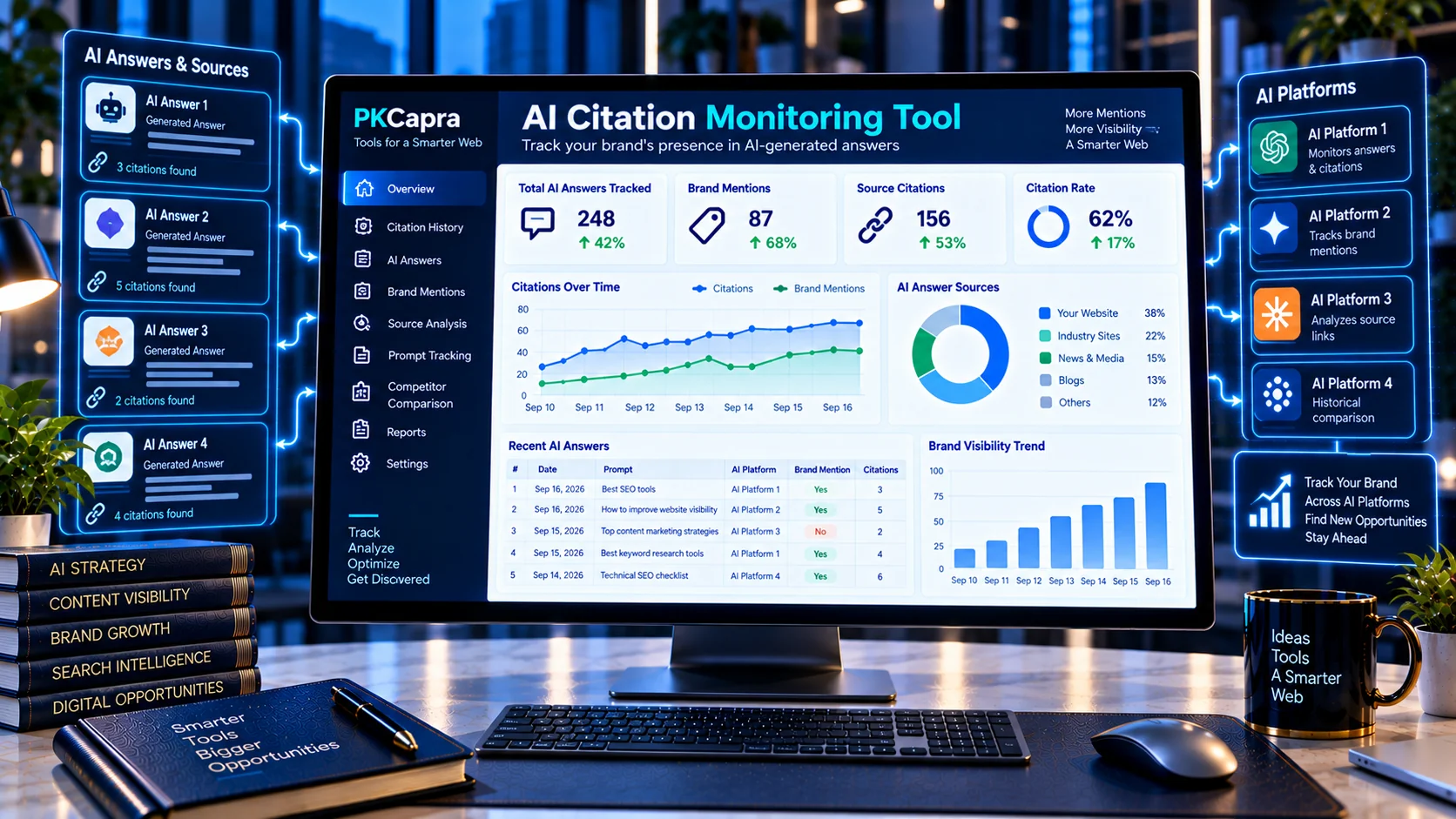
Monitor AI citation and mention patterns over time with PKCapra’s AI Citation Monitoring Tool. Record AI-generated answer snapshots, track your brand, website, or entity, compare historical results, and identify changes in citation and mention rates across your collected data.
AI Citation Monitoring Tool
Turn repeated AI-answer snapshots into a structured citation and mention monitoring report for a brand, website, product or entity.
Use only AI-answer samples you are authorized to analyze. Supplied text is sent to the PKCapra WordPress endpoint for deterministic parsing; it is not sent to an external AI provider by this tool.
What Is AI Citation Monitoring?
AI citation monitoring is the process of checking whether AI-powered search experiences and answer systems reference your website, pages, brand or published information when responding to relevant questions. It helps website owners understand where their content appears as a cited source, which pages are referenced, and how citation patterns may change across queries or observation periods.
The PKCapra AI Citation Monitoring Tool is designed for this monitoring task. Use the options and results available in the tool to review citation-related information; the precise sources, tracking scope and reporting features depend on its implementation.
Why Monitor Citations in AI Search?
Search journeys increasingly include generated answers alongside traditional search results. When an answer includes source references, those citations can help users investigate the information further. Monitoring citations gives publishers another way to examine how their content is being surfaced—not just whether a page ranks in a conventional results list.
Understand Source Visibility
Identify whether your pages appear among the sources referenced for selected topics, prompts or queries.
Review Content Performance
Compare citation observations with the pages, subjects and questions your content is intended to answer.
Find Content Opportunities
Use citation gaps and relevant source patterns to identify topics that may need clearer, more complete supporting content.
What Should You Track?
A useful citation review looks beyond a simple yes-or-no result. The following dimensions help organize observations when the corresponding information is available from your monitoring process.
| Monitoring dimension | What it helps you understand | Questions to ask |
|---|---|---|
| Source URL | The page referenced in an AI-generated answer. | Is the cited page relevant, accurate and up to date? |
| Query or topic | The question or subject associated with a citation. | Does the query match the page’s intended audience and purpose? |
| AI platform | The answer environment where the citation was observed. | Does source visibility differ between platforms? |
| Observation date | When a citation was checked or recorded. | Is the source appearance consistent across repeated checks? |
| Competitor sources | Other pages referenced for the same subject. | What useful evidence, structure or coverage do those pages provide? |
| Citation context | How the source supports the generated answer. | Is the page cited for a claim it actually supports? |
These are recommended analysis dimensions, not a statement that every field is automatically collected or displayed by this tool. Review the actual controls and output provided on the page.
How to Use an AI Citation Monitoring Tool
Use a consistent review process so that citation observations are meaningful and can be compared over time.
Define Your Website or Brand
Identify the domain, brand or content property you want to examine. Use the input format requested by the tool.
Select Relevant Topics
Focus on real questions your audience asks and subjects directly connected to your published content.
Run the Available Check
Follow the on-page instructions and use the monitoring options currently supported by the tool.
Review the Evidence
Examine cited URLs, query context and any comparison information shown in the results.
Record Your Observations
Keep a dated record of the queries and sources checked if you need to compare findings later.
Improve the Relevant Page
Address missing explanations, unclear claims, outdated facts or weak supporting evidence where appropriate.
How to Interpret AI Citation Monitoring Results
Citation observations are useful signals, but they need context. Avoid drawing broad conclusions from a single response or isolated check.
Your Page Is Cited
Review the cited passage and confirm that the page supports the answer accurately. Check whether the citation points to the most useful page for that topic.
Your Page Is Not Cited
This does not prove that your site is excluded from AI search. The response may use different sources, answer the query differently or omit citations altogether.
A Citation Changes
Compare the query, platform, date and response context before treating a change as a trend. Generated answers are not fixed search rankings.
AI Citations vs. Traditional SEO Metrics
AI citation monitoring complements established SEO analysis. It does not replace search performance, crawlability or analytics data.
| Signal | What it measures | What it does not prove |
|---|---|---|
| AI citation | A source reference observed in an AI answer. | That the page ranks highly in traditional search. |
| Search impression | A page was shown in a search result, as reported by the relevant platform. | That an AI answer cited the page. |
| Organic click | A user visited through a tracked organic search result. | That the visit originated from an AI citation. |
| Referral visit | A visit attributed to a referring source by analytics. | That every AI-generated mention is measurable as a referral. |
| Brand mention | A name or entity appears in answer text. | That a clickable source link was provided. |
Use citation observations alongside relevant data from search analytics, website analytics and technical SEO checks. Each source measures a different part of the user journey.
How to Improve the Chances of Being Cited
No website can guarantee citation in a generated answer. However, publishers can make their pages easier to understand, verify and retrieve by maintaining sound content and technical practices.
Make the page answer a clear question
- State the subject and purpose of the page clearly.
- Answer the main question directly before adding supporting detail.
- Use descriptive headings that accurately reflect each section.
- Define specialized terms and explain important relationships.
Support claims with reliable evidence
- Link to primary sources when they support a factual claim.
- Distinguish verified facts from estimates, opinions and examples.
- Keep time-sensitive information current and identify relevant dates.
- Correct statements that are ambiguous, unsupported or misleading.
Maintain technical accessibility
- Make important page content available in crawlable HTML.
- Check that important URLs return appropriate HTTP responses.
- Review robots directives and ensure they match your access intentions.
- Use internal links to connect related pages with clear anchor text.
- Keep structured data accurate and consistent with visible content.
Common AI Citation Monitoring Mistakes
Testing Only One Query
A single question may not represent how your audience searches. Use a relevant set of topic-specific queries for a broader review.
Assuming Every Platform Behaves the Same
AI products differ in retrieval, answer generation, source presentation and update behavior. Compare them separately.
Confusing Mentions With Links
A brand name in an answer is not necessarily a citation. Record source links and text mentions as distinct observations.
Treating One Result as a Trend
Responses can change between checks. Look for repeated, comparable observations before making strategic decisions.
Ignoring the Cited Page
A citation is more useful when the referenced page is relevant, readable and genuinely supports the answer.
Expecting Guaranteed Traffic
A citation may provide visibility without producing a measurable click. Do not equate source appearance with visits or conversions.
Related PKCapra AI Search & Citation Tools
Citation monitoring is one part of a wider AI search visibility workflow. These related tools can help you investigate source readiness, technical access and citation quality.
Browse the complete PKCapra AI Tools category for additional utilities.
AI Citation Monitoring FAQs
What is an AI citation?
An AI citation is a source reference associated with an AI-generated answer. It may link to a webpage or identify another source used to support information in the response.
What does an AI citation monitoring tool do?
It helps users examine citation-related visibility for a website, brand, page or topic. Available monitoring sources, inputs and outputs depend on the specific tool’s implementation.
Is an AI citation the same as an organic search ranking?
No. A citation is a source reference in an AI answer, while a traditional organic ranking describes a page’s position in a search results list. The two signals should be analyzed separately.
Does being cited by an AI system guarantee website traffic?
No. A citation can provide source visibility, but users may not click it. Traffic depends on factors such as the answer, source presentation, user intent and whether a link is available.
Why might my website not appear in AI citations?
The system may select other sources, the query may not match your page, the content may not provide the required evidence, or the answer may not include citations. A missing citation in one response does not prove your website is universally excluded.
How often should I check AI citations?
Choose a review schedule that fits your content and reporting needs. For comparisons, use consistent queries and record the date and platform so changes can be interpreted correctly.
Can structured data guarantee AI citations?
No. Structured data can help describe page entities and content, but it does not guarantee citation, ranking or inclusion in a generated answer. Markup should accurately represent the visible page.
Can I monitor citations for competitors?
Competitor citation analysis can be useful when the tool or your research workflow supports it. Compare sources for the same topic and evaluate their relevance, evidence and page quality.
Does citation monitoring replace Google Search Console?
No. Citation observations and Search Console performance data answer different questions. Use citation monitoring alongside traditional search, analytics and technical SEO information where appropriate.
What should I do after finding a citation gap?
Review the query and competing sources, then improve the relevant page where a genuine gap exists. Add useful explanations, reliable evidence, clear structure and appropriate internal links. Avoid making changes solely to imitate another site’s wording.
Measure AI Citation Visibility With Context
Use citation observations as one part of a balanced search strategy. Review the sources, understand the query and improve the pages that provide genuine value to your audience.
Explore PKCapra AI Tools