
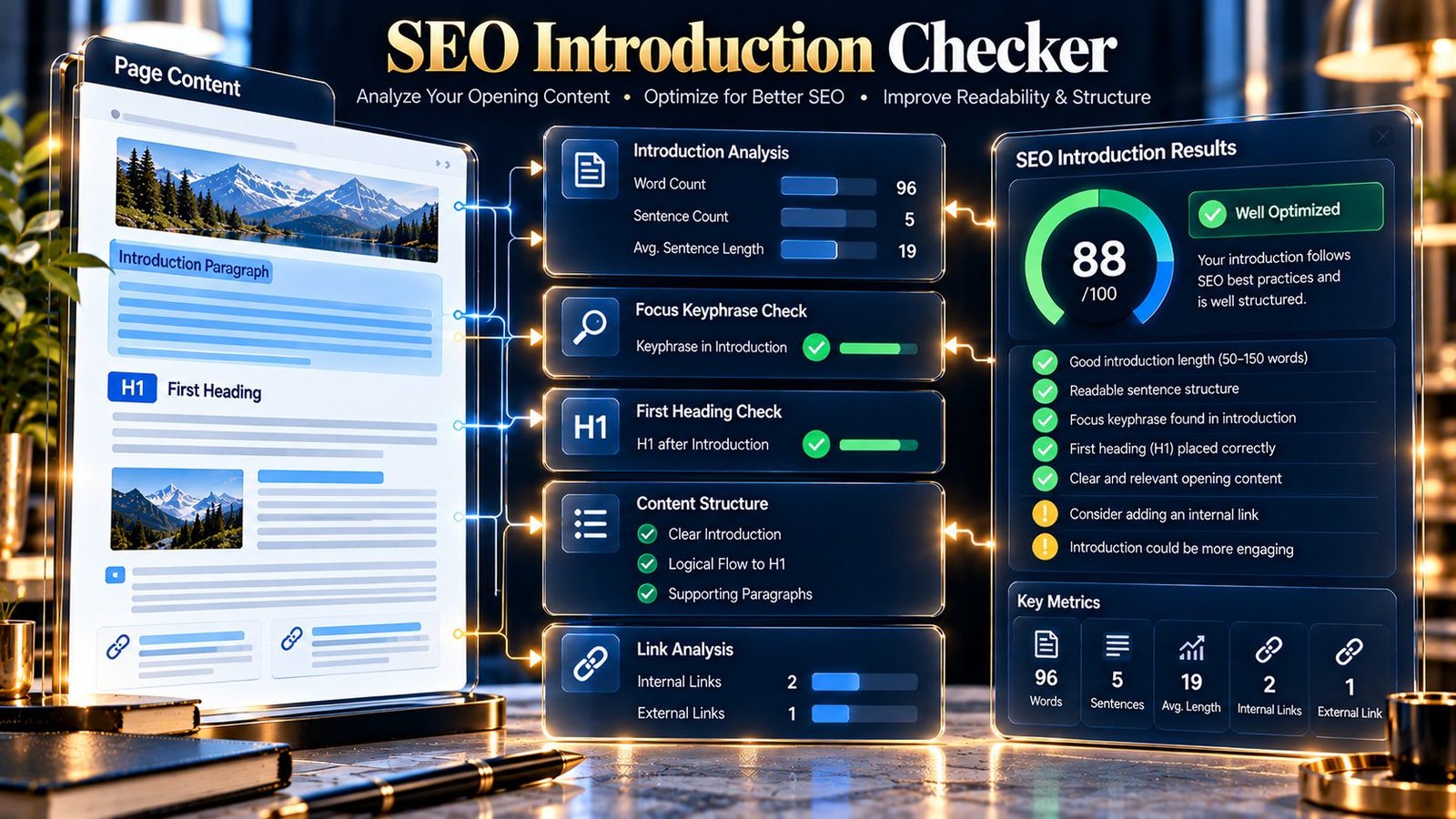
The SEO Introduction Checker is a practical on-page content analysis tool that reviews the opening section of a webpage or supplied HTML/text. It focuses on the introduction itself: its length, sentence structure, opening paragraph, first heading, optional focus keyphrase placement, links, and other measurable signals that can help you review whether the beginning of a page is clear and appropriately structured.
SEO Introduction Checker
Review the opening section of a webpage or draft for length, focus-term placement, clarity signals, headings, and introductory structure.
| Signal | Result | Meaning |
|---|
The score is a PKCapra diagnostic heuristic. It does not reproduce Google's internal ranking systems or determine whether a page will rank.
When a public URL is supplied, the page HTML is fetched by the PKCapra WordPress endpoint for analysis. Pasted content is sent to the same endpoint. Do not submit confidential, personal, or sensitive material.
What Is an SEO Introduction Checker?
An SEO introduction checker analyzes the opening content of a page instead of treating the entire document as one block.
The PKCapra SEO Introduction Checker can analyze either a public URL or pasted HTML/text. It extracts the available introduction content and evaluates several structural and content signals, then produces a score, grade, findings, and supporting metrics.
The tool is designed to help answer practical questions such as:
- How long is the introduction?
- How many sentences does it contain?
- Is the first sentence unusually short or long?
- Does the introduction appear before the first heading?
- How many opening paragraphs are present?
- Is an optional focus keyphrase present in the introduction?
- Is the focus keyphrase present in the first paragraph?
- What is the first heading and what heading level does it use?
- Are there links in the introduction?
- Does the opening contain a question?
- Are there signals that deserve manual review?
The result is a structured diagnostic rather than a claim about how Google internally evaluates a page.
What Does the PKCapra SEO Introduction Checker Check?
The current tool evaluates the following signals when the supplied source provides enough information:
| Check | What it measures |
|---|---|
| Introduction word count | Number of words detected in the opening introduction |
| Introduction sentences | Number of sentences detected in the introduction |
| First sentence length | Word count of the first detected sentence |
| First 150 words | Opening content window used for introductory analysis and keyphrase detection |
| Focus keyphrase in introduction | Whether the optional supplied keyphrase appears in the introduction |
| Focus keyphrase in first paragraph | Whether the optional supplied keyphrase appears in the first opening paragraph |
| First heading | The first detected heading after the opening content |
| Heading level | Whether the first heading is H1, H2, H3, and so on |
| Opening paragraphs | Number of paragraphs detected before the first heading |
| Introduction links | Number of links found in the opening content |
| Opening question | Whether question-style punctuation is detected in the introduction |
| Introduction length | Review of the introduction against the tool’s practical length signals |
| First-sentence length | Review of unusually short or long first sentences |
| Keyphrase placement | Diagnostic signal based on the optional focus keyphrase |
| Heading context | Relationship between the opening content and first detected heading |
These are content-analysis signals implemented by PKCapra. They should be interpreted as practical review indicators rather than as Google’s private ranking criteria.
Why Does the Introduction Matter?
The opening section is often the first substantial part of a page that a reader encounters after the title.
A useful introduction can quickly establish:
- what the page is about;
- what problem the content addresses;
- what the reader can expect;
- why the subject is relevant;
- and where the main content begins.
An introduction that is extremely short may provide little context, while an unnecessarily long opening can delay the information the visitor came to find.
The objective is not to make every introduction conform to one universal word count. The appropriate length depends on the page, search intent, subject, audience, and type of content.
The SEO Introduction Checker therefore provides signals for review rather than declaring that one exact introduction length is universally correct.
How the SEO Introduction Checker Works
1. Provide a source
You can analyze:
- a public webpage URL; or
- pasted HTML/text.
For a URL, PKCapra retrieves the publicly accessible page source and analyzes the available content.
For pasted content, the supplied HTML or text is processed directly.
2. Optionally provide a focus keyphrase
The focus keyphrase is optional.
When supplied, the tool checks whether that phrase appears in the detected introduction and first paragraph. This provides a diagnostic indication of introductory keyphrase placement.
Leaving the focus keyphrase empty allows the tool to perform the structural introduction analysis without this particular signal.
3. Identify the opening content
The analyzer examines the content appearing before the first detected heading and extracts the relevant introductory information.
It also uses the first 150 words as an opening analysis window.
4. Calculate measurable signals
The tool calculates metrics such as:
- introduction word count;
- sentence count;
- first-sentence word count;
- opening paragraph count;
- introduction link count;
- first heading and heading level;
- question detection;
- keyphrase presence;
- and other introduction signals.
5. Produce findings and a score
The tool combines its implemented signals into a score out of 100 and assigns a practical grade.
The output also includes prioritized findings so that you can identify areas requiring closer review rather than relying only on the numerical score.
How to Use the SEO Introduction Checker
- Open the SEO Introduction Checker.
- Enter a public webpage URL or paste HTML/text.
- Optionally enter your focus keyphrase.
- Start the analysis.
- Review the introduction metrics.
- Check the first-sentence and introduction-length signals.
- Review the keyphrase-placement results if a keyphrase was supplied.
- Examine the first heading and opening-paragraph information.
- Read the prioritized findings.
- Make editorial changes where they improve clarity and usefulness.
- Run the analysis again if you want to compare the revised introduction.
Understanding Introduction Length
The tool uses practical review ranges rather than presenting one mandatory SEO length.
An introduction of fewer than 30 words is treated as a short-introduction signal.
An introduction between approximately 30 and 150 words falls within the tool’s practical review range.
An introduction above approximately 150 words is treated as a long-introduction signal.
These thresholds are analysis heuristics implemented by PKCapra. They are not presented as official Google requirements.
Example
Suppose an article begins with only:
SEO is important for websites.
The introduction may be extremely brief and provide little context about what the article will explain.
A more useful opening could establish the subject, explain the problem being addressed, and prepare the reader for the content that follows.
The appropriate wording and length should still depend on the page’s purpose.
Understanding the First Sentence
The tool separately measures the first sentence because an unusually long opening sentence can sometimes make an introduction harder to scan.
The current analysis treats approximately 6–35 words as a practical first-sentence range.
A first sentence above 35 words generates a long-first-sentence signal.
A very short first sentence can also provide a useful review signal, particularly when it does not communicate enough context.
These signals are not grammatical or ranking requirements. They are prompts for editorial review.
Focus Keyphrase Analysis
The focus keyphrase field is optional.
When you supply a keyphrase, the analyzer checks its presence within the detected introduction and first paragraph.
For example, if the focus keyphrase is technical SEO audit, the tool can indicate whether that phrase occurs in the relevant opening content.
This does not mean that placing a keyphrase in an introduction guarantees rankings. It simply gives you a measurable way to inspect the opening copy.
Natural language should take priority over forcing a phrase into an introduction where it does not belong.
First Heading and Introduction Structure
The analyzer also identifies the first heading detected after the opening content and reports its heading level.
This can help you inspect the transition from introduction to the main body.
For example, a page might follow a structure such as:
- WordPress page title as the page’s H1
- introductory paragraphs
- an H2 introducing the first major section
- supporting H3 sections
The tool reports what it detects in the supplied source; it does not automatically determine whether the page’s entire information architecture is appropriate.
For deeper heading analysis, you can also use the SEO Heading Analyzer.
Opening Paragraph Analysis
The tool identifies opening paragraphs before the first heading and reports their count.
This can help reveal introductions that are split into several very small paragraphs or introductions that contain a large amount of opening copy before the first section heading.
The metric should be interpreted alongside the actual writing. Paragraph count by itself does not determine whether an introduction is good or bad.
Opening Questions
The analyzer can detect question-style punctuation in the opening content.
For example:
What is technical SEO, and why does it matter for a growing website?
This signal can help identify introductions that open with a question.
A question is not inherently required. The signal simply describes what appears in the supplied introduction.
Introduction Links
The tool also reports links detected in the introduction.
Links can be useful when an opening section needs to provide immediate access to a relevant definition, supporting resource, or related page.
However, links should be relevant to the reader rather than inserted simply to increase a metric.
For broader internal-link analysis, PKCapra also provides the Internal Links & Crawl Path Analyzer.
How to Interpret the Score
The SEO Introduction Checker produces a score out of 100 and a corresponding practical grade.
The score summarizes the implemented introduction signals. It should be treated as a diagnostic aid rather than a search-engine score.
A high score does not guarantee search visibility.
Likewise, a lower score does not automatically mean that the introduction is poor. A specialized page may intentionally use an introduction that falls outside a general heuristic.
The most useful workflow is to read the individual findings and inspect the actual text before making changes.
Common Introduction Problems
The introduction is too short
A very short opening may fail to establish enough context.
Consider whether the introduction clearly communicates:
- the subject;
- the reader’s problem;
- the purpose of the page;
- and what the following content will cover.
The introduction is too long
A long introduction can delay the primary answer.
Review whether some background material could be moved into later sections while keeping the opening focused.
The first sentence is too long
A very long first sentence may contain several ideas at once.
Consider splitting it into two clearer sentences when doing so improves readability.
The focus keyphrase is absent
If a focus keyphrase was supplied and the tool does not detect it in the introduction, review whether the phrase genuinely belongs there.
Do not insert a keyphrase unnaturally simply to satisfy a diagnostic signal.
Too many opening paragraphs
Several short opening paragraphs can sometimes make the beginning feel fragmented.
Review the actual content and combine paragraphs when they communicate closely related ideas.
The introduction delays the main subject
An introduction can contain technically correct information while still taking too long to reach the page’s main point.
Consider answering the primary reader question earlier and moving secondary background information further down the page.
Practical Introduction Review Workflow
A simple editorial workflow is:
- Define the page’s primary search intent.
- Write a direct opening that establishes the subject.
- Explain the reader’s problem or expected outcome.
- Keep the opening focused on information needed at the beginning.
- Check the first sentence for unnecessary complexity.
- Review the introduction length.
- Check the optional focus keyphrase naturally.
- Confirm that the first major heading follows logically.
- Run the page through the SEO Introduction Checker.
- Review the individual findings rather than relying only on the score.
- Revise where the findings identify a genuine readability or structure issue.
- Recheck the final version.
Example: What to Review
Imagine an article about technical SEO.
A weak opening might immediately contain a long block of background information before explaining what the article will help the reader accomplish.
A stronger editorial approach would make the subject clear early, explain the practical problem, and transition naturally into the first major section.
The checker can then be used to measure the resulting introduction rather than replacing editorial judgment.
Relationship to Other SEO Analysis
Introduction quality is only one part of on-page SEO.
A page can have a well-structured introduction while still having problems elsewhere, such as poor title tags, weak meta descriptions, heading issues, broken links, or problematic indexability signals.
For broader analysis, PKCapra provides tools such as the On-Page SEO Checker, SEO Content Readability Analyzer, Paragraph Optimization Checker, and Content Structure Analyzer.
You can also use the Title Tag Analyzer and Meta Description Analyzer when reviewing the page’s search-result-facing elements.
JSON and PDF Results
After analysis, the tool provides structured results that can be copied as JSON.
The results can also be downloaded as a PDF report directly from the tool interface.
The JSON output is useful when you need the structured analysis data, while the PDF can be useful for keeping or sharing a human-readable report.
Privacy and Processing
The SEO Introduction Checker is designed around the source you provide to the tool.
For URL analysis, the server retrieves the publicly accessible page so that its source can be analyzed.
For pasted analysis, the supplied HTML/text is processed for the requested analysis.
The tool does not claim access to private website data, Google Search Console data, Google Analytics data, or Google’s internal ranking systems.
Do not submit confidential content unless you are comfortable processing that content through the tool’s normal website-analysis workflow.
Important Limitations
The SEO Introduction Checker should be interpreted within the limits of its implementation.
- It analyzes the source content available from the supplied URL or pasted material.
- It does not reproduce Google’s internal ranking systems.
- Its score and grades are heuristic diagnostics.
- Introduction-length thresholds are practical review signals, not universal SEO requirements.
- Focus-keyphrase analysis is optional and does not guarantee rankings.
- Detecting a question does not mean that an introduction should contain a question.
- A high score does not guarantee search performance.
- A lower score does not automatically mean that the writing is poor.
- Dynamic content that is not available in the analyzed source may not be represented.
- The tool should be combined with human editorial review.
Frequently Asked Questions
What is an SEO Introduction Checker?
It is a tool that analyzes the opening section of a webpage or supplied HTML/text and reports measurable signals such as introduction length, sentence structure, keyphrase presence, opening paragraphs, first heading, links, and questions.
Does the SEO Introduction Checker tell me the ideal introduction length?
No. It uses practical heuristic ranges to identify short and long introductions for review. It does not establish a universal ideal length.
Can I analyze a URL?
Yes. The tool accepts a public webpage URL for analysis.
Can I paste HTML instead?
Yes. You can provide pasted HTML/text instead of a public URL.
Do I have to provide a focus keyphrase?
No. The focus keyphrase is optional.
Does the tool check whether my keyphrase is in the introduction?
Yes. When you provide a focus keyphrase, the tool checks its presence in the detected introduction and first paragraph.
Does having the keyphrase in the introduction improve rankings?
The tool does not make that claim. Keyphrase presence is reported as a diagnostic content signal and should not be interpreted as a ranking guarantee.
Does the score represent a Google SEO score?
No. The score is generated from PKCapra’s implemented analysis signals and is not Google’s score.
Does the tool analyze the whole website?
No. This tool focuses on the introduction of the supplied source. It is not a whole-site crawler.
Can I download the results?
Yes. The tool provides JSON copying and a direct PDF download for the analysis results.
What should I do if the score is low?
Review the individual findings first. Look at the actual introduction, sentence structure, opening paragraphs, first heading, and optional keyphrase placement. Then make changes only where they improve the page for its intended readers.
Is a short introduction always bad?
No. Some pages can communicate their purpose effectively with a short introduction. The tool’s short-introduction signal is a prompt for review, not an automatic quality judgment.
Related PKCapra Tools
For broader on-page analysis, you can continue with:
- On-Page SEO Checker
- SEO Content Readability Analyzer
- Paragraph Optimization Checker
- Content Structure Analyzer
- SEO Heading Analyzer
- Title Tag Analyzer
- Meta Description Analyzer
- Internal Links & Crawl Path Analyzer
- All Free Online Tools
The SEO Introduction Checker is most useful when treated as one part of a wider content-review workflow: inspect the opening, understand the findings, improve the writing where appropriate, and then evaluate the page’s other technical and content elements separately.