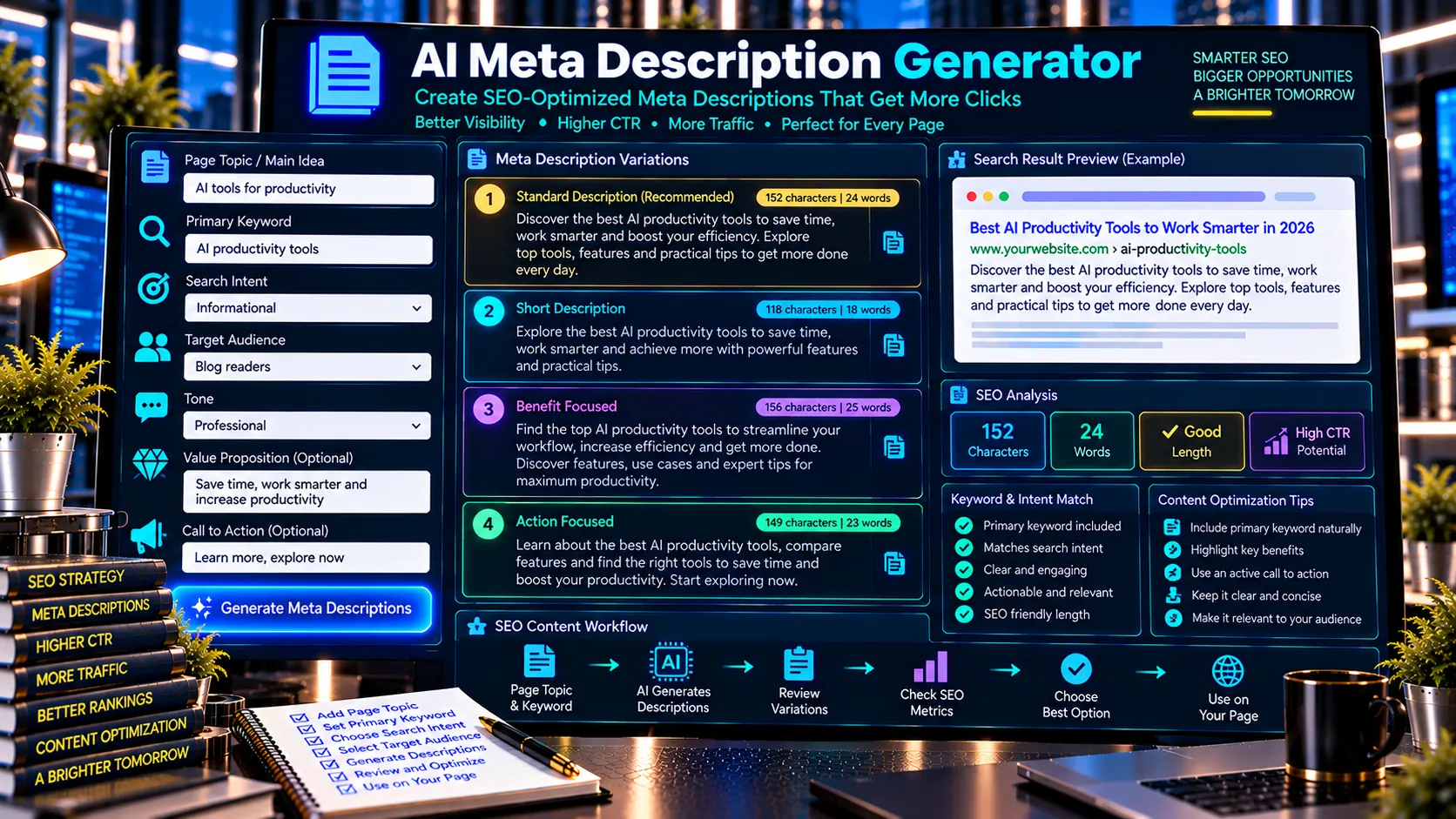
Generate multiple SEO-focused meta description ideas from a page topic, primary keyword, target audience, search intent, tone, value proposition, call to action, and additional context. PKCapra’s AI Meta Description Generator helps create concise description variations that can be reviewed and adapted for search snippets, landing pages, blog posts, product pages, tools, and other web content.
AI Meta Description Generator
Generate SEO meta description ideas from your page topic, primary keyword, search intent, audience, benefits, and supporting context. This browser-based utility uses structured description patterns and does not require an external AI API.
Meta descriptions are search-result snippets, not a guaranteed ranking factor or fixed display length. Review every description for accuracy, relevance, duplication, and search-result presentation before publishing.
What Does an AI Meta Description Generator Do?
An AI meta description generator helps turn a page topic, product, article, or service into a concise search-result description. It can suggest wording, highlight a page’s main benefit, and provide alternative descriptions for editorial review.
A generated description is a draft—not a guarantee that a search engine will display it exactly as written. Search engines may create a different snippet from page content when they consider it more useful for a particular query.
Describe the Page
Give the generator the subject and purpose of the page so the description reflects its actual content.
Review the Draft
Check whether the wording is specific, accurate, readable, and relevant to the intended searcher.
Edit Before Publishing
Remove vague claims, unsupported benefits, repetition, and language that does not match the page.
Why Meta Descriptions Matter
A meta description is a short summary commonly placed in the HTML document’s <head> section using the description meta tag. It gives search engines and readers a concise explanation of what a page covers.
Google may use a page’s meta description to form a search snippet, but it can also select text from the page itself. The displayed snippet can vary according to the search query, device, and available space.
| Element | Purpose | What to Remember |
|---|---|---|
| Meta description | Summarizes the page for potential search visitors. | Write a useful, page-specific description; search engines may rewrite it. |
| Title tag | Provides the page title used in browser tabs and as a possible search title. | Keep it distinct from the description and focused on the page topic. |
| Search snippet | The descriptive text shown beneath a search result title. | It may come from the meta description or relevant on-page text. |
| On-page content | Explains the subject in detail and supports the page’s purpose. | It should agree with the summary rather than contradict it. |
Important: Meta descriptions are not a direct ranking factor in Google’s web search ranking systems. A clear, relevant description can still help a searcher understand the result and decide whether it matches their needs.
How to Use an AI Meta Description Generator
- Identify the page type. Decide whether you are describing a product page, service page, category, article, landing page, or tool.
- Provide the main subject. Include the central topic or product name and the page’s primary purpose.
- Add useful context. Mention a genuine feature, audience, outcome, or differentiator that is actually covered on the page.
- Generate a draft. Use the generator’s available controls to create a description or wording alternatives.
- Check factual accuracy. Confirm that every benefit, feature, price, and claim is supported by the page.
- Improve readability. Remove filler, repeated keywords, awkward phrasing, and unnecessary adjectives.
- Review the final length. Use a length preview as a practical editing aid, not as a strict Google character limit.
- Publish and inspect. Add the final description to the page’s SEO settings or HTML, then review it after publication.
The exact input fields and output options depend on the generator’s implementation. Follow the controls shown in the tool above.
How to Write a Useful Meta Description
Match the Page Intent
Describe what visitors will actually find. A product page, tutorial, and free online tool should not use interchangeable summaries.
Use Natural Language
Write for people first. Include the main topic naturally instead of repeating the same keyword to force relevance.
Make the Value Clear
Explain the practical information, service, or task the page provides without exaggerating its benefits.
Keep It Distinct
Give important pages their own descriptions. Reusing one description across many unrelated URLs makes the summaries less informative.
Avoid Unsupported Promises
Do not claim guaranteed rankings, instant results, complete accuracy, or features that the page does not deliver.
Write a Complete Thought
Use a clear sentence or concise phrase that remains understandable if the snippet is shortened.
Meta Description Example: Before and After
The following example uses a fictional page about a beginner’s guide to indoor herb gardening. It illustrates how a vague description can be made more specific.
Learn more about gardening with our helpful guide. Find information and tips today.
Learn how to grow herbs indoors, choose suitable pots and light, and care for basil, mint, and parsley in a small home garden.
The revised version names the subject, describes the guide’s practical coverage, and avoids a generic call to action. It should still be checked against the actual page before use.
How Long Should a Meta Description Be?
Google does not specify a fixed character limit for meta descriptions. Search snippets are generally truncated to fit the device and result layout, and the visible amount can change.
Many SEO editors use an approximate character range as a writing guideline. Treat that range as a preview target rather than a technical rule or ranking requirement.
| Writing Check | Recommended Approach |
|---|---|
| Length | Keep the summary concise and prioritize its most useful information early. |
| Clarity | Use a straightforward sentence that can be understood without extra context. |
| Keyword use | Include the main topic naturally when it helps explain the page. |
| Call to action | Use a relevant invitation only when it fits the page and does not sound forced. |
| Uniqueness | Write a distinct description for each important page where practical. |
Do not optimize only for a character counter. A concise description that accurately explains the page is more useful than a longer description filled with repeated keywords or promotional language.
Meta Description Mistakes to Avoid
- Duplicate descriptions: Avoid using the same generic summary on multiple pages with different purposes.
- Keyword stuffing: Repeating search terms makes the description unnatural and less helpful.
- Misleading claims: A description should not promise content, services, discounts, or results that are absent from the page.
- Empty promotional language: Phrases such as “best ever” or “number one” add little unless they are substantiated and relevant.
- Missing page context: A summary that could describe any website does not help visitors distinguish the result.
- Ignoring page updates: Revisit the description when the page’s purpose or important content changes.
- Assuming Google will display it unchanged: Search engines may generate a different snippet for a particular query.
Meta Description and the Rest of Your SEO Setup
A meta description works best as part of a consistent page-level SEO process. It should reinforce—not replace—the title, headings, main content, and user experience.
| Page Element | Review Question |
|---|---|
| Title tag | Does the title clearly identify the page’s main topic? |
| Meta description | Does the summary explain why the page is relevant to the searcher? |
| H1 and headings | Do the headings accurately describe the content and its organization? |
| Main content | Does the page deliver the information or functionality promised in the snippet? |
| Internal links | Can visitors and search engines discover related, useful pages? |
| Indexing signals | Are canonical and robots directives appropriate for the page’s intended visibility? |
For a broader review, use the Meta Tags Analyzer to examine page metadata, the Title Tag Analyzer to review title wording, and the SERP Snippet Preview to visualize a possible search-result presentation.
Final Meta Description Review Checklist
- The description accurately summarizes the specific page.
- The main topic is clear without unnatural keyword repetition.
- The wording is distinct from descriptions used on other important pages.
- Any product, service, or benefit mentioned is supported by the page.
- The first part communicates the main value if the snippet is shortened.
- The text reads naturally and is free of spelling or grammar errors.
- The description aligns with the title tag and visible page content.
- The final version has been reviewed after being added to the page.
Continue Your SEO Workflow
Use these related utilities to review other elements that contribute to a clear and consistent search-result presentation.
AI Meta Description Generator FAQs
What is an AI meta description generator?
It is a writing utility that uses AI to suggest short descriptions for webpages. The suggestions should be reviewed and edited to ensure they accurately reflect the page.
Are meta descriptions a Google ranking factor?
Google does not use the meta description as a direct ranking factor for web search. A useful description may help searchers understand a result, while relevance and page quality remain important to the overall search experience.
Does Google always show my meta description?
No. Google may use the supplied description or select relevant text from the page to generate a snippet for a particular search.
What is the ideal meta description length?
There is no fixed character limit specified by Google. Keep the description concise, put important information early, and use preview tools as a practical editing aid.
Should every page have a unique meta description?
For important pages, unique descriptions are generally preferable because they help communicate each page’s distinct content. Avoid copying one generic description across unrelated URLs.
Can AI-generated descriptions be published without editing?
Review them first. AI-generated text can be vague, repetitive, or factually incorrect. Confirm that the description matches the actual page and does not make unsupported claims.
Should I include my target keyword in the description?
Include the main topic naturally when it helps explain the page. Do not repeat keywords unnaturally or treat the description as a place to add a list of search terms.
Can a meta description improve click-through rate?
A relevant and clear description may help a searcher decide whether a result meets their needs. The effect varies by query, audience, search presentation, and competing results; no specific improvement is guaranteed.