
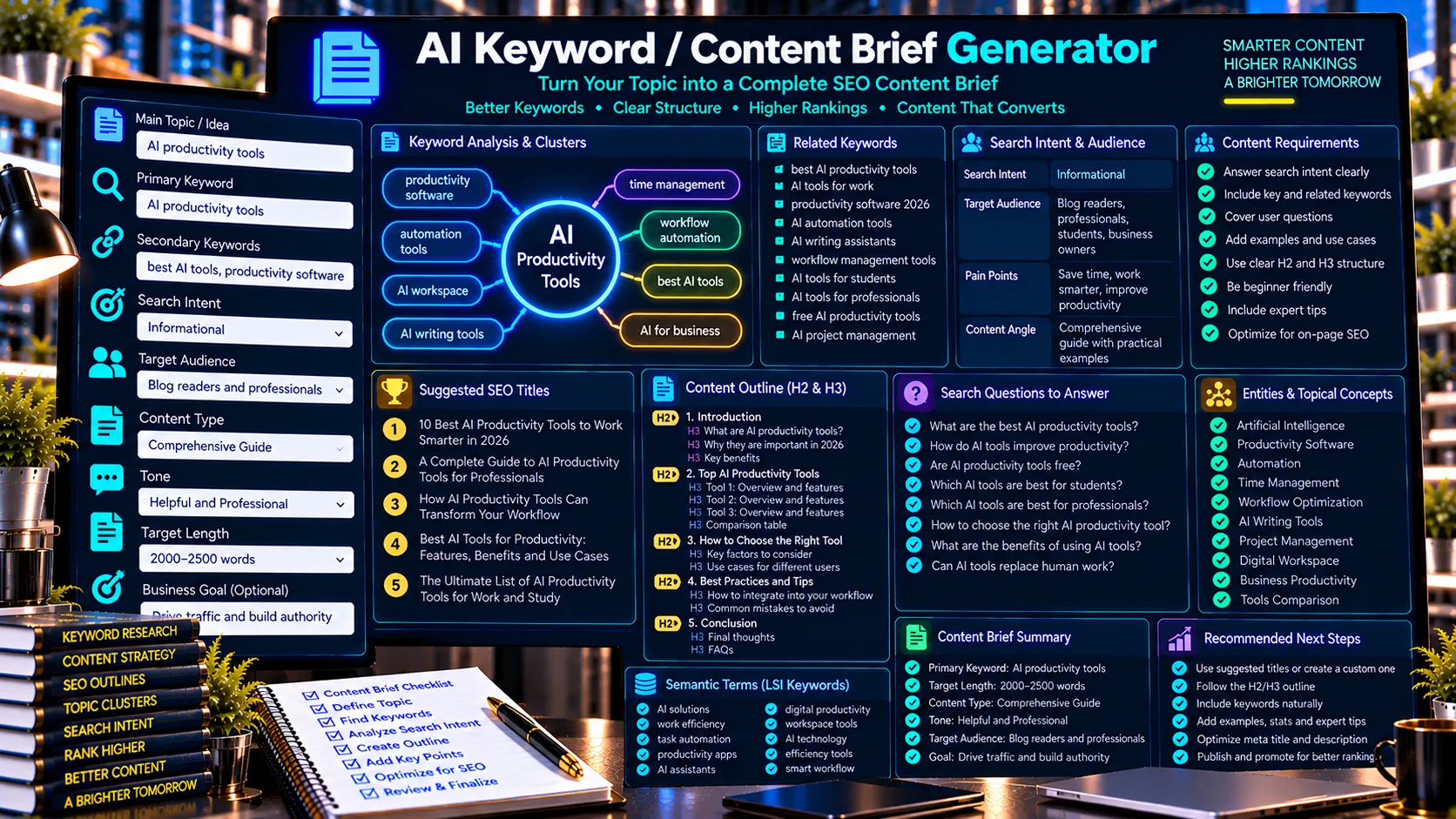
Build a structured SEO content brief from a primary topic or keyword with keyword ideas, related concepts, search intent, audience, content format, suggested titles, headings, questions, entities, content requirements, and business goals. PKCapra’s AI Keyword / Content Brief Generator helps turn an initial topic into a practical starting framework for planning search-focused content.
Content Brief Generator
Build a structured content brief from a topic, primary keyword, audience, intent, content type, tone, target length, business goal, and editorial context. Generation runs locally in the browser and does not call an external AI API.
JSON report
Planning signals are generated locally from deterministic patterns. This tool does not fetch live search volume, keyword difficulty, SERP, competitor, traffic, or ranking data.
Build a Structured Content Brief
A good content brief brings the main content requirements together before writing begins. PKCapra lets you provide a topic or primary keyword and build a structured brief around it.
The generated brief can include:
- Primary keyword
- Secondary keyword ideas
- Related and semantic terms
- Search intent
- Target audience
- Content type
- Recommended tone
- Target content length
- Suggested SEO titles
- H2/H3 content outline
- Search-question ideas
- Entities and topical concepts
- Content requirements
- Main benefit or business goal
- Additional content angles
This gives writers and content teams a structured starting point rather than beginning with an empty document.
Generate Keyword Ideas
Enter your main topic or primary keyword to generate supporting keyword ideas.
The tool can organize keyword suggestions into areas such as:
- Secondary keywords
- Related terms
- Semantic concepts
- Question-based topics
- Supporting entities
These suggestions can help expand a page beyond a single keyword and provide additional topical directions to consider.
Define Search Intent
Select the intended search behavior for the content:
- Informational
- Commercial
- Transactional
- Navigational
- Local
Understanding the intended purpose of a page helps shape its structure, messaging, and content angle.
Define Your Target Audience
Specify who the content is intended for.
For example:
- Beginners
- Professionals
- Business owners
- Developers
- Marketers
- Students
- Customers
- Researchers
A defined audience helps make the generated brief more specific and useful for the intended reader.
Choose the Content Type
The content brief can be adapted to different content formats, allowing you to plan content according to the type of page or resource you want to create.
You can also specify the preferred tone and target content length.
Generate an SEO-Friendly Content Outline
The generator can produce a structured outline with suggested H2 and H3 sections.
This can help organize:
- Main topics
- Supporting subtopics
- Questions users may have
- Related concepts
- Important content areas
- Supporting explanations
The outline is a planning framework and should be reviewed and adapted to the actual subject before publication.
Find Search Questions to Address
Question-based ideas can help identify information that readers may expect a page to answer.
These can be useful when developing:
- FAQ sections
- How-to content
- Educational articles
- Product guides
- Comparison pages
- Informational resources
The questions should be checked against the actual topic and intended audience before being incorporated into the final content.
Identify Entities and Topical Concepts
The generator can suggest entities and concepts associated with the subject.
These can help writers understand the broader topical context around a page and identify subjects that may deserve explanation or coverage.
Suggestions are generated from the tool’s structured browser-side patterns and should not be treated as a live entity database or authoritative search-engine knowledge graph.
Add Business Goals and Content Requirements
You can provide the main benefit, business objective, required angle, or additional context you want the content to address.
For example, a brief can be shaped around:
- Generating leads
- Educating users
- Promoting a product
- Explaining a technical topic
- Supporting a service page
- Answering customer questions
- Building topical coverage
This makes the resulting brief more closely aligned with the purpose of the page.
Review the Brief Before Writing
A generated content brief is a planning aid rather than a guarantee of search performance.
Before using it for publication, review the recommendations for:
- Keyword relevance
- Search intent
- Audience fit
- Topic accuracy
- Content requirements
- Business objectives
- Factual accuracy
- Appropriate headings
- Actual user needs
Keyword suggestions should also be validated with appropriate SEO or search-data tools when current search volume, competition, trends, or SERP information is required.
Browser-Based Content Brief Generation
PKCapra’s AI Keyword / Content Brief Generator uses browser-side structured generation patterns and does not require an external AI API for its generation process.
It does not claim to provide live keyword search volume, keyword difficulty, real-time SERP results, competitor analysis, or proprietary search-engine data.
Copy and Download Your Content Brief
After generating a brief, you can copy the complete output for use in your writing workflow. The tool also provides structured JSON output for downloading and further processing.
This can be useful for writers, SEO professionals, publishers, marketers, agencies, and content teams that need repeatable content-planning workflows.
Frequently Asked Questions
What is an AI Keyword / Content Brief Generator?
It is a planning tool that creates a structured content brief from a topic or primary keyword, including keyword ideas, related concepts, search intent, audience, titles, headings, questions, entities, and content requirements.
Can it generate secondary keywords?
Yes. The generator can produce secondary keyword ideas along with related and semantic terms.
Can I choose search intent?
Yes. You can select informational, commercial, transactional, navigational, or local intent.
Can it create an H2 and H3 outline?
Yes. The generated brief includes a structured content outline with suggested H2 and H3 sections.
Does it provide live keyword search volume?
No. PKCapra’s implementation does not provide live search-volume, keyword-difficulty, SERP, or competitor data.
Can I use the generated brief for an SEO article?
Yes. The brief can be used as a starting framework for planning an SEO-focused article or other content. It should be reviewed and refined before writing and publishing.
Does the tool use an external AI API?
No. The current implementation uses browser-side structured generation patterns and does not require an external AI API.