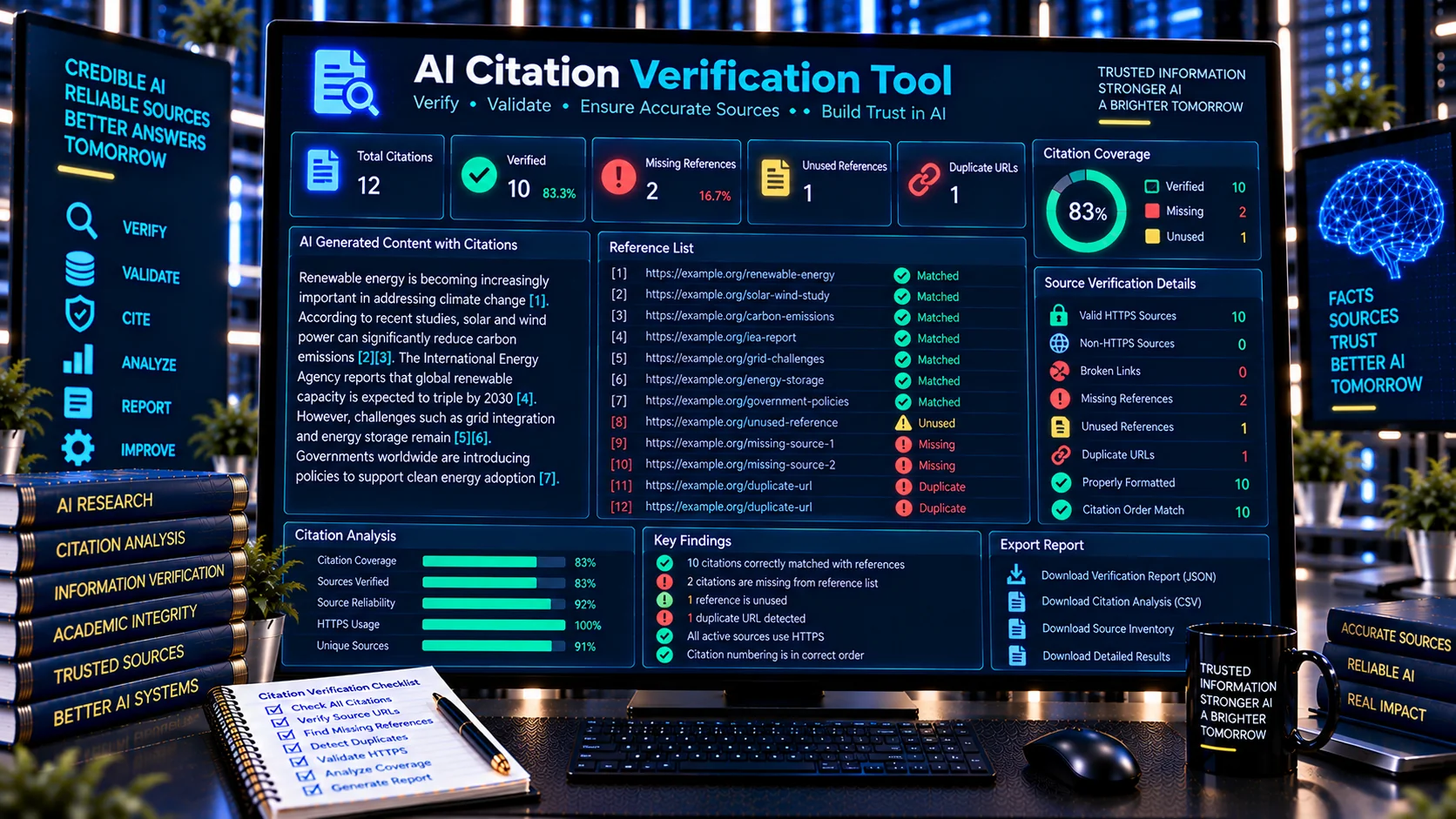
AI-generated answers often contain citations, references, and source links, but citation quality involves more than simply adding a URL to a response. A citation can be missing, duplicated, incorrectly mapped, unused, or attached to a reference that does not correspond to the expected citation marker.
The AI Citation Verification Tool helps inspect citation structure and reference integrity in AI-generated text. It can identify citation markers, extract URLs, check reference matching, detect missing or unused references, find duplicate source URLs, and report citation coverage.
The tool runs in the browser and does not require an external AI API or upload the source content to a remote AI service.
AI Citation Verification Tool
Check AI-generated citations for URL validity, citation-number consistency, duplicate sources, missing references, unsupported citation markers, and citation coverage signals without sending your text to an external AI service.
Citation Findings
Source Inventory
Verification Report
What Does an AI Citation Verification Tool Do?
An AI citation verification tool helps you examine whether a reference, source URL, or cited statement can be traced to supporting evidence. It is useful for reviewing citations found in AI-generated answers, research notes, articles, and other content before relying on them.
Important: Finding a real URL does not automatically prove that the source supports the claim. Verification requires checking the source content, context, and accuracy of the cited information.
Why AI Citation Verification Matters
AI-generated answers can include references that look credible but may be incomplete, irrelevant, outdated, or incorrectly connected to a statement. A citation should help readers locate the evidence behind a claim—not simply make the answer appear authoritative.
Checking citations is especially useful when an answer includes statistics, technical explanations, product details, legal or policy information, research findings, or claims that may change over time.
Source authenticity
Confirm that the referenced page or publication exists and can be identified.
Claim-to-source match
Read the cited material to determine whether it actually supports the statement.
Context and currency
Check dates, qualifications, definitions, and whether the information remains relevant.
What Should You Check in an AI Citation?
A useful citation review considers more than whether a link opens. Use the following criteria when examining a source and the claim attached to it.
| Verification point | What to examine | Why it matters |
|---|---|---|
| Source identity | Publisher, author, organization, or original document | Helps establish where the information came from. |
| URL and access | Correct destination, redirects, availability, and page relevance | A valid link should lead to the intended reference. |
| Evidence match | Whether the source directly supports the cited sentence | Prevents unrelated references from being used as proof. |
| Context | Surrounding paragraphs, definitions, limitations, and scope | A quotation or finding can be misleading when taken out of context. |
| Publication date | Published or updated date, where available | Helps assess relevance for time-sensitive information. |
| Source quality | Primary evidence, methodology, editorial standards, and transparency | Supports a more informed judgment about reliability. |
Verification is not the same as endorsement. A source may be genuine and accessible while still being inaccurate, biased, incomplete, or unsuitable for a particular claim.
How to Verify an AI Citation
Use the available input fields and instructions on the tool above. The precise inputs and result labels depend on the tool’s current implementation. For a thorough manual review, follow these steps:
- Identify the claim. Copy the exact sentence or factual statement that needs checking.
- Locate its citation. Record the source title, URL, reference, or other citation information provided.
- Open the original source. Prefer the original research, official documentation, publication, or primary record when available.
- Find the supporting passage. Search within the source for the relevant phrase, figure, or concept.
- Compare meaning and context. Check whether the source supports the complete claim, including its dates, scope, and qualifications.
- Record the outcome. Note whether the citation is supported, partially supported, unsupported, inaccessible, or requires further review.
Practical tip: Verify important claims individually. One reliable citation does not automatically validate every sentence in an AI-generated response.
Example: Checking a Citation Against a Claim
Claim being reviewed
“A particular web standard requires every website to use a specific implementation.”
Source review
The cited documentation describes the standard but states that the implementation is optional or applies only in certain circumstances.
Verification conclusion
The source may be authentic, but it does not fully support the claim as written. The claim should be corrected to reflect the source’s actual scope and wording.
This example is hypothetical. It demonstrates the difference between a genuine citation and a citation that accurately supports the statement.
How to Interpret Citation Verification Results
Verification labels can vary between tools. Use the tool’s own definitions where provided, and treat automated findings as a starting point for review rather than a substitute for reading the source.
| Possible finding | Meaning | Recommended next step |
|---|---|---|
| Supported | The reviewed source appears to substantiate the claim. | Check context and retain the reference. |
| Partially supported | The source supports only part of the statement or includes qualifications. | Rewrite the claim more precisely. |
| Unsupported | The source does not provide clear evidence for the claim. | Find a better source or remove the claim. |
| Inaccessible | The reference could not be reviewed at that time. | Try the publisher’s page, an official copy, or another credible source. |
| Needs review | The evidence or source context is ambiguous. | Review manually before publishing or relying on it. |
These are general review categories, not a claim about the exact output labels displayed by the PKCapra tool.
Common AI Citation Problems
Watch for these issues when reviewing citations in AI answers or written content:
- Fabricated or malformed references: The citation details do not correspond to a real source.
- Correct source, incorrect claim: The page exists but does not support the statement attached to it.
- Misleading quotation: A passage is quoted without its important surrounding context.
- Secondary source presented as primary: A summary is treated as though it were the original research or official record.
- Outdated evidence: An old page is used for a current policy, price, statistic, or technical specification.
- Overstated conclusion: A limited finding is described as universal or definitive.
- Broken or redirected link: The reference no longer leads to the intended evidence.
Best Practices for Reliable AI Citations
Prefer primary sources when possible
For technical standards, research findings, regulations, and product specifications, look for the original documentation or record. Secondary sources can provide useful explanations, but they should not be confused with primary evidence.
Keep claims proportional to the evidence
A source that supports a narrow statement should not be used to justify a broader conclusion. Preserve important conditions, limitations, and uncertainty when summarizing the evidence.
Check changing information again
Prices, software features, guidelines, laws, and statistics may change. Review the source’s date and verify current information before using it in a decision or publication.
Maintain a clear evidence trail
For important research, record the claim, source URL, relevant passage, date checked, and verification notes. This makes later review and correction easier.
Use AI as an assistant, not the final authority
AI tools can help organize references and identify claims to investigate. The source itself remains the place to confirm what was published and what it actually says.
Explore More AI Citation and Visibility Tools
Use these related tools to examine different parts of AI search visibility and citation quality. Each tool addresses a distinct task; results from one should not be treated as a substitute for another.
AI Citation Verification FAQs
What is AI citation verification?
AI citation verification is the process of checking whether a reference is genuine, accessible, relevant, and accurately supports the claim associated with it.
Can an AI-generated citation be real but still be wrong?
Yes. A real source can be linked to an unsupported or misleading statement. Always compare the claim with the source’s actual content and context.
Does a working citation URL prove that a claim is accurate?
No. A working URL confirms only that a destination can be reached. It does not establish that the source is reliable or that it supports the claim.
What is the difference between citation verification and source validation?
Source validation focuses on examining the source itself, such as its identity, relevance, and credibility. Citation verification also checks the relationship between that source and the specific claim being cited.
Should I verify every citation in an AI answer?
For high-impact, technical, factual, or time-sensitive content, verify each important claim and its supporting reference. For lower-risk content, prioritize statements that materially affect the answer.
Can citation verification guarantee that AI content is accurate?
No. Citation checks can improve evidence review, but they cannot guarantee the accuracy of an entire response. Claims may also rely on reasoning, interpretation, or information not covered by the cited source.
What should I do when a citation cannot be accessed?
Try the publisher’s official page, search for the document title, or locate an authoritative copy. If the evidence still cannot be reviewed, mark the claim as unverified rather than assuming the citation is correct.
Is AI citation verification useful for SEO and GEO?
It can support content quality and evidence practices used in SEO and generative engine optimization. However, verifying citations does not guarantee that a page will rank in search results or be cited by an AI system.