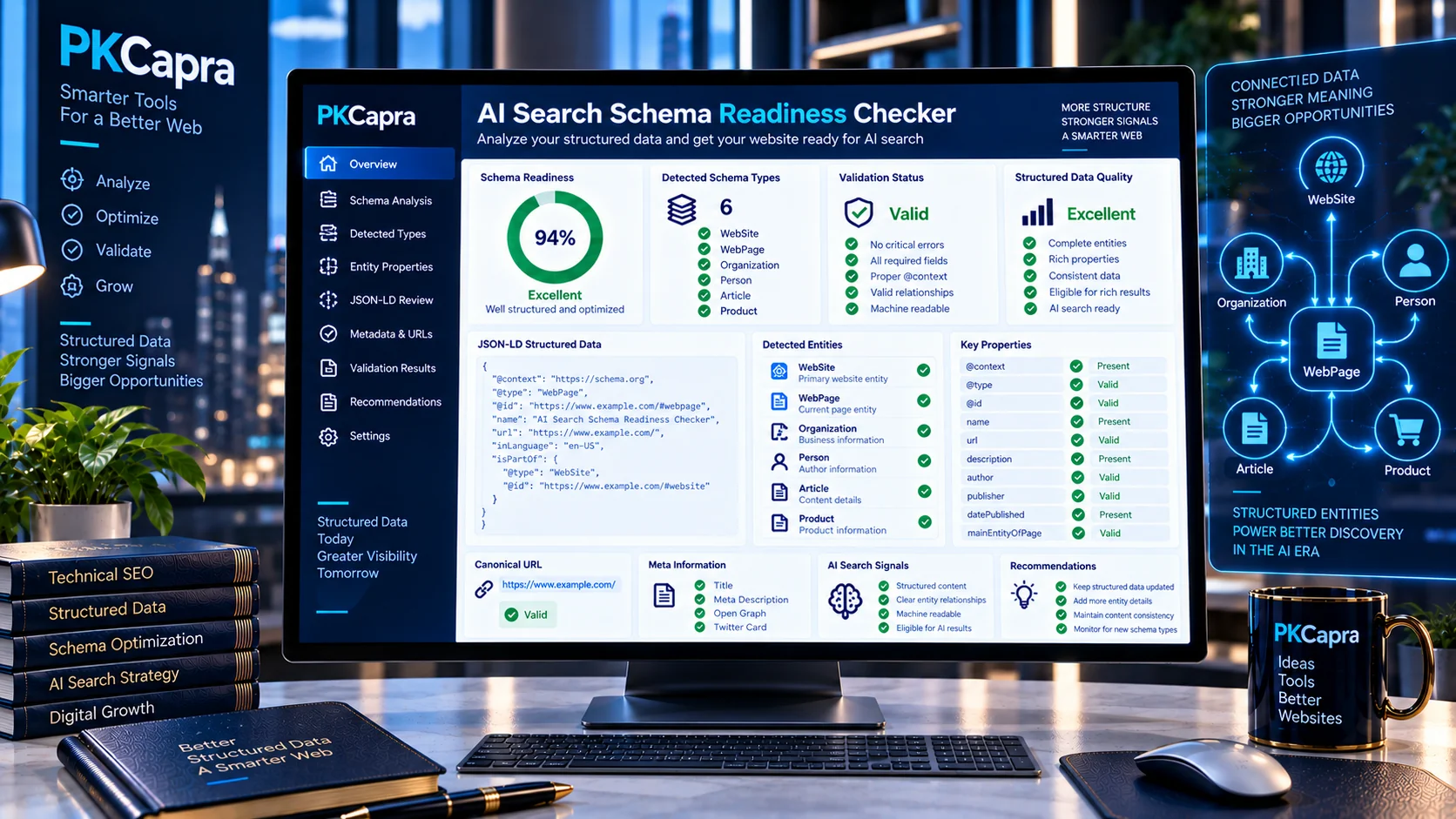
Analyze Your Website’s AI Search Schema Readiness
The AI Search Schema Readiness Checker helps you evaluate whether a webpage presents clear, consistent, and machine-readable structured data and page signals.
Analyze a public webpage to review JSON-LD validity, schema types, important properties, entity relationships, canonical information, page metadata, and other signals that can help machines interpret webpage content.
AI Search Schema Readiness Checker
Analyze whether a webpage clearly identifies its main structured data, schema types, properties, and page signals using visible content, metadata, links, and structured data.
What Is AI Search Schema Readiness?
AI Search Schema Readiness refers to how clearly and consistently a website uses structured data to describe its pages, organization, content and relevant entities. Well-organized schema can help search systems interpret the information published on a website.
The AI Search Schema Readiness Checker is designed to help you review schema-related readiness signals and identify areas that may need attention before relying on structured data as part of your search visibility strategy.
Why Schema Readiness Matters for AI Search
Search systems need to interpret the meaning and relationships of website content. Structured data provides machine-readable context that can support this understanding when it accurately reflects visible page information.
Clearer Content Meaning
Schema can identify whether a page represents an article, product, organization, webpage, software application or another supported entity type.
Consistent Entity Information
Accurate names, descriptions, identifiers and relationships help maintain consistency between structured data and the information presented to visitors.
Better Technical Organization
A coherent schema implementation makes it easier to maintain page-level markup, avoid duplication and review structured data as a part of technical SEO.
What Should a Schema Readiness Review Consider?
A useful review goes beyond checking whether a JSON-LD block exists. It considers whether the markup is appropriate, accurate, consistent and technically understandable.
Relevant Schema Types
Choose schema types that accurately describe the page and its primary purpose. Avoid adding unrelated types simply to increase the amount of markup.
Accurate Properties
Use properties that are supported by the selected vocabulary and provide values that genuinely describe the page, entity or organization.
Visible Content Alignment
Structured data should represent information users can reasonably find on the page. Do not mark up misleading, hidden or unrelated content.
Entity Relationships
Where appropriate, connect related entities using stable identifiers and references instead of describing the same entity inconsistently across pages.
Technical Validity
Check syntax, required properties for the intended use, nesting, data types and duplicate or conflicting markup.
Page-Level Suitability
Apply markup according to the actual page content. A product page, article, homepage and software tool page may need different structured data.
How to Review Your Website’s Schema Readiness
Use a structured review process to understand your current implementation and decide which improvements deserve priority.
Identify the Page Purpose
Determine whether the page is an article, product, organization page, software tool, service page or another content type.
Review Existing Markup
Locate the structured data currently used on the page and identify its vocabulary, format and declared entities.
Check Accuracy and Consistency
Compare schema values with visible page content, site identity and other relevant information.
Validate the Implementation
Use appropriate structured-data testing tools to investigate syntax and eligibility-related issues.
Correct the Highest-Impact Issues
Prioritize incorrect entity information, invalid markup, unsuitable schema types and inconsistencies.
Recheck After Changes
Review the updated page and confirm that the structured data remains consistent with its content.
Common Schema Types for Website Pages
Schema.org provides a vocabulary for describing entities and relationships. The correct type depends on what a page actually represents—not simply on which type appears most frequently in SEO examples.
| Schema Type | Typical Purpose | Practical Consideration |
|---|---|---|
| WebPage | Describes an individual webpage. | Use page-specific information and a suitable relationship to the website. |
| WebSite | Describes the website as a whole. | Keep the site name and canonical identity consistent. |
| Organization | Describes a business, company or other organization. | Use accurate identity and contact-related properties where applicable. |
| Article | Describes editorial content such as an article or blog post. | Ensure headline, author and publication information reflect the actual article. |
| SoftwareApplication | Describes a software application. | Use only properties that accurately apply to the software or online tool. |
| Product | Describes a product offered or represented on a page. | Do not add product or offer information that does not exist. |
| BreadcrumbList | Describes a page’s position within a website hierarchy. | Keep breadcrumb names and URLs aligned with the actual navigation structure. |
JSON-LD, Microdata and RDFa
Structured data can be implemented in different formats. The best choice depends on your website’s architecture, publishing workflow and maintenance requirements.
| Format | How It Works | Maintenance Consideration |
|---|---|---|
| JSON-LD | Structured data is expressed in a JSON-based script block. | Often convenient to manage separately from visible HTML markup. |
| Microdata | Properties are added through attributes within HTML elements. | Markup is closely connected to the page’s HTML structure. |
| RDFa | Semantic information is expressed through attributes in HTML. | Requires careful coordination between attributes and page content. |
JSON-LD is widely used for modern structured-data implementations, but choosing JSON-LD alone does not make a page schema-ready. The content, properties, entity relationships and technical implementation still need to be accurate.
Common Schema Readiness Problems
These issues can reduce the reliability or usefulness of a structured-data implementation. Review them before adding more markup to a page.
Incorrect Schema Type
Selecting a type that does not represent the page’s real purpose can create confusing or misleading markup.
Unsupported or Invalid Values
Properties with incorrect data types, invalid values or unsuitable nesting can cause validation problems.
Content Mismatch
Marking up information that is absent, inaccurate or inconsistent with visible content undermines trust.
Duplicate or Conflicting Entities
Multiple plugins or templates may output overlapping schema with inconsistent names, identifiers or properties.
Unnecessary Markup
Adding many schema types without a clear purpose increases maintenance work and can obscure the page’s primary meaning.
Validation Without Review
Passing a syntax test does not confirm that every property is accurate, useful or eligible for a specific search feature.
Schema Readiness Checklist
Before considering a page’s structured data ready, review these practical implementation points.
Related PKCapra SEO & AI Search Tools
Schema is one part of a wider website-readiness process. Use these related tools to examine other technical and content signals that may influence how search systems access and interpret your pages.
AI Search Schema Readiness FAQs
Clear answers to common questions about structured data, schema validation and AI search readiness.
What is an AI Search Schema Readiness Checker?
It is a tool intended to help review schema-related readiness signals for websites. Structured data can describe page types, organizations, content and other entities in a machine-readable format.
Does schema markup guarantee AI search citations?
No. Schema markup does not guarantee that a website will be cited, recommended or included in an AI-generated answer. AI search systems consider multiple signals, and their selection processes can change.
Is valid schema the same as AI search readiness?
No. Valid syntax is an important technical requirement, but readiness also involves appropriate schema types, accurate properties, consistent entities and alignment with the actual page content.
Which schema format should I use?
JSON-LD is a commonly used format for structured data. Microdata and RDFa are also supported formats in the broader structured-data ecosystem. Choose a format that your website can implement and maintain accurately.
Can I add multiple schema types to one page?
Yes, when the types accurately describe the page and its related entities. Multiple types should have a clear purpose and should not create duplicate or contradictory information.
Does Google use every Schema.org type for rich results?
No. Schema.org defines a broad vocabulary, while Google supports specific structured-data features with their own eligibility and implementation requirements. A valid type is not automatically eligible for a Google rich result.
How often should I review my website’s schema?
Review structured data when page templates, content, site identity or relevant technical implementations change. Periodic checks can also help identify issues introduced by plugins or website updates.
Should every page have structured data?
Structured data should be used where it provides accurate and meaningful context. Not every page needs extensive markup, and adding irrelevant schema does not improve a page’s quality.
Make Your Structured Data Clear, Accurate and Maintainable
A dependable schema implementation starts with the right page type, accurate information and a clear relationship between structured data and visible content. Review your markup carefully, correct meaningful issues and keep it aligned with your website as it evolves.
Use the AI Search Schema Readiness Checker as part of your broader technical review—not as a promise of rankings, indexing or AI search citations.