
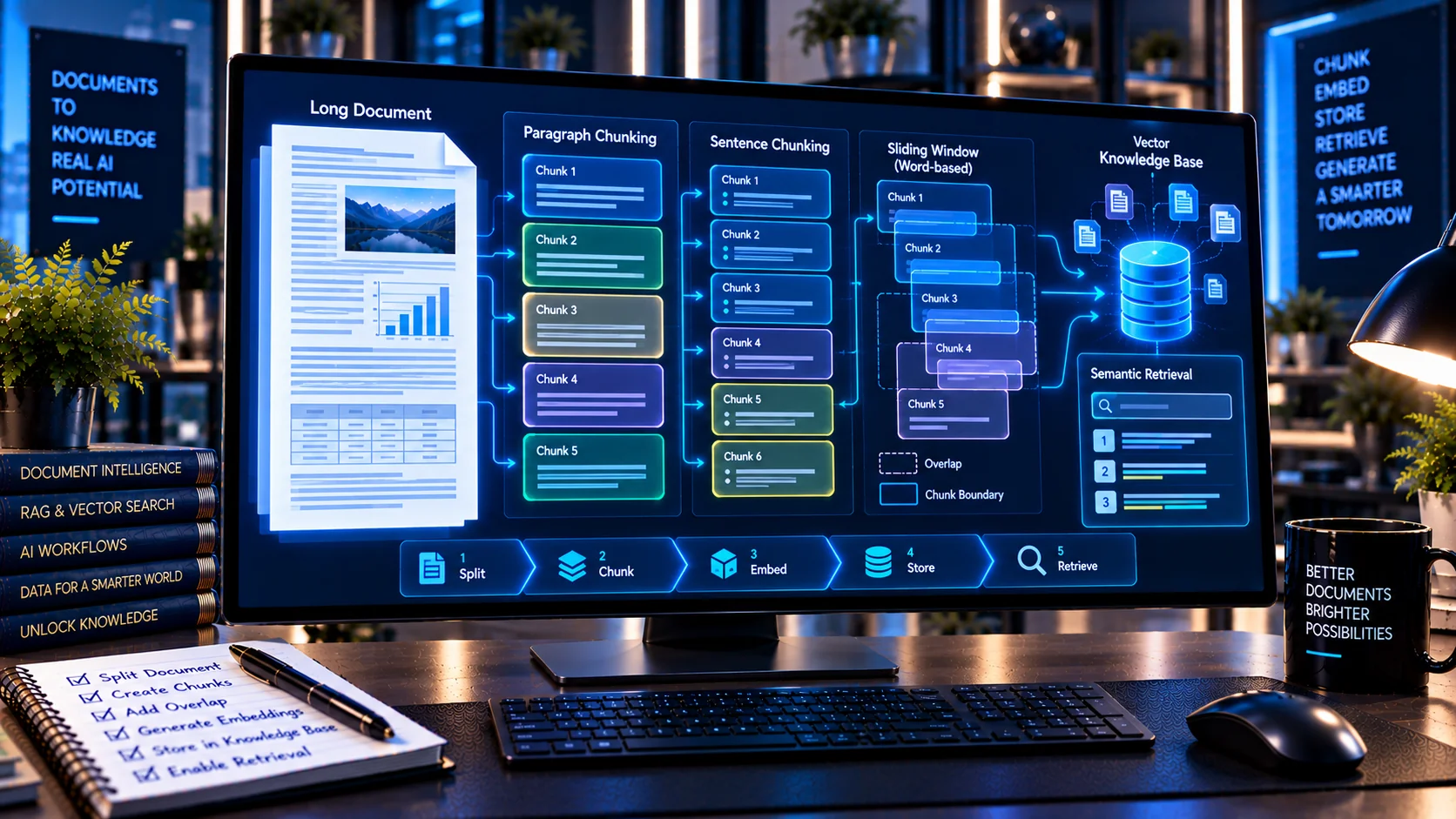
Chunking is one of the most important preparation steps in a Retrieval-Augmented Generation (RAG) workflow because documents are usually divided into smaller pieces before they are indexed and retrieved. PKCapra’s RAG Chunking Analyzer lets you preview different chunking approaches, adjust chunk size and overlap, compare chunk statistics, and identify chunks that may be unusually small or large before using the content in a RAG pipeline.
What Is a RAG Chunking Analyzer?
A RAG Chunking Analyzer is a document-preparation tool that helps you understand how source text behaves when divided into retrieval chunks.
PKCapra’s analyzer supports several practical approaches, including:
- Paragraph-based chunking
- Sentence-based chunking
- Fixed word-window chunking
- Custom chunk size
- Chunk overlap
- Chunk previews
- Chunk-size statistics
- Undersized chunk detection
- Oversized chunk detection
Instead of applying one chunking configuration blindly, you can inspect the resulting chunks and compare their characteristics.
Why Chunking Matters in RAG
RAG systems generally retrieve portions of source material rather than supplying an entire document to the language model every time.
The way a document is divided can therefore affect how much context is available inside each retrieved unit.
If chunks are extremely small, important context may be separated.
If chunks are extremely large, individual chunks may contain several unrelated ideas.
Chunking analysis helps you inspect these trade-offs before ingestion.
Choose a Chunking Strategy
Different documents can benefit from different structural approaches.
Paragraph-Based Chunking
Paragraph-based chunking keeps paragraph boundaries as the primary unit.
This approach can be useful for documents where paragraphs already represent reasonably complete ideas.
Examples include:
- Articles
- Reports
- Business documentation
- Guides
- Policies
The analyzer shows how many chunks result and provides statistics about their sizes.
Sentence-Based Chunking
Sentence-based chunking uses sentence boundaries to divide content.
This can provide smaller units than paragraph-based chunking and may be useful when individual sentences contain relatively self-contained information.
However, very small sentence chunks can sometimes lose surrounding context, so reviewing the resulting chunks is important.
Fixed Word-Window Chunking
Fixed word-window chunking divides text according to a selected word-based size.
This provides more direct control over chunk length and can be useful when you want predictable chunk sizing.
The analyzer allows you to adjust the chunk-size setting and inspect the resulting output.
Set a Custom Chunk Size
Chunk size determines approximately how much content is placed into each generated chunk.
You can adjust the chunk-size setting and immediately inspect how the document is divided.
A larger setting generally produces fewer, larger chunks, while a smaller setting generally produces more, smaller chunks.
There is no single chunk size that is universally correct for every RAG system.
The appropriate configuration depends on the source material, retrieval system, embedding process, and application requirements.
Use Chunk Overlap
Chunk overlap allows neighboring chunks to share some content.
This can help preserve context around boundaries when an important sentence or concept falls close to the end of one chunk.
For example:
Chunk 1: A B C D E F
Chunk 2: E F G H I J
Here, E F represents overlapping content.
The analyzer allows you to adjust overlap and inspect how that setting changes the resulting chunks.
Preview Individual Chunks
Chunk statistics alone do not show everything.
Two configurations can produce similar average chunk sizes while creating very different content boundaries.
The chunk preview lets you inspect individual generated chunks and see how the source text has actually been divided.
This makes it easier to identify:
- Broken context
- Incomplete sections
- Extremely short chunks
- Overly broad chunks
- Awkward boundaries
- Repeated overlap
Compare Chunk Counts
Changing the chunking configuration can significantly change the number of chunks produced from the same document.
The analyzer calculates the resulting chunk count so you can compare different approaches.
For example, reducing the chunk size may increase the number of chunks, while increasing the chunk size may reduce them.
This matters because chunk count can influence:
- Index size
- Processing requirements
- Embedding volume
- Retrieval behavior
- Storage requirements
Average Chunk Size
The analyzer calculates average chunk size across the generated chunks.
Average size provides a useful high-level measurement, but it should not be considered sufficient by itself.
Two documents can have the same average chunk size while one contains highly consistent chunks and the other contains a mixture of very small and very large chunks.
For that reason, PKCapra also provides minimum and maximum chunk measurements and identifies unusual chunk sizes.
Identify Undersized Chunks
Very small chunks may contain insufficient context to represent a meaningful retrieval unit.
Examples might include:
- Isolated headings
- Short fragments
- Single sentences
- Broken extraction segments
The analyzer identifies undersized chunks according to the selected analysis thresholds.
These findings can help you determine whether a particular chunking configuration creates excessive fragmentation.
Identify Oversized Chunks
Oversized chunks can contain multiple topics or more information than necessary for a focused retrieval result.
The analyzer identifies unusually large chunks so they can be reviewed.
An oversized chunk is not automatically incorrect. Some documents naturally contain long, coherent sections.
The purpose of the finding is to highlight areas where the selected chunking configuration may need adjustment.
Chunk-Size Score
The analyzer provides a chunk-size assessment based on the resulting chunk distribution.
The score is intended as a diagnostic signal rather than a universal measure of RAG quality.
A high score does not guarantee better retrieval, and a lower score does not mean the chunks are unusable.
The actual chunk previews and statistics should be considered alongside the score.
Compare Different Configurations
A useful way to use the analyzer is to test several configurations against the same document.
For example:
Configuration A
- Paragraph-based
- Low overlap
Configuration B
- Sentence-based
- Moderate overlap
Configuration C
- Fixed word window
- Custom chunk size
- Moderate overlap
You can then compare:
- Number of chunks
- Minimum size
- Maximum size
- Average size
- Undersized chunks
- Oversized chunks
- Actual chunk boundaries
This provides a more practical basis for configuring a RAG ingestion workflow.
Chunking After Document Readiness Analysis
Chunking is normally more useful after the source document has been reviewed for structural problems.
A practical workflow is:
Document Safety → Structure → RAG Readiness → Chunking → Indexing
PKCapra’s RAG Document Readiness Checker can help identify duplication, noisy text, paragraph issues, headings, sections, lists, and tables before chunking.
The Document Structure Analyzer for AI can provide another view of headings, sections, lists, tables, and document hierarchy.
RAG Chunking for Knowledge Bases
Chunking is commonly used when preparing documents for:
- AI knowledge bases
- Customer-support systems
- Internal company assistants
- Technical documentation
- Product documentation
- Research repositories
- Enterprise search
- RAG applications
The appropriate chunking method depends on how the target system retrieves and uses information.
The analyzer helps you inspect the source material before committing to a particular configuration.
Browser-Based Chunking Analysis
PKCapra’s RAG Chunking Analyzer is designed for browser-based analysis.
The chunking calculations and previews do not require an external AI API.
This allows you to test different configurations without first sending the document to an external AI service.
Important Limitations
Chunk size alone does not determine RAG performance.
Real-world retrieval quality can also depend on:
- Document quality
- Text extraction
- Chunk boundaries
- Embedding model
- Metadata
- Retrieval algorithm
- Ranking
- Query formulation
- Context limits
- RAG implementation
The analyzer therefore should be treated as a chunking inspection and comparison utility rather than a guarantee of retrieval performance.
A Practical RAG Chunking Workflow
A practical workflow can look like this:
- Inspect document safety.
- Review document structure.
- Check RAG readiness.
- Select a chunking strategy.
- Adjust chunk size.
- Adjust overlap.
- Inspect individual chunks.
- Review chunk statistics.
- Identify oversized and undersized chunks.
- Select a configuration appropriate for the target RAG system.
This approach helps turn chunking from a blind configuration step into a measurable document-preparation process.
Frequently Asked Questions
What is a RAG Chunking Analyzer?
It is a tool for previewing and analyzing how source text is divided into chunks for Retrieval-Augmented Generation workflows.
What chunking methods are supported?
PKCapra’s analyzer supports paragraph-based, sentence-based, and fixed word-window chunking approaches.
Can I change the chunk size?
Yes. You can configure the chunk-size setting and review the resulting chunk distribution.
Can I set chunk overlap?
Yes. The analyzer provides an overlap control so you can inspect how shared content between neighboring chunks changes the output.
Can I preview individual chunks?
Yes. The generated chunks can be reviewed directly so you can inspect their boundaries and content.
Does the tool detect oversized chunks?
Yes. It identifies chunks that exceed the configured analysis thresholds.
Does it detect very small chunks?
Yes. Undersized chunks are identified as part of the chunk analysis.
Does it use an AI API?
No external AI/API call is required for the browser-based chunking analysis.
Is there one perfect chunk size for RAG?
No. Chunking requirements depend on the document, retrieval system, embedding approach, metadata, and application.
Does a better chunk-size score guarantee better RAG results?
No. The score is a diagnostic measurement of the generated chunk distribution, not a prediction of complete RAG performance.
Related AI Document Tools
For a complete document-to-RAG workflow, explore: