
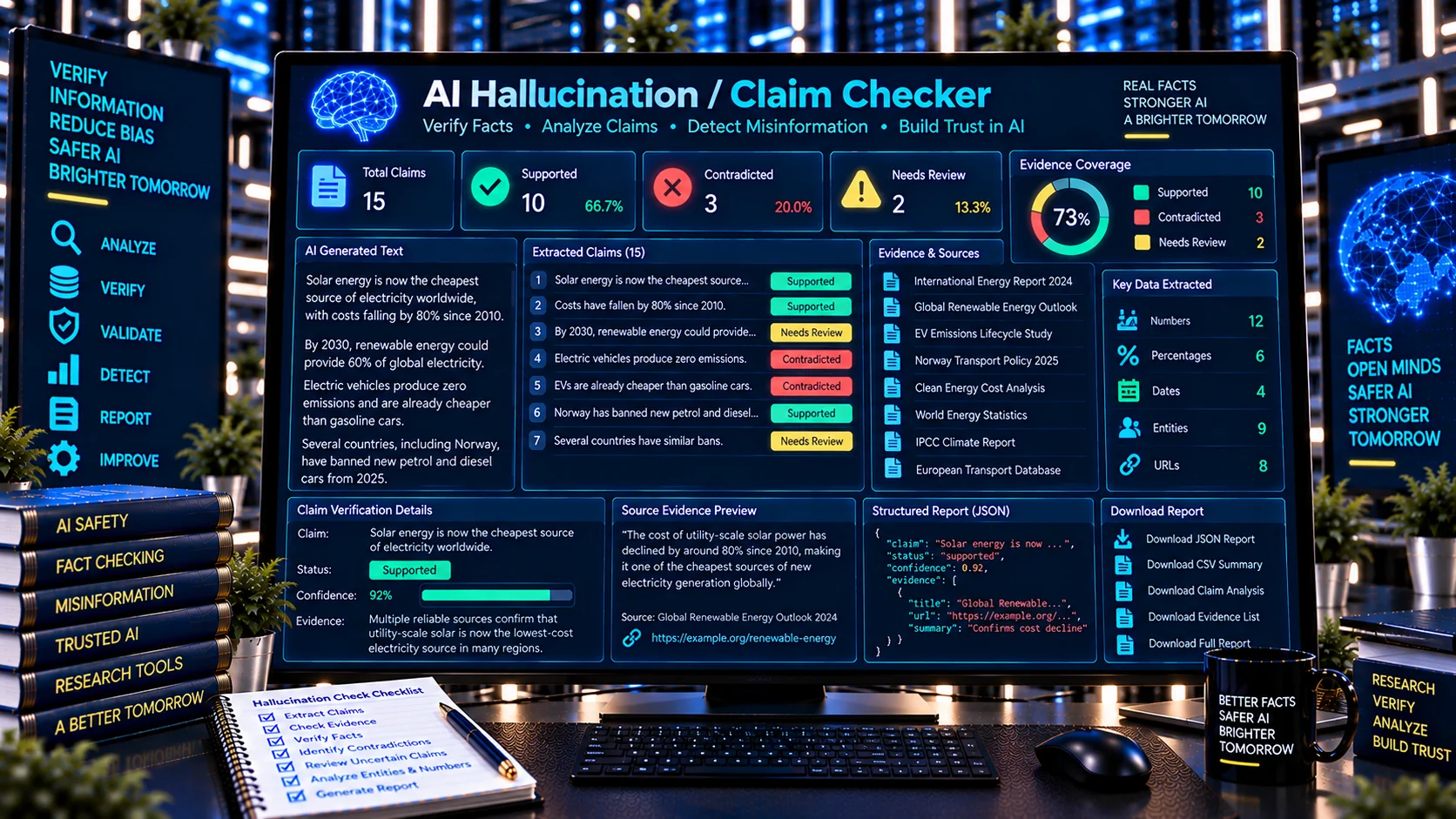
AI Hallucination / Claim Checker is a browser-based tool for reviewing AI-generated text for potentially unsupported, contradicted, or uncertain claims. It helps break an AI response into claim-like statements, examine important factual signals such as numbers, dates, entities, and URLs, and compare those signals with evidence supplied by the user.
The tool is designed for AI quality assurance, research workflows, content review, RAG evaluation, fact-checking preparation, and human-in-the-loop verification. Processing happens in the browser, so the tool does not require an external AI API or automatically send the text to a remote verification service.
AI Hallucination / Claim Checker
Review AI-generated claims against evidence you provide. The checker breaks text into claim-like statements, extracts factual signals, compares claims with evidence, and labels them as supported, contradicted, or needing review. It does not browse the web or declare truth on its own.
Claim Review
Detected Factual Signals
Findings
JSON Report
What Is an AI Hallucination / Claim Checker?
An AI Hallucination / Claim Checker helps identify parts of an AI-generated response that may require factual review.
Large language models can generate fluent statements that are inaccurate, unsupported by the supplied context, or difficult to verify. Research into hallucination detection increasingly examines generated content at the claim or atomic-fact level rather than treating an entire response as one factual unit.
Instead of simply asking whether an entire AI response is “correct,” claim-level analysis can highlight individual statements for further investigation.
PKCapra’s AI Hallucination / Claim Checker follows this review-oriented approach. It identifies claim-like content and compares detectable signals in the claims with evidence provided by the user.
What Does the AI Hallucination / Claim Checker Check?
Claim-Like Statements
The tool analyzes AI-generated text and identifies sentences or text units that appear to contain factual claims.
This makes long AI responses easier to review because potentially important statements can be examined individually rather than treating the entire response as one block.
Claim Decomposition
A complex response can contain several independent factual assertions.
Breaking a response into smaller claim-like units helps expose individual statements that may need evidence. Fine-grained verification has been explored in recent factuality research because complex claims can hide smaller inaccuracies.
Numbers and Quantitative Claims
The checker extracts detectable numerical signals such as:
- Numbers
- Percentages
- Years
- Dates
- Quantities
- Numeric comparisons
These signals can be compared with supplied evidence to identify potential mismatches that deserve review.
Dates and Years
Dates and years can be especially important in AI-generated research, historical summaries, reports, and current-event content.
The tool highlights detected temporal information so users can inspect whether the supplied evidence supports the same information.
Entities and Important Terms
The checker examines important terms and entities within claims and evidence.
This can help identify situations where an AI response discusses a person, organization, product, location, event, or other identifiable subject that is not clearly represented in the supplied evidence.
URLs and Domains
URLs and recognizable domains can be detected within AI-generated content and evidence.
This is useful when reviewing research answers, cited content, RAG responses, or AI-generated summaries containing source references.
Evidence Coverage
The tool provides an evidence-oriented coverage signal based on detectable matching information between claims and the supplied evidence.
Coverage is a review aid rather than proof that a claim is factually true.
Supported, Contradicted, and Needs Review
The AI Hallucination / Claim Checker organizes findings into practical review states.
Supported
A claim may be marked as Supported when detectable information in the supplied evidence aligns with the claim.
This does not mean that PKCapra has independently established the objective truth of the claim.
Contradicted
A claim may be flagged as Contradicted when detectable evidence signals conflict with important information contained in the claim.
Contradiction findings should be reviewed by a human, particularly when the language is nuanced or context-dependent.
Needs Review
Claims can require additional review when the available evidence does not provide enough detectable information for a confident classification.
This category is important because lack of evidence is not automatically proof that a statement is false.
Evidence-based factuality systems commonly distinguish supported, unsupported, and undecidable content rather than forcing every statement into a simple true-or-false classification.
Why Check AI Hallucinations at the Claim Level?
An AI response can contain a mixture of accurate information, unsupported assertions, numerical errors, and claims that require additional evidence.
Checking individual claims provides a more detailed review workflow.
For example, an AI-generated research paragraph could contain:
- A correct definition
- An unsupported statistic
- A potentially incorrect date
- A source URL
- A claim about an organization
- A conclusion that goes beyond the supplied evidence
A response-level label could hide these differences. Claim-level analysis makes individual review points easier to identify.
Research such as HALoGEN similarly uses atomic factual units and verification against knowledge sources when evaluating hallucinations across different domains.
How the AI Hallucination / Claim Checker Works
A typical workflow is:
- Paste the AI-generated response.
- Provide supporting evidence or source text.
- Run the analysis.
- Review detected claim-like statements.
- Examine numbers, dates, entities, and URLs.
- Review Supported, Contradicted, and Needs Review findings.
- Investigate flagged claims against authoritative sources.
- Export the generated JSON report when required.
The tool is intended to support the verification workflow rather than replace authoritative source checking.
AI Hallucination Detection vs Fact Checking
Hallucination detection and traditional fact checking are related but not identical.
Hallucination detection focuses on identifying generated content that may be unsupported, inconsistent, or factually unreliable.
Fact checking generally requires checking a claim against appropriate external evidence or authoritative sources.
A browser-side static checker cannot independently establish the truth of every claim without authoritative evidence. Therefore, PKCapra uses the tool as a claim-review and evidence-comparison layer, not as an absolute truth engine.
Research on claim verification describes pipelines involving claim identification, retrieval or evidence gathering, and verification.
AI Hallucination / Claim Checker vs AI Citation Verification Tool
The AI Hallucination / Claim Checker focuses on the content of AI-generated claims and whether supplied evidence contains signals that support or conflict with those claims.
The AI Citation Verification Tool focuses primarily on citation structure, citation markers, reference matching, URLs, duplicate sources, and citation coverage.
Use the hallucination checker when the main question is:
Which claims in this AI response need closer evidence review?
Use citation verification when the main question is:
Are the citations and references structurally connected correctly?
For citation structure and reference matching, use PKCapra’s AI Citation Verification Tool.
AI Hallucination / Claim Checker vs AI Citation Source Validator
Citation validation and hallucination checking address different stages of an AI research workflow.
The citation source validator can help review citation sources and their relationship to generated content.
The hallucination / claim checker instead focuses on identifying individual claim-like statements and comparing them with supplied evidence.
A useful workflow is:
Generate → Extract Claims → Review Evidence → Verify Citations → Human Review
For source-oriented citation analysis, use PKCapra’s AI Citation Source Validator.
AI Hallucination / Claim Checker vs AI Response Consistency Checker
The AI Response Consistency Checker examines multiple AI responses for consistency and differences.
The AI Hallucination / Claim Checker examines individual claims against supplied evidence.
These are complementary checks.
For example, if three AI models provide different answers, consistency analysis can reveal disagreement. Claim checking can then examine the disputed claims against available evidence.
Common AI Hallucination Patterns
The checker can help users investigate several common patterns.
Unsupported Specific Facts
An AI response may introduce a specific fact that does not appear in the supplied evidence.
Incorrect Numbers
Statistics, percentages, prices, measurements, rankings, and quantities can be altered or fabricated during generation.
Incorrect Dates
AI-generated content can contain incorrect publication dates, historical dates, event dates, or time periods.
Entity Confusion
A response may associate information with the wrong person, organization, product, location, or event.
Overextended Conclusions
An AI response can make a stronger conclusion than the supplied evidence actually supports.
Citation Without Actual Support
A response can contain a citation while the cited material does not clearly support the claim.
Citation presence therefore should not automatically be treated as factual verification.
Using the Tool for RAG Evaluation
Retrieval-Augmented Generation systems can still produce responses that are unsupported or contradicted by retrieved source material.
Recent research specifically studies hallucination detection in RAG systems by examining whether generated content is grounded in retrieved evidence.
A practical RAG review workflow can use PKCapra to:
- Collect the generated answer.
- Supply the retrieved context as evidence.
- Identify individual claims.
- Examine claim/evidence alignment.
- Investigate unsupported or conflicting claims.
- Continue with deeper source verification.
This makes the tool useful as one component of a broader RAG evaluation pipeline.
Using the Tool for AI Content Quality Assurance
Content teams can use claim-level analysis before publishing AI-assisted content.
Potential workflows include:
- AI-generated blog articles
- Research summaries
- Product comparisons
- Technical documentation
- Knowledge-base content
- AI-generated reports
- Educational material
- Internal business summaries
- RAG-generated answers
- Customer-support responses
The goal is not to automatically approve content. Instead, the tool helps identify statements that deserve human attention.
Using the Tool for AI Research
Researchers can use claim-level analysis when reviewing generated research summaries.
Important factual signals can be isolated and compared against supplied source material before a response is used in a paper, report, presentation, or knowledge base.
For more structured AI evaluation workflows, PKCapra also provides an LLM Evaluation Dataset Validator for reviewing evaluation datasets.
Evidence Quality Still Matters
A claim can only be meaningfully evaluated against the quality and relevance of the evidence being used.
A weak, outdated, incomplete, or unrelated source may produce a misleading verification result.
For important claims, users should prefer appropriate primary or authoritative sources and review the actual evidence rather than relying only on automated labels.
Recent claim-verification research emphasizes evidence retrieval and claim-level reasoning as important parts of reliable verification systems.
Browser-Based and Privacy-Friendly Processing
PKCapra’s AI Hallucination / Claim Checker is designed for browser-side analysis.
The tool does not require an external AI API to process the submitted text. This makes it useful when users want to perform an initial claim review without automatically sending their content to a third-party AI service.
Users should still follow their own organization’s privacy and data-handling policies when working with sensitive information.
Who Can Use an AI Hallucination / Claim Checker?
The tool can be useful for:
- AI researchers
- Prompt engineers
- LLM developers
- RAG developers
- AI QA teams
- Content teams
- Technical writers
- Researchers
- Students
- Data teams
- AI product teams
- Developers building AI evaluation workflows
It can be particularly useful wherever generated text needs a structured evidence-review step before publication or downstream use.
Frequently Asked Questions
What is an AI Hallucination / Claim Checker?
It is a tool for identifying claim-like statements in AI-generated text and comparing detectable information in those claims with evidence supplied by the user.
Can it prove whether an AI statement is true?
No. It is an evidence-comparison and claim-review tool. A Supported finding does not independently prove that a statement is objectively true.
What does a Contradicted result mean?
It means that detectable information in the supplied evidence conflicts with important information in the claim. The finding should still be reviewed in context.
What does Needs Review mean?
It means the available evidence does not provide enough detectable information for a stronger classification.
Does the tool browse the web automatically?
No. The tool is designed around user-supplied AI text and evidence rather than automatic web verification.
Does it use an external AI API?
No external AI API is required for the browser-side analysis.
Can it detect numerical hallucinations?
It can detect and compare numerical signals such as numbers, percentages, dates, years, and quantities, helping users identify potential mismatches.
Can it detect unsupported claims?
It can flag claims where the supplied evidence does not provide sufficient matching information. Such findings should be treated as review signals rather than automatic proof of falsehood.
Is it useful for RAG evaluation?
Yes. It can be used as part of a RAG review workflow by comparing generated claims with retrieved context or other evidence supplied by the user.
Does it replace human fact checking?
No. Important claims should still be checked against authoritative and relevant sources.
Build a Stronger AI Verification Workflow
Reliable AI content review works better when hallucination checking is combined with other quality and citation checks.
A practical PKCapra workflow can be:
Generate → Clean → Format → Validate → Check Consistency → Verify Citations → Check Claims → Human Review
The AI Hallucination / Claim Checker adds the claim-review layer by helping identify statements that may be unsupported, contradicted, or in need of additional evidence.
Use it as a structured quality-assurance step before AI-generated content becomes published content, documentation, research, or downstream data.