AI-generated answers often contain citations, references, and source links, but citation quality involves more than simply adding a URL to a response. A citation can be missing, duplicated, incorrectly mapped, unused, or attached to a reference that does not correspond to the expected citation marker.
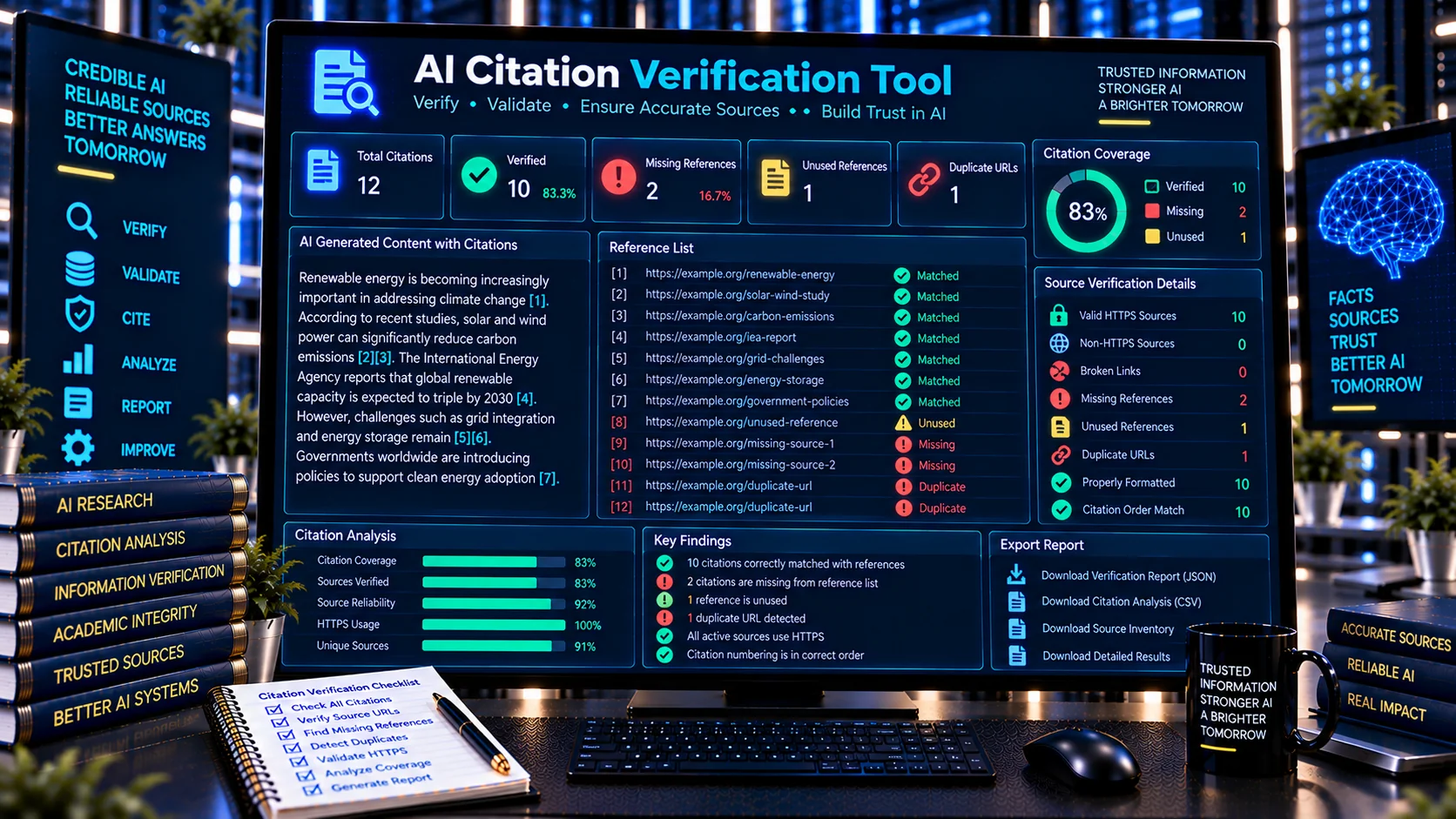
The AI Citation Verification Tool helps inspect citation structure and reference integrity in AI-generated text. It can identify citation markers, extract URLs, check reference matching, detect missing or unused references, find duplicate source URLs, and report citation coverage.
The tool runs in the browser and does not require an external AI API or upload the source content to a remote AI service.
AI Citation Verification Tool
Check AI-generated citations for URL validity, citation-number consistency, duplicate sources, missing references, unsupported citation markers, and citation coverage signals without sending your text to an external AI service.
Citation Findings
Source Inventory
Verification Report
What Is an AI Citation Verification Tool?
An AI Citation Verification Tool is a utility for checking whether citations and references in AI-generated content are structurally organized and consistently mapped.
An AI response may contain citation markers such as [1], [2], or [3] together with a list of source URLs. As the number of citations grows, manually checking whether every marker has a corresponding reference can become difficult.
PKCapra’s AI Citation Verification Tool provides a structured way to review these citation relationships.
It focuses on citation integrity and reference structure, rather than claiming that a cited webpage proves the factual statement associated with it.
What Does the AI Citation Verification Tool Check?
Citation Markers
The tool detects numbered citation markers in AI-generated text, such as:
[1][2][3]
These markers can then be compared with the available reference list.
Reference Matching
Citation markers should correspond to the intended references.
The checker identifies citation-reference relationships and highlights cases where the expected reference is missing.
Missing References
A response may contain a citation marker without a corresponding source.
For example, a response could contain [4] while only references [1], [2], and [3] are supplied.
This creates a citation-integrity problem that should be reviewed.
Unused References
The opposite problem can also occur.
A reference may appear in the source list but never be cited in the response.
The tool identifies unused references so the source list can be reviewed for unnecessary or disconnected entries.
URL Extraction
The checker extracts URLs from the supplied citation or reference data.
This creates a source inventory that can be reviewed alongside the citation markers.
URL Syntax Validation
The tool checks whether extracted source URLs follow the expected HTTP or HTTPS URL structure.
Malformed or incomplete URLs can therefore be identified before the citation set is reused.
HTTPS Warnings
HTTP sources can receive a warning because they are not using HTTPS.
This is a review signal rather than a claim that every HTTP source is automatically invalid.
Duplicate Source URLs
The same source URL can sometimes appear more than once in a reference list.
Duplicate detection helps identify redundant references and potential citation-management problems.
Citation Coverage
The tool calculates citation coverage based on the detected citation and reference relationships.
This provides a measurable structural signal for reviewing how extensively the supplied response uses its references.
Why Verify AI Citations?
AI-generated content can contain many references, especially when the response is produced through retrieval, research, or source-grounded generation workflows.
Citation verification can help identify basic integrity problems before content is published or used in a downstream workflow.
Common reasons to verify citations include:
- finding missing references
- identifying unused sources
- detecting duplicate URLs
- checking citation numbering
- reviewing URL structure
- measuring citation coverage
- auditing generated research content
- preparing AI-generated reports
- reviewing source-grounded answers
Citation verification is therefore useful as a quality-control step before deeper source or factual review.
AI Citation Verification Workflow
1. Prepare the AI Response
Start with the AI-generated text containing the citation markers you want to review.
Numbered citations such as [1], [2], and [3] can be analyzed by the checker.
2. Provide the References
Provide the associated source references or URLs.
The tool uses the supplied reference information to identify citation relationships and source-level issues.
3. Run Citation Verification
Run the checker to analyze citation markers, references, URLs, and their relationships.
4. Review Findings
Review the reported findings for issues such as:
- missing references
- unused references
- duplicate URLs
- invalid URL structures
- HTTP sources
- citation mismatches
- coverage issues
5. Review the Source Inventory
Use the generated source inventory to examine the URLs associated with the citation set.
6. Export the Verification Report
The checker generates a structured JSON report that can be copied or downloaded for documentation and QA workflows.
Common AI Citation Problems
Citation Marker Without a Reference
A response may contain [7] even though the supplied reference list ends at [6].
This is a straightforward citation-integrity problem that should be corrected or investigated.
Reference Without a Citation
A source may be included in the reference list but never actually cited in the response.
Unused references can make a citation list harder to audit.
Duplicate Source URLs
The same URL can appear under multiple references.
This may happen during automated citation generation or when source lists are merged.
Invalid URL
A citation can contain an incomplete or malformed URL.
URL syntax validation helps identify these problems.
HTTP Instead of HTTPS
A source may use an HTTP URL rather than HTTPS.
The tool reports this as a review warning rather than treating it as automatic proof that the source is unusable.
Incorrect Citation Numbering
Citation numbering can become inconsistent when references are manually edited or generated from multiple systems.
Checking marker-to-reference relationships can help identify these discrepancies.
Low Citation Coverage
Some AI-generated content may contain many factual or research-oriented statements but relatively few citations.
Citation coverage provides a structural signal that can prompt a deeper review of the content and its sourcing requirements.
Citation Integrity vs Factual Verification
Citation integrity and factual verification are separate tasks.
A structurally valid citation does not automatically mean that the cited source supports the claim.
For example, a response could contain:
A factual statement [1]
and reference a valid webpage for [1].
The citation is structurally present, but determining whether that webpage actually supports the statement requires reviewing the source content and the claim.
The PKCapra AI Citation Verification Tool does not claim to independently establish that relationship.
Its purpose is to verify citation structure and reference integrity.
Citation Verification vs Source Verification
Source verification involves evaluating whether a source is appropriate, accessible, authoritative, current, and relevant to a particular claim.
Citation verification is narrower.
It checks the relationship between the response’s citation markers and the supplied reference information.
These two processes can be combined:
Citation integrity check → Source review → Claim verification
AI Citation Verification vs AI Citation Source Validator
PKCapra’s AI Citation Verification Tool focuses on citation markers, reference matching, URLs, duplicates, and citation coverage.
The AI Citation Source Validator addresses source-level citation validation.
These tools can therefore support different stages of an AI citation workflow rather than performing the same operation.
AI Citation Verification vs AI Response Consistency Checker
The AI Response Consistency Checker compares multiple AI responses for variation in wording, structure, length, claims, numbers, percentages, and URLs.
The AI Citation Verification Tool focuses specifically on citation and reference integrity within AI-generated content.
A research-quality workflow can use both when multiple AI-generated responses need to be evaluated and their citations reviewed.
Citation Verification for AI-Generated Research
AI-generated research can contain numerous citations and source URLs.
Before publishing or distributing such material, a citation audit can help identify basic structural problems.
Useful checks include:
- Are all citation markers represented?
- Are any references unused?
- Are source URLs duplicated?
- Are URLs properly formed?
- Are any sources using HTTP?
- Is citation coverage sufficient for the intended content?
These checks do not replace manual source review, but they can reduce avoidable citation-management errors.
Citation Verification for AI Reports
AI-generated reports can contain references throughout long sections of content.
When reports are assembled automatically, citation numbering can become difficult to maintain.
The AI Citation Verification Tool can provide a quick structural audit before a report is finalized.
For important reports, the resulting findings should still be reviewed against the actual source material.
Citation Verification for RAG Applications
Retrieval-augmented generation systems commonly provide retrieved sources or citations alongside generated answers.
A citation verification layer can help inspect the structure of those citations.
For example, teams can review whether:
- citation markers correspond to supplied references
- source URLs are valid
- duplicate references exist
- references are unused
- citation coverage meets the application’s expected format
This is a structural quality-control step and should not be interpreted as proof that the retrieved source semantically supports every generated claim.
Privacy-Friendly Citation Verification
PKCapra’s AI Citation Verification Tool is designed to perform its analysis in the browser.
No external AI API is required for citation verification, and the tool does not need to send the response to a remote AI service for analysis.
This can be useful when reviewing internal AI-generated content or research drafts.
Organizations should still follow their own privacy and data-handling requirements when working with sensitive information.
Who Can Use an AI Citation Verification Tool?
The tool can be useful for:
- AI engineers
- LLM developers
- AI researchers
- content teams
- technical writers
- SEO teams
- RAG developers
- AI application developers
- QA engineers
- evaluation engineers
- research teams
- publishers
It can be particularly useful when citations are generated automatically or when large numbers of AI-generated responses need structural citation checks.
Frequently Asked Questions
What is an AI Citation Verification Tool?
It is a tool for checking citation markers, reference matching, source URLs, duplicate references, unused references, and citation coverage in AI-generated content.
Does it verify that a source proves a claim?
No. It verifies citation structure and reference integrity. Determining whether a source actually supports a claim requires reviewing the source and the claim.
Can it detect missing references?
Yes. It identifies citation markers that do not have corresponding references.
Can it detect unused references?
Yes. References that are supplied but not connected to detected citation markers can be identified.
Can it detect duplicate URLs?
Yes. Duplicate source URLs are reported for review.
Does it check HTTPS?
Yes. HTTP URLs can receive a warning because they are not using HTTPS.
Does it validate URLs?
Yes. The tool checks URL syntax and identifies malformed or incomplete URL structures.
What is citation coverage?
Citation coverage is a structural measure based on the citation/reference information detected by the tool. It should be interpreted as a review signal rather than a measure of factual accuracy.
Does the tool use an external AI API?
No. The citation verification process does not require an external AI API.
Can I export the verification results?
Yes. The tool provides a JSON verification report that can be copied or downloaded.
Build a Stronger AI Citation Workflow
Reliable AI-generated research requires more than placing links beside generated text.
The AI Citation Verification Tool provides a practical structural audit for citation markers, references, URLs, duplicate sources, missing references, unused references, and citation coverage.
A broader AI research workflow can separate the process into distinct stages:
Generate content → Verify citation structure → Review sources → Verify claims → Publish
This separation is important because a correctly formatted citation does not by itself establish that a source supports a claim.
Use the PKCapra AI Citation Verification Tool as the citation-integrity layer, then perform the deeper source and claim review required by the content or research workflow.