
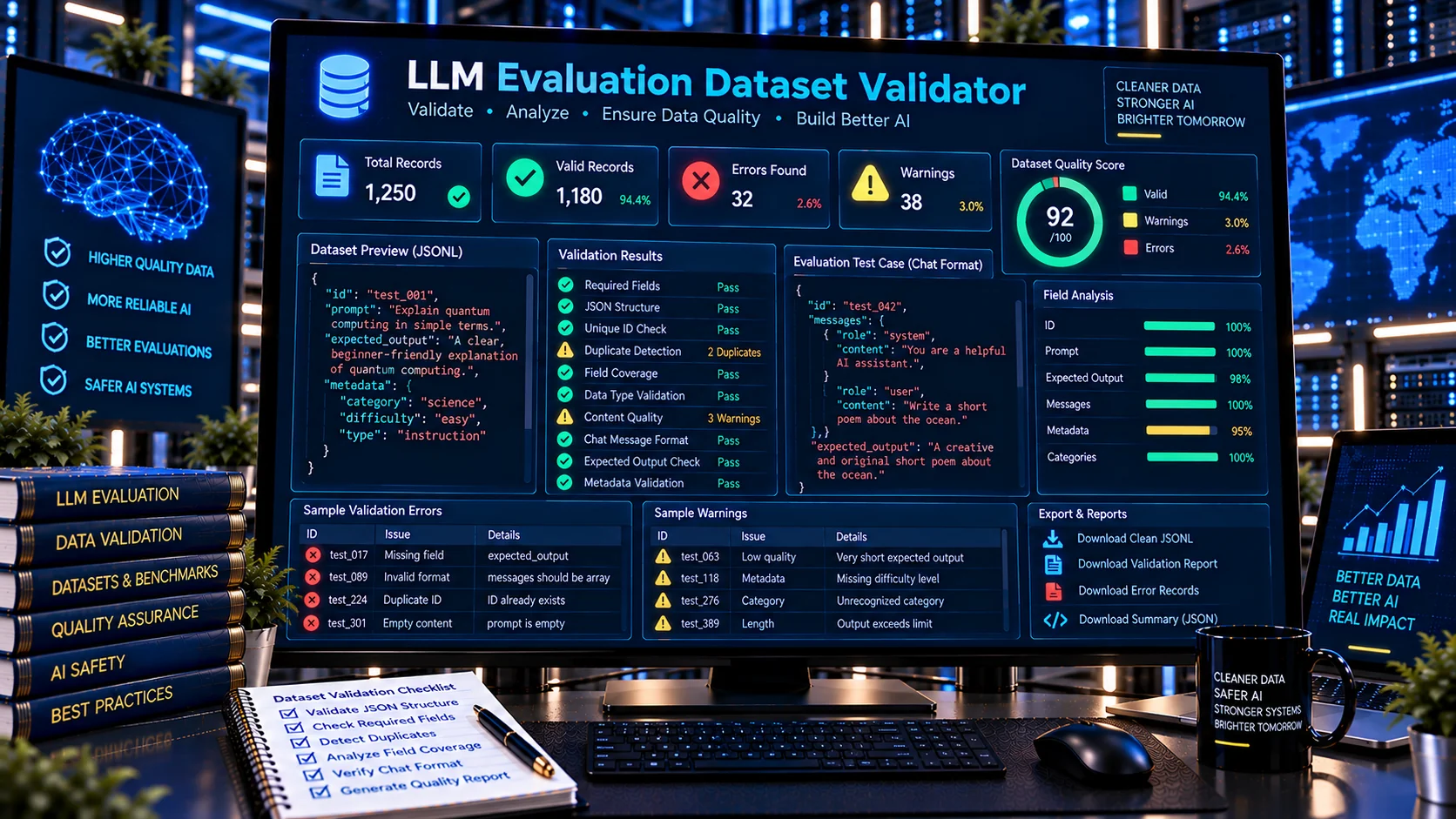
An LLM evaluation dataset is only useful when its records are consistent enough to test an AI system reliably. PKCapra’s LLM Evaluation Dataset Validator checks JSON and JSONL evaluation datasets for structural problems, missing fields, duplicate identifiers, inconsistent evaluation records, invalid score fields, and other dataset-quality issues before the data is used in an evaluation workflow.
The validator runs in the browser and produces structured findings with Pass, Error, and Warning results, along with a dataset quality score and downloadable JSON report.
LLM Evaluation Dataset Validator
Validate evaluation datasets used to test language-model responses. Check record structure, required evaluation fields, duplicate identifiers, empty inputs or references, message arrays, expected-answer fields, metadata shape, and common JSONL or JSON dataset problems entirely in the browser.
Validation Summary
Dataset Findings
Field Coverage
JSON Report
What Is an LLM Evaluation Dataset Validator?
An LLM evaluation dataset validator is a quality-control tool for datasets used to evaluate large language models, AI assistants, agents, and other generative AI systems.
Evaluation datasets can contain prompts, questions, expected answers, reference outputs, labels, metadata, conversation messages, scoring information, and other test-case fields. Public evaluation datasets commonly use JSONL, with one JSON object representing an individual evaluation record.
A dataset may be valid JSON while still being unsuitable for evaluation because records have missing identifiers, inconsistent fields, duplicate cases, invalid expected values, or incomplete evaluation information.
PKCapra’s validator focuses on identifying these structural and consistency problems before the dataset moves into an evaluation pipeline.
What Does the LLM Evaluation Dataset Validator Check?
JSON and JSONL Structure
The validator checks whether the supplied evaluation data can be interpreted as structured JSON or JSONL data.
This helps identify malformed records and structural inconsistencies before deeper dataset checks are performed.
Evaluation Record Structure
Individual evaluation records are examined for expected test-case information such as identifiers, prompts or inputs, expected/reference values, metadata, and related evaluation fields.
Different evaluation datasets can use different schemas, so the validator focuses on structural and quality signals rather than claiming that every dataset must follow one universal schema.
Duplicate IDs
Evaluation records often use identifiers to distinguish individual test cases. Duplicate IDs can make tracking, debugging, result matching, and regression analysis more difficult.
The validator detects duplicate identifiers when they are present.
Missing or Weak Input Fields
Evaluation cases generally need some form of model input, such as a prompt, question, query, instruction, or conversation.
The validator checks for missing or structurally problematic input information.
Expected and Reference Values
Many evaluation datasets contain expected answers, reference outputs, labels, or ground-truth values.
The validator checks relevant expected/reference fields so obvious structural problems can be identified before evaluation.
Chat Messages
Datasets designed for conversational or instruction-following evaluations may store messages as structured arrays.
The validator checks message structures when they are present and identifies malformed or incomplete message records.
Metadata
Evaluation datasets frequently include metadata such as categories, difficulty, source, task type, evaluator information, or other record-level attributes.
The validator checks metadata structures and reports relevant problems without requiring every dataset to use the same metadata vocabulary.
Score Fields
Evaluation records can contain scoring information or expected score-related fields.
The validator checks score structures and identifies values that appear structurally inconsistent with evaluation data.
Why Validate an LLM Evaluation Dataset?
Evaluation results are only meaningful when the underlying test data is sufficiently well-formed and consistently interpreted.
Modern evaluation ecosystems increasingly use structured schemas for evaluation results and may store aggregate results separately from per-sample JSONL records. The Every Eval Ever project, for example, uses structured schemas for evaluation results and optional instance-level JSONL data.
A dataset validator can help catch problems before they affect an evaluation run.
Common reasons to validate include:
- Preparing a new benchmark dataset
- Checking an evaluation dataset before running a model
- Reviewing JSONL test cases
- Detecting duplicate evaluation records
- Checking expected-answer fields
- Preparing regression-test datasets
- Reviewing AI agent test cases
- Checking datasets exported from another system
- Troubleshooting evaluation-pipeline errors
- Verifying dataset consistency before sharing it
LLM Evaluation Dataset Validation Workflow
A practical workflow is straightforward:
1. Prepare the Dataset
Export or prepare the evaluation dataset as JSON or JSONL.
Keep the original dataset unchanged so validation findings can be compared against the source.
2. Run the Dataset Through PKCapra
Load the dataset into the LLM Evaluation Dataset Validator.
The tool analyzes the available records and evaluates structural and consistency signals.
3. Review Errors and Warnings
Separate actual structural errors from warnings.
An error may indicate a problem that should be corrected before the dataset is used. A warning may indicate a quality concern that requires human review.
4. Review Dataset Coverage
Use the reported field coverage and record-level findings to identify inconsistent datasets.
For example, one record may contain an expected answer while another record uses a different structure.
5. Correct the Source Dataset
Fix the underlying JSON or JSONL dataset rather than treating the validator report itself as the dataset.
6. Validate Again
Run the corrected dataset through the validator again and compare the findings.
Repeated validation helps create a more consistent evaluation preparation process.
Common LLM Evaluation Dataset Problems
Duplicate Evaluation IDs
Two or more records may accidentally use the same identifier.
This can create ambiguity when evaluation results are mapped back to individual test cases.
Missing Prompts or Inputs
An evaluation record without a usable model input may not represent a complete test case.
Missing Expected Outputs
Reference or expected values may be required for deterministic comparison, depending on the evaluation design.
Inconsistent Record Structures
One JSONL record may contain fields that other records do not use, creating inconsistent downstream processing.
Invalid Chat Message Structures
Conversation-based datasets may contain incomplete message objects or incorrectly structured message arrays.
Inconsistent Metadata
Fields such as difficulty, category, source, or task type may vary unexpectedly between records.
Invalid Score Information
Score-related values may be malformed or structurally inconsistent with the intended evaluation format.
Mixed Dataset Conventions
Datasets assembled from multiple sources can contain different field names or record structures.
Validation helps expose these differences before they become evaluation-pipeline problems.
LLM Evaluation Dataset Validator vs JSON Validator
A general JSON validator answers a basic question:
Is this data valid JSON?
An LLM evaluation dataset validator goes further by examining whether the structured data contains recognizable evaluation-oriented records and quality signals.
For example, valid JSON can still contain:
- Duplicate test-case IDs
- Missing prompts
- Missing expected values
- Inconsistent records
- Malformed message structures
- Problematic score fields
Therefore, JSON syntax validation and evaluation-dataset validation serve different purposes.
LLM Evaluation Dataset Validator vs AI Structured Output Validator
PKCapra’s AI Structured Output Validator focuses on validating structured AI output.
The LLM Evaluation Dataset Validator focuses on the dataset used to test or evaluate AI systems.
The distinction is important:
Structured Output Validator → Is this AI-generated structured output valid?
Evaluation Dataset Validator → Is this evaluation/test dataset structurally consistent enough to use?
Both can be useful in an AI quality workflow.
What Makes a Useful Evaluation Dataset?
A technically valid dataset is not automatically a scientifically strong benchmark.
Dataset quality can also depend on whether the test cases represent the intended population, whether important edge cases are covered, whether labels are consistent, whether data leakage exists, and whether the dataset is appropriate for the evaluation objective.
The PKCapra validator therefore should be treated as a dataset quality and structural validation layer, not as proof that an evaluation benchmark is unbiased, statistically representative, or scientifically valid.
Human review and domain-specific evaluation methodology remain important.
JSON vs JSONL for LLM Evaluation Datasets
Both JSON and JSONL can be useful for evaluation workflows.
JSON can represent an entire structured dataset in a single document.
JSONL stores individual JSON objects line by line, making it convenient for datasets containing many independent evaluation records. Current public evaluation datasets commonly publish JSONL files for per-example benchmark data.
The appropriate format depends on the evaluation framework and processing pipeline being used.
Privacy-Friendly Evaluation Dataset Validation
PKCapra’s LLM Evaluation Dataset Validator is designed around browser-side analysis.
That makes it useful for checking the structure of evaluation datasets without requiring the dataset to be sent to an external AI API for analysis.
However, users should still avoid exposing sensitive information unnecessarily. Evaluation datasets can contain prompts, proprietary information, personal data, credentials, internal instructions, or other confidential material.
Always review your dataset before sharing it with third-party systems.
Who Can Use an LLM Evaluation Dataset Validator?
The tool can be useful for:
- AI engineers
- Machine learning engineers
- LLM evaluation teams
- AI researchers
- Dataset developers
- RAG developers
- AI agent developers
- QA engineers
- AI safety teams
- Benchmark developers
- Software teams building regression tests
- Organizations preparing internal AI evaluation datasets
Frequently Asked Questions
What is an LLM evaluation dataset?
An LLM evaluation dataset is a collection of test cases used to evaluate an AI model or system. Records may contain prompts, inputs, expected answers, reference outputs, labels, metadata, scoring information, or other evaluation-specific fields.
What formats does the PKCapra validator support?
The tool is designed to validate JSON and JSONL evaluation datasets.
Can it detect duplicate evaluation IDs?
Yes. The validator checks for duplicate identifiers when IDs are present in the dataset.
Can it check expected answers?
Yes. The validator checks expected/reference fields and reports relevant structural problems.
Can it validate chat-style evaluation records?
Yes. When records contain structured chat messages, the validator checks their message structure.
Does it run an LLM to judge my dataset?
No. PKCapra’s validator uses browser-side validation and heuristic structural checks rather than sending the dataset to an external AI API.
Does validation prove that my benchmark is scientifically valid?
No. Structural validation cannot prove that a benchmark is unbiased, representative, statistically sound, or suitable for every evaluation objective.
Can I download the validation report?
Yes. The tool provides a structured JSON report that can be copied or downloaded.
Should I validate a dataset before running an LLM evaluation?
Validation is useful before an evaluation run because it can expose structural and consistency problems that might otherwise create confusing evaluation results or pipeline errors.
Build a More Reliable AI Evaluation Workflow
A strong AI evaluation process starts with well-structured test data. Before comparing models or analyzing evaluation results, validate the dataset itself for structural consistency, duplicate records, missing information, malformed evaluation fields, and other obvious quality problems.
PKCapra’s LLM Evaluation Dataset Validator provides a browser-based quality-control layer for JSON and JSONL evaluation datasets, helping teams identify dataset problems before they become evaluation-pipeline problems.