
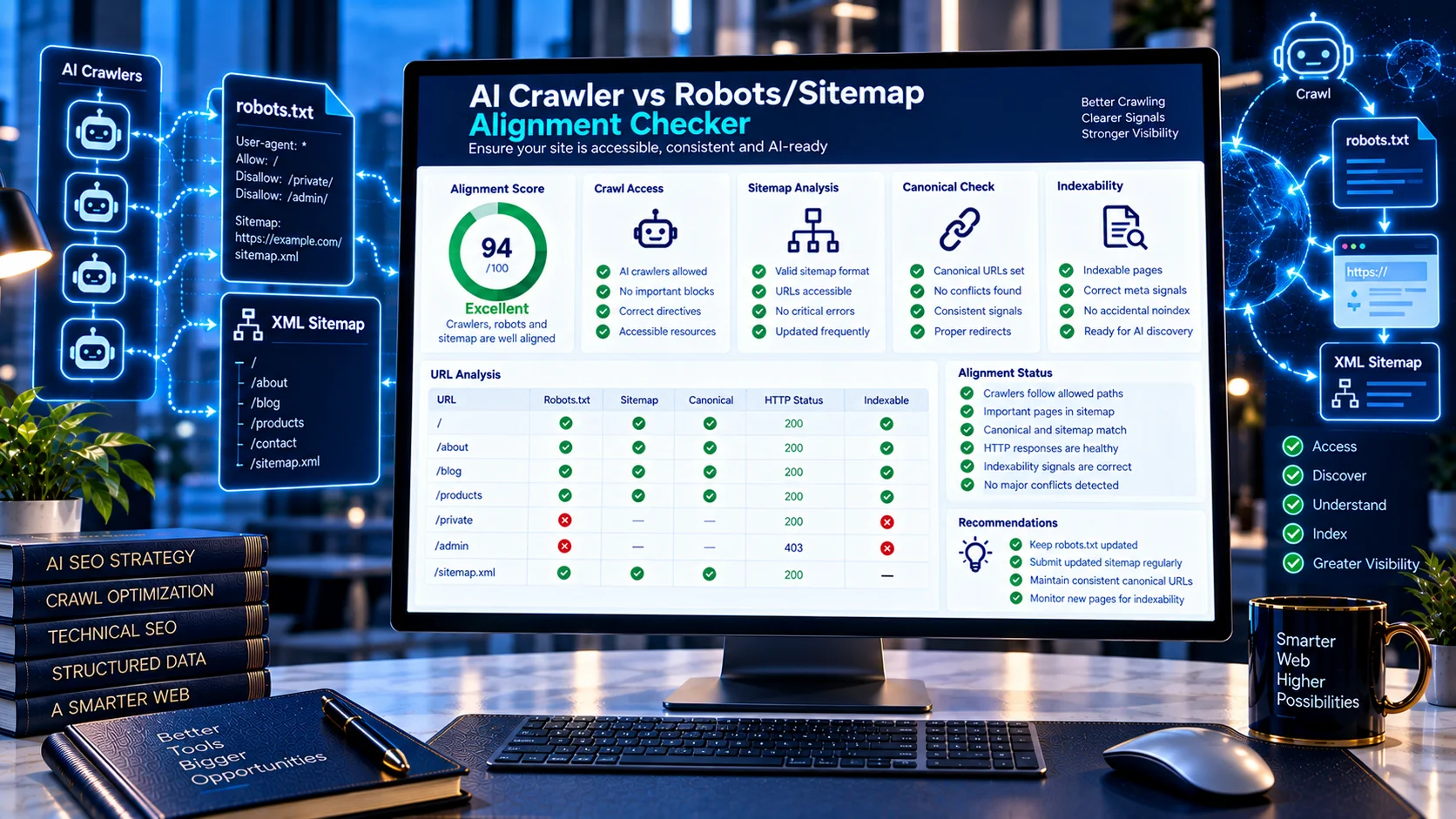
Check AI Crawler, Robots.txt, Sitemap & Indexability Alignment
Modern AI search visibility depends on more than allowing or blocking individual crawlers. Your robots.txt rules, XML sitemap URLs, canonical URLs, HTTP responses, and indexability signals should work together consistently.
The AI Crawler vs Robots/Sitemap Alignment Checker by PKCapra analyzes these signals together to identify potential conflicts that may affect how AI crawlers can discover and access your website content.
Enter your website URL to check crawler policies, sitemap exposure, canonical signals, indexability, and HTTP accessibility in one report.
AI Crawler vs Robots/Sitemap Alignment Checker
Cross-check AI crawler rules, sitemap exposure, canonical URLs, and indexability signals to identify alignment gaps.
What the AI Crawler vs Robots/Sitemap Alignment Checker Checks
AI Crawler Access
The checker reviews crawler-specific access rules for major AI-related user agents, including:
- OAI-SearchBot
- GPTBot
- Claude-SearchBot
- ClaudeBot
- PerplexityBot
- Google-Extended
It helps identify whether important URLs appear accessible or restricted under the relevant robots.txt rules.
Robots.txt Policies
Your robots.txt file provides important crawler-access signals.
The analyzer checks applicable robots.txt directives and compares them with the URLs discovered through your sitemap.
This can reveal situations where a URL is included in your sitemap but appears blocked for a selected AI crawler.
Sitemap Discovery
The tool checks whether your website exposes an XML sitemap through standard discovery signals.
It can analyze:
- robots.txt sitemap declarations
- Common sitemap locations
- Sitemap indexes
- Nested sitemap references
- Sampled sitemap URLs
This helps establish whether important URLs are being exposed through your site’s sitemap infrastructure.
Sitemap URL Accessibility
The analyzer samples URLs discovered from your sitemap and checks their HTTP accessibility.
It reviews signals such as:
- HTTP status
- Successful responses
- Redirect behavior
- Accessibility
- URL availability
A sitemap entry that cannot be successfully accessed deserves further investigation.
Canonical URLs
Canonical signals help indicate which URL should represent a page when multiple URLs can expose similar content.
The checker compares sampled sitemap URLs with their canonical signals to identify potential inconsistencies.
For example, a sitemap may contain one URL while the page identifies a different canonical URL.
Indexability and Noindex Signals
The analyzer checks sampled pages for indexability-related signals, including noindex directives.
This helps identify situations where a URL is:
- Included in a sitemap
- Accessible over HTTP
- But explicitly marked as non-indexable
Such combinations may require review depending on your website’s intended architecture.
Robots, Sitemap and Canonical Alignment
The core purpose of the tool is to bring these signals together.
It looks for relationships between:
Robots.txt → Sitemap → HTTP Access → Canonical → Indexability → AI Crawler Access
Instead of checking each signal independently, the report highlights potential alignment issues across the complete chain.
Why AI Crawler and Sitemap Alignment Matters
A sitemap can expose URLs that robots.txt restricts.
A page can be accessible but declare a different canonical URL.
A sitemap URL can return an unexpected HTTP response.
A page can be listed in a sitemap while carrying a noindex directive.
These situations do not automatically mean that your website is broken, but they can indicate configuration differences that should be reviewed.
The AI Crawler vs Robots/Sitemap Alignment Checker gives you a centralized diagnostic view of these relationships.
How to Use the AI Crawler vs Robots/Sitemap Alignment Checker
Step 1: Enter Your Website URL
Enter the public URL of the website you want to analyze.
Step 2: Select the AI Crawler
Choose the AI crawler or user agent you want to evaluate.
The available crawler options cover several major AI-related crawler identities.
Step 3: Run the Alignment Check
Start the analysis.
PKCapra retrieves the relevant public robots.txt and sitemap information and evaluates sampled URLs against the available signals.
Step 4: Review the Alignment Report
Review the results for:
- Robots access
- Sitemap discovery
- Sitemap URL accessibility
- Canonical consistency
- Noindex signals
- AI crawler access
- Potential alignment conflicts
Step 5: Fix Configuration Issues
Use the detailed findings to review your site’s robots.txt, sitemap, canonical, and indexability configuration where necessary.
Understanding the Alignment Score
The analyzer provides an AI crawler alignment score from 0 to 100 based on the signals evaluated by the tool.
The score is a diagnostic indicator rather than a search-engine or AI-platform ranking.
The detailed findings are more important than the score alone because a website can have legitimate reasons for intentionally blocking certain crawlers or excluding particular URLs from indexing.
Review each warning in the context of your website’s intended architecture.
Common AI Crawler Alignment Issues
Sitemap URLs Blocked by Robots.txt
A URL may appear in an XML sitemap while robots.txt prevents a particular crawler from accessing it.
If the restriction is intentional, no action may be necessary. If the URL is intended to be accessible, review the relevant robots.txt rule.
Sitemap URLs With Noindex Signals
A URL may be included in a sitemap while the page contains a noindex directive.
This combination should be reviewed when the URL is intended to be indexed and discoverable.
Canonical Does Not Match Sitemap URL
A sitemap may contain one URL while the page declares another canonical URL.
This can indicate inconsistent URL signals that should be investigated.
Inaccessible Sitemap URLs
A sitemap can contain URLs that return errors, unexpected redirects, or other HTTP responses.
Removing outdated URLs or correcting inaccessible resources can help maintain a cleaner sitemap.
Different Crawler Policies
Robots.txt rules can apply differently to different crawler user agents.
A page that is accessible to one crawler may not necessarily have the same robots policy for another crawler.
AI Crawler Alignment and Technical SEO
AI crawler accessibility should be considered alongside traditional technical SEO signals.
PKCapra’s Robots.txt Analyzer can provide a more focused robots.txt analysis, while the XML Sitemap Analyzer can be used for dedicated sitemap analysis.
For broader crawlability and indexability diagnostics, use the Indexability & Crawlability Analyzer.
These tools can complement the alignment report when a specific technical issue requires deeper investigation.
AI Crawler Alignment and AI Search Readiness
Crawler accessibility is one component of a broader AI search infrastructure.
You can combine this analysis with the AI Search Readiness Analyzer to review broader website-level AI search signals.
For page content accessibility, the AI Content Extractability Checker can analyze whether important webpage content is structurally extractable.
Important Limitations
The analyzer evaluates publicly accessible technical signals and sampled URLs.
It does not guarantee that an AI system will crawl, index, retrieve, cite, rank, or use any particular page.
AI platforms can apply their own crawling, indexing, retrieval, ranking, and policy systems beyond the signals detectable by this tool.
A potential alignment issue is also not automatically an error. Some websites intentionally restrict certain crawlers, exclude URLs from indexing, or use canonical URLs that differ from sitemap entries for legitimate reasons.
Privacy and Processing
The checker analyzes publicly accessible website resources required for the diagnostic.
No private credentials are required.
Do not submit private, authenticated, internal, or confidential URLs for analysis.
Frequently Asked Questions
What is an AI Crawler vs Robots/Sitemap Alignment Checker?
It is a technical diagnostic tool that compares AI crawler access rules with robots.txt, sitemap URLs, HTTP responses, canonical URLs, and indexability signals.
Which AI crawlers can the tool check?
The tool supports several major AI-related crawler identities, including OAI-SearchBot, GPTBot, Claude-SearchBot, ClaudeBot, PerplexityBot, and Google-Extended.
Does the tool analyze robots.txt?
Yes. It checks robots.txt rules and compares applicable crawler access policies with sitemap and URL signals.
Does it check XML sitemaps?
Yes. It discovers sitemap resources and analyzes sampled URLs from the available sitemap structure.
Does it check canonical URLs?
Yes. Sampled sitemap URLs are checked for canonical signals so potential differences between sitemap URLs and canonical URLs can be identified.
Does it check noindex?
Yes. The analyzer checks sampled pages for indexability-related noindex signals.
Can a URL be accessible but still have an alignment issue?
Yes. Accessibility is only one part of the analysis. Canonical, robots, sitemap, and indexability signals can still differ.
Does a high alignment score guarantee AI visibility?
No. The score is a technical diagnostic measure and does not guarantee AI crawling, indexing, retrieval, citation, or visibility.
Should every AI crawler be allowed?
Not necessarily. Crawler access policies depend on your website’s objectives, content, licensing considerations, infrastructure, and operational requirements.
What should I do if a sitemap URL is blocked?
First determine whether the restriction is intentional. If the URL should be accessible to the relevant crawler, review the applicable robots.txt directive and your site’s intended crawling policy.
Continue Your Technical AI Search Diagnostics
Use the AI Crawler Checker for focused crawler and URL testing.
Use the AI Sitemap Coverage Checker to examine sitemap coverage from an AI crawler perspective.
For broader AI search diagnostics, use the AI Search Readiness Analyzer.