
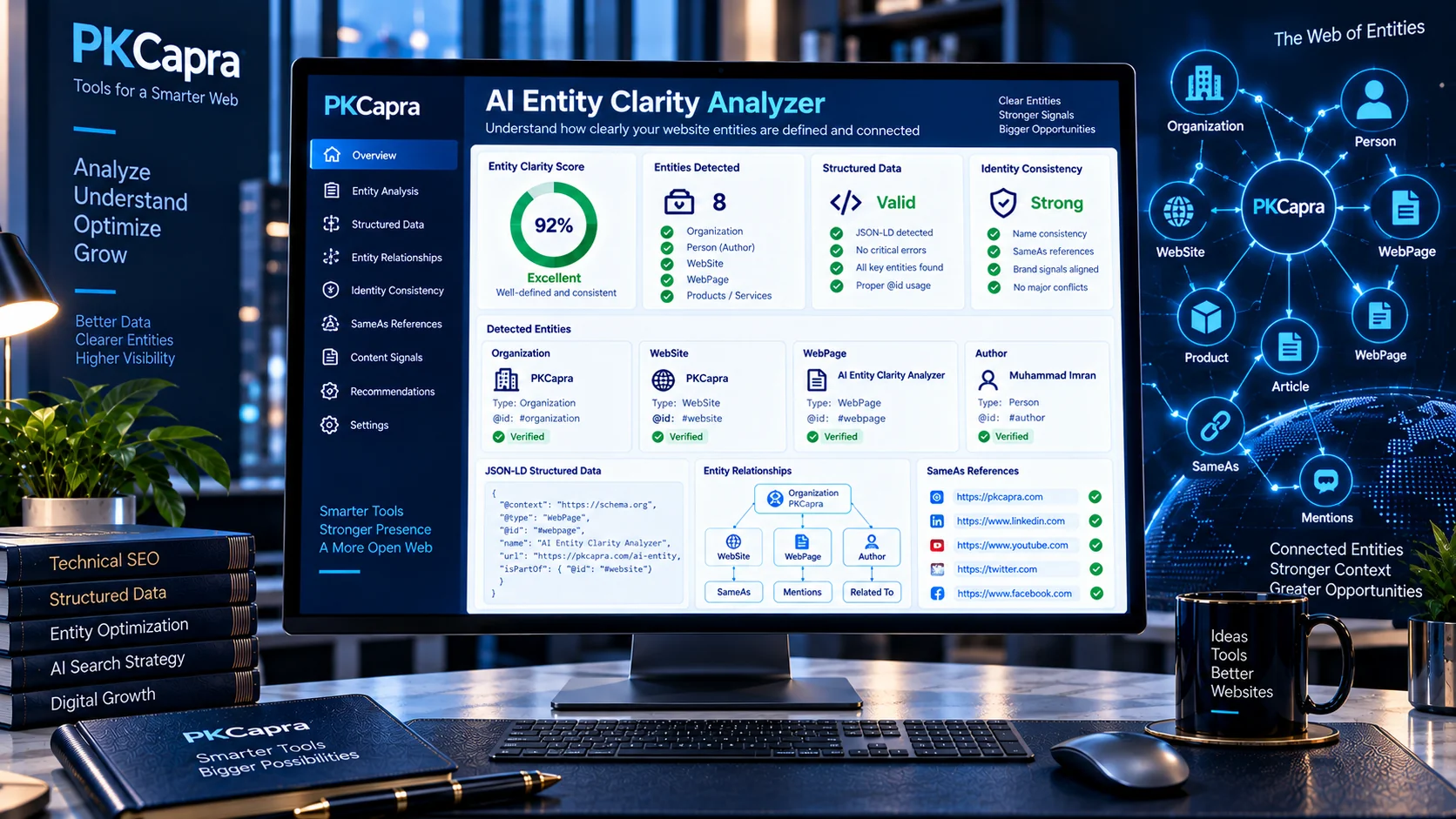
AI systems need to understand what a website, organization, person, brand, and other important entities represent. The AI Entity Clarity Analyzer helps identify whether your webpage presents clear and consistent entity signals that machines can interpret.
Enter a public webpage URL to analyze structured identity signals, entity relationships, organization information, authorship, and related machine-readable data.
AI Entity Clarity Analyzer
Analyze whether a webpage clearly identifies its main organization, people, topics, and relationships using visible content, metadata, links, and structured data.
What Does an AI Entity Clarity Analyzer Help You Review?
An AI Entity Clarity Analyzer helps you examine how clearly a piece of content identifies and describes its important entities—such as people, organizations, products, places, concepts, and named topics. Clear entity references can make content easier for readers and language systems to interpret. Use the analysis as a content review aid, not as a guarantee of search rankings or AI citations.
Identify Key Entities
Recognize the main people, brands, places, products, and concepts discussed in a passage.
Review Meaning and Context
Check whether each important name or concept is explained clearly enough for someone unfamiliar with the subject.
Improve Content Precision
Find vague references, unexplained abbreviations, inconsistent naming, or missing context that may confuse readers.
What Is an Entity in Content and Search?
An entity is a distinct thing or concept that can be identified and described. In content analysis and search technology, entities are often represented by names, attributes, relationships, and surrounding context. A clearly described entity is easier to distinguish from another entity with a similar name.
| Entity type | Illustrative example | Useful context to provide |
|---|---|---|
| Person | Marie Curie | Relevant role, field, or contribution |
| Organization | World Health Organization | Organization name and its relevant purpose |
| Product | A named software application | Product category, function, and distinguishing features |
| Place | Paris | Country, region, or other detail when the location could be ambiguous |
| Concept | Canonical URL | A concise definition and its role in the topic |
Why Entity Clarity Is Useful for SEO and AI-Readable Content
Search engines and AI systems use many signals to interpret content. Accurate names, meaningful descriptions, and consistent relationships help establish what a page is discussing. Entity clarity is one part of a broader content-quality and technical-SEO workflow.
Less Ambiguous Language
Replace unclear references such as “it,” “the company,” or “this system” when the intended subject is not obvious from the context.
Consistent Naming
Use the correct entity name and introduce abbreviations or alternate names in a way that readers can follow.
Stronger Topic Context
Explain how the main entity relates to the page’s subject instead of relying on a list of disconnected names or keywords.
Entity-focused review is especially useful when preparing explanatory articles, product pages, company profiles, comparison guides, service descriptions, and reference content. It can also complement a broader AI tools workflow.
How to Review Entity Clarity Step by Step
Use the analyzer according to the input and result options provided on the tool interface. The following editorial workflow can help you interpret the findings and make useful revisions.
Prepare Your Content
Select a passage, draft, or page text that you want to review. Include enough surrounding context for the subject to be understood.
Run the Available Analysis
Enter the required content in the tool and use its provided analysis control. Follow any input limits shown on the page.
Review the Main Subjects
Check whether the central entities are correctly named, relevant to the topic, and explained with enough detail.
Edit and Recheck
Improve unclear descriptions, remove accidental inconsistencies, and review the revised passage for natural readability.
Example: Improving an Unclear Entity Description
The examples below are illustrative. They show how a writer can make the subject and its role more explicit without making the text repetitive or unnatural.
“It helps businesses manage their website information and improve performance.”
Why it may be unclear: The sentence does not identify what “it” refers to. “Performance” is also broad and could mean loading speed, search visibility, usability, or another measure.
“The website audit tool helps site owners review technical website signals, including page metadata, crawl directives, and response information.”
What improved: The subject is named, its intended audience is identified, and the type of information it reviews is described more precisely.
“PKCapra provides online utilities for website owners. Its SEO and website tools include resources for reviewing metadata, sitemap information, and structured data.”
The passage establishes a simple relationship between the organization, its audience, and a relevant group of tools. The details are connected through meaningful sentences rather than presented as an isolated keyword list.
Entity Clarity Best Practices
Use this checklist when editing content after an entity analysis. Prioritize accuracy and reader understanding over unnecessary optimization.
Names and Definitions
- Use the correct name for the main subject.
- Define specialized terms when first introduced.
- Explain abbreviations that may be unfamiliar.
- Distinguish entities with similar or identical names.
Context and Relationships
- Describe what the entity does or represents.
- Connect related entities with clear wording.
- Keep supporting entities relevant to the topic.
- Use specific details instead of vague claims.
Content Quality
- Check facts, dates, names, and terminology.
- Remove repetitive or unnatural name mentions.
- Keep the passage readable for human visitors.
- Review the final text in its full page context.
Entity Clarity Mistakes to Avoid
| Common issue | Why it creates confusion | Practical correction |
|---|---|---|
| Unexplained abbreviations | Readers may not know which term the abbreviation represents. | Write the full term first, followed by the abbreviation when useful. |
| Vague pronouns | The reference may point to more than one subject. | Repeat the entity name where the meaning is not clear. |
| Inconsistent names | Different labels may appear to describe different entities. | Use a consistent name and explain legitimate alternate names. |
| Unrelated entity mentions | Extra names distract from the page’s main purpose. | Keep references that add useful context or evidence. |
| Unsupported descriptions | Incorrect attributes can misrepresent a person, product, or organization. | Verify descriptions against reliable, relevant sources. |
| Keyword-style writing | A list of names does not explain their meaning or relationships. | Write complete, natural sentences that establish context. |
Entity Clarity and Structured Data: How They Work Together
Clear page content helps explain the subject to readers. Structured data can provide additional machine-readable descriptions of page elements when it is accurate, relevant, and implemented correctly. These are complementary practices—not substitutes for one another.
Content clarity comes first
Make sure the page visibly explains its main subject, purpose, and relevant details. Structured data should reflect information that visitors can verify from the page and should not introduce misleading claims.
Use appropriate structured data
Schema.org types and properties should match the actual entity or content being described. Avoid marking up unsupported relationships or using a schema type solely because it appears to be an SEO shortcut.
Review the markup separately
Entity clarity analysis does not replace syntax validation or review of structured data. For a separate technical check, use the Schema Markup / Structured Data Analyzer. You can also review your page’s metadata with the Meta Tags Analyzer.
Useful Applications of an Entity Clarity Review
SEO Professionals
Review whether important page subjects are named and explained consistently across informational and commercial content.
Content Writers
Improve introductions, definitions, product descriptions, and explanatory passages before publication.
Website Owners
Check whether visitors can quickly understand the organization, service, product, or topic described on a page.
Editors and Publishers
Identify inconsistent naming and unclear references during content review or editorial quality checks.
Technical Content Teams
Make documentation easier to follow by defining systems, components, standards, and relationships clearly.
AI-Ready Content Workflows
Improve the precision of reference material that may be consumed by search, retrieval, or language-processing systems.
AI Entity Clarity Analyzer FAQs
What is an AI Entity Clarity Analyzer?
It is a content-review utility intended to help examine how clearly important entities and concepts are identified and described in text. Use the findings to improve precision and context in your writing.
What does entity clarity mean?
Entity clarity means that a reader can identify the subject being discussed and understand its relevant attributes, purpose, or relationship to other subjects without unnecessary ambiguity.
What types of entities can appear in content?
Common entity types include people, organizations, brands, products, places, events, and abstract concepts. The relevant entities depend on the subject and context of the passage.
Does entity clarity directly improve Google rankings?
No specific ranking improvement can be guaranteed. Clear, accurate content supports reader understanding and can help search systems interpret a page, but rankings depend on many factors beyond entity wording.
Can entity clarity help AI search and answer systems?
Clear definitions, consistent names, and meaningful context can make content easier to interpret. However, no analyzer or writing technique guarantees that an AI system will select, cite, or summarize a page.
Is entity clarity the same as schema markup?
No. Entity clarity is a content and meaning issue. Schema markup is structured data that describes information in a machine-readable format. Accurate content and suitable structured data can work together.
Should I repeat an entity name throughout an article?
Repeat a name when it improves clarity, especially after a long passage or when several subjects are being discussed. Avoid excessive repetition that makes the writing unnatural.
What should I do after reviewing my content?
Correct unclear references, verify entity descriptions, explain important terms, and make relationships explicit. Then read the revised content as a visitor would and check that it remains accurate and easy to understand.
Does an entity analyzer replace human editing?
No. Automated analysis can help identify areas for review, but a human editor should confirm factual accuracy, relevance, tone, and whether the final text communicates the intended meaning.
Related PKCapra Tools
Continue your content and technical review with these relevant utilities from PKCapra.