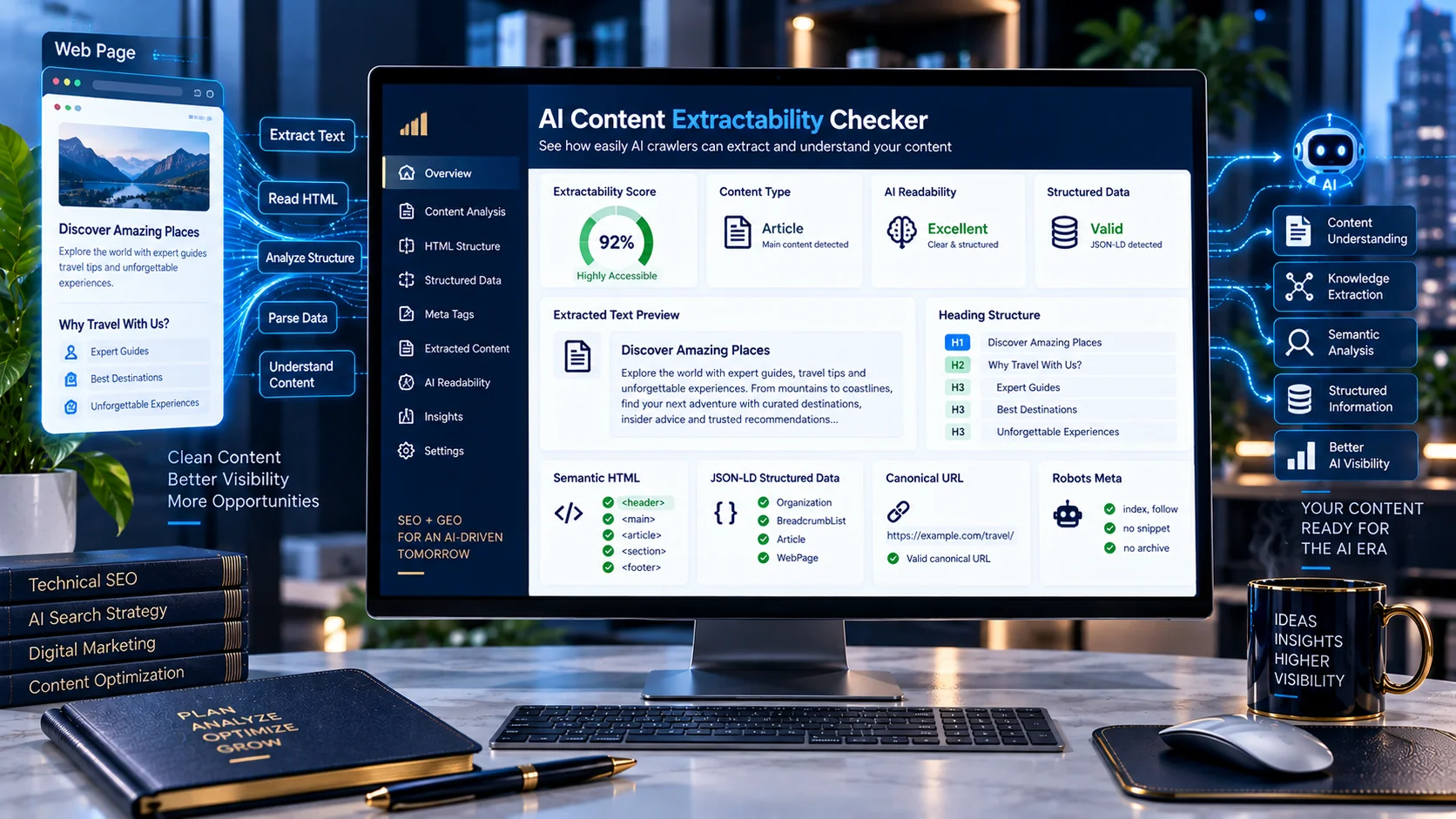
AI Content Extractability Checker helps you determine whether important content on a webpage is accessible, structured, and technically extractable by automated systems such as search crawlers and AI-oriented web crawlers.
A page can be publicly accessible and still be difficult for automated systems to interpret if important information is hidden behind client-side rendering, poorly structured HTML, embedded media, or unclear content boundaries. Google also recommends checking how crawlers see a page and notes that pages should be accessible rather than blocked by robots.txt, noindex, or login requirements.
AI Content Extractability Checker
Check whether important page content is publicly retrievable and presented in a structure that is easier for automated systems to parse and extract.
What Does an AI Content Extractability Checker Do?
An AI content extractability checker helps you assess whether the information on a webpage is presented in a clear, structured, and easy-to-understand format that automated systems can potentially identify and use. It focuses on how content is organized and communicated—not whether an AI system will definitely crawl, retrieve, quote, or cite the page.
What Is Content Extractability?
Content extractability describes how easily a meaningful piece of information can be identified and separated from the surrounding page content. A page may contain useful answers, facts, instructions, or definitions, but those details can be difficult to interpret when they are buried in vague wording, poorly organized sections, or unclear page structure.
For search and answer systems, well-organized content can make the subject and relationships between ideas easier to interpret. Clear headings, descriptive paragraphs, accurate terminology, and direct explanations help readers as well as automated processing systems.
Clear Answers
Important questions are answered directly, without requiring readers to decode vague or unnecessarily long wording.
Logical Structure
Headings, paragraphs, lists, and tables organize related information into understandable sections.
Meaningful Context
Definitions, examples, and supporting details make statements easier to interpret accurately.
Why Make Website Content Easier to Extract?
Website visitors often scan pages to find a specific answer. Search engines and AI-powered systems also need to interpret the information available on a page. Content that is organized around clear questions and meaningful explanations is easier for people to navigate and may be easier for automated systems to process.
- Better reader experience: Visitors can locate important information without searching through unrelated text.
- Clearer topic coverage: Headings and supporting sections show how individual points relate to the main subject.
- More useful answers: Direct explanations help readers understand the page’s central information.
- Improved content maintenance: A structured page is easier to review, update, and keep factually consistent.
- AI and search readiness: Clear content presentation supports interpretation, although platform behavior and selection remain outside the page owner’s control.
How to Review Content Extractability
Use the checker’s available input and instructions to assess the page or content you want to review. Once you receive its output, use the findings as a guide for improving clarity and structure rather than treating them as a final verdict on search or AI performance.
Select the Content to Review
Choose a relevant webpage or content sample according to the input options displayed in the tool.
Run the Analysis
Submit the selected input using the tool’s available controls and wait for the result.
Read the Findings Carefully
Identify any reported areas related to clarity, organization, answer presentation, or content structure.
Improve the Original Page
Make useful edits to the content itself, then review the revised page in its real publishing context.
The exact checks and result labels depend on the checker’s implementation. Interpret the output according to the explanations provided by the tool.
What Makes Content Easier to Extract?
The following practices are broadly useful when preparing informational webpages. They are content-quality recommendations, not a claim that the checker measures every item listed here.
| Content Element | Less Clear Approach | More Extractable Approach |
|---|---|---|
| Headings | Generic headings that do not explain the section | Descriptive headings that identify the topic or question |
| Definitions | Meaning is implied across several paragraphs | A concise definition followed by relevant context |
| Answers | The main answer appears only after unrelated details | A direct answer followed by explanation and evidence |
| Lists | Several separate points are combined into a dense paragraph | Related steps or items are presented in a meaningful list |
| Tables | Comparisons are difficult to follow in continuous prose | Comparable information is arranged under clear column headings |
| Terminology | Unexplained abbreviations or inconsistent names | Consistent terms with explanations where needed |
| Context | Statements lack conditions, dates, or necessary qualifications | Claims include relevant context and limitations |
Example: Improving an Answer for Clarity
Consider a page that explains how to prepare an image for a website. The example below illustrates a content improvement; it is not a sample result generated by this checker.
Less Direct
Images can have different properties, and there are several things that may be considered when preparing them for use online, depending on the requirements of the website.
More Direct
Before uploading an image to a website, choose dimensions that fit the display area, use a suitable file format, and reduce unnecessary file size while preserving acceptable visual quality.
Why the Revision Helps
The revised passage identifies the task, presents practical actions, and keeps the main information together in one understandable answer.
Content Extractability Checklist
Before publishing or updating an important page, review these questions manually alongside any checker output.
- Does the page clearly identify its main subject?
- Do the headings describe the information in each section?
- Are important questions answered directly?
- Are definitions and technical terms explained when necessary?
- Can readers distinguish facts, examples, opinions, and recommendations?
- Are lists and tables used only when they make information easier to understand?
- Are important claims supported by suitable evidence or references?
- Is the content readable on mobile devices?
- Does the page provide enough context for individual statements to make sense?
- Have outdated, duplicated, or irrelevant paragraphs been removed?
What Content Extractability Does Not Mean
Extractability is one part of content presentation. It should not be confused with broader technical or search outcomes.
| It Does Not Automatically Mean | What It Actually Depends On |
|---|---|
| Guaranteed AI citations | Each platform’s retrieval, selection, source evaluation, and response-generation processes |
| Guaranteed search rankings | Many factors, including relevance, quality, competition, technical accessibility, and search-system decisions |
| Guaranteed indexing | Crawling, indexation decisions, canonicalization, and other search engine processes |
| Proof of factual accuracy | Fact-checking, reliable sources, correct context, and editorial review |
| Proof of originality | Originality assessment and appropriate plagiarism or source comparison methods |
| A replacement for technical SEO | Separate checks for accessibility, crawlability, indexability, rendering, and website configuration |
Explore Related AI and Content Tools
Use these related tools for different aspects of content preparation, search readiness, and AI-oriented website analysis.
AI Content Extractability Checker FAQs
What is an AI content extractability checker?
It is a tool intended to help assess how clearly website content presents information that automated systems may need to identify and interpret. The exact checks depend on the tool’s implementation.
How is content extractability different from AI content detection?
Extractability concerns how information is organized and presented for interpretation. AI content detection attempts to estimate whether text may have been generated by an AI system. These are different tasks and should not be treated as interchangeable.
Does high extractability guarantee that AI tools will cite my page?
No. A clear and well-structured page may be easier to interpret, but citations depend on the systems, sources, queries, and selection processes used by each platform.
Can extractability improvements help readers?
Yes. Direct answers, descriptive headings, consistent terminology, and logical organization can make content easier for people to scan and understand.
Should I use short paragraphs everywhere?
Use paragraphs that suit the information. Shorter paragraphs can improve scanning, but complex subjects may need longer explanations to preserve accuracy and context.
Are tables always better than paragraphs?
No. Tables are useful for comparing related information with consistent attributes. Explanations, narratives, and nuanced arguments are often clearer in paragraphs.
Does structured data guarantee content extraction?
No. Structured data can describe page entities and information using a defined vocabulary, but it does not guarantee that a search engine or AI system will extract or cite the content.
Can this checker verify that my content is factually correct?
Extractability analysis should not be treated as a substitute for fact-checking. Verify important claims against reliable sources and review whether the wording preserves the correct context.
How often should I review content extractability?
Review important pages when their purpose, information, structure, or audience changes. Periodic editorial reviews can also help identify unclear or outdated sections.
What should I do after reviewing the result?
Prioritize changes that improve clarity, organization, context, and usefulness. Recheck the revised content and confirm that the changes remain accurate and relevant to the page’s readers.