
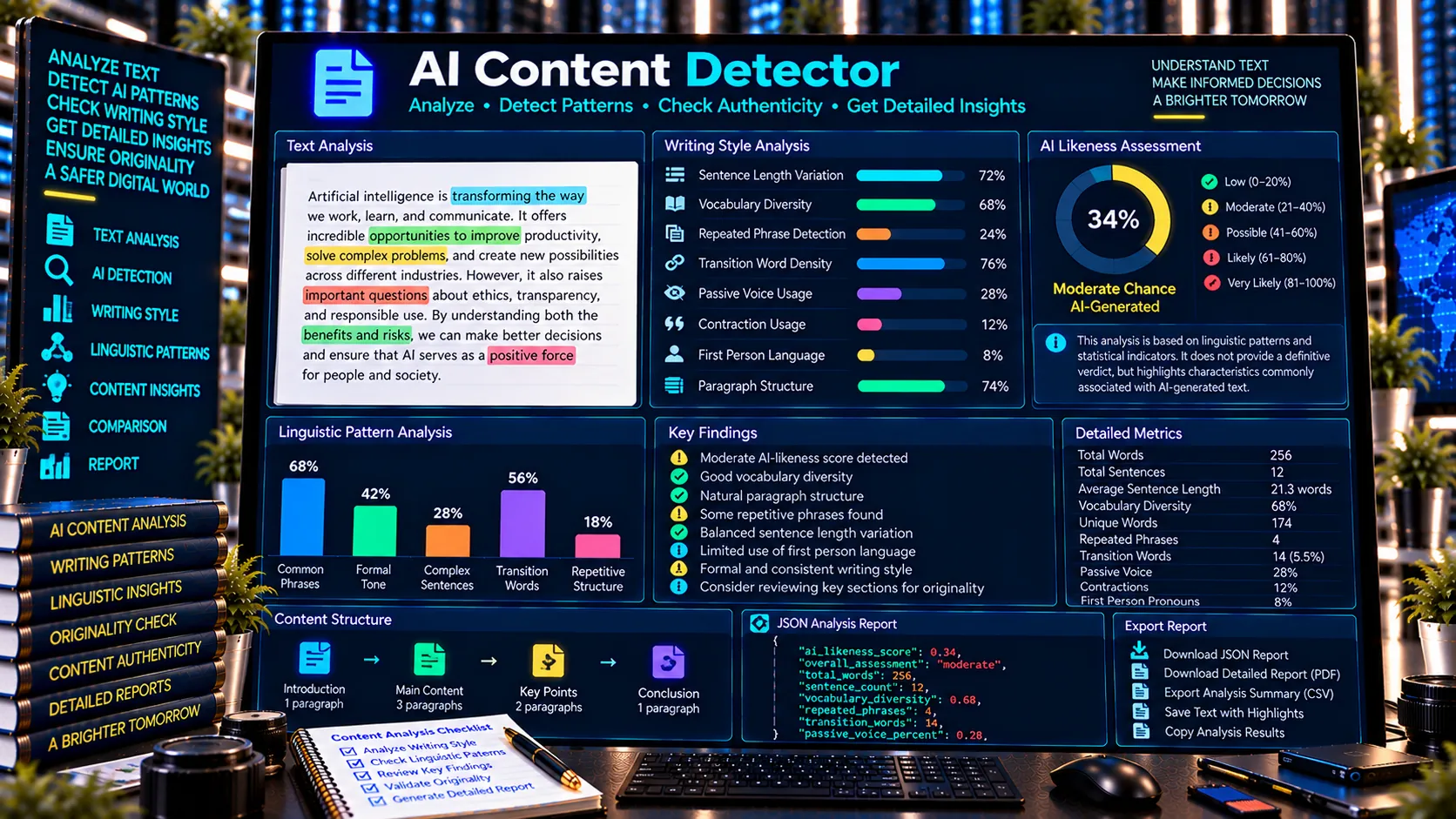
PKCapra’s AI Content Detector is a browser-based text analysis tool that examines writing for patterns commonly associated with AI-generated or highly formulaic text. It evaluates sentence structure, vocabulary diversity, repeated phrases, transition-word usage, punctuation patterns, contractions, first-person language, and overall text structure to produce a heuristic AI-likeness assessment.
Paste Text to Analyze
Analyze a text sample to review AI-likeness signals.
What This Detector Checks
PKCapra uses browser-side linguistic and statistical signals to identify patterns that can sometimes appear in AI-generated or heavily machine-assisted writing.
- Sentence-length variation
- Vocabulary diversity
- Repeated phrases and wording
- Transition-word density
- Punctuation patterns
- Contraction and first-person usage
- Text structure and repetition
This is a heuristic detector, not proof of authorship or AI generation.
AI-Likeness Signal
Signal Findings
Text Metrics
JSON Report
What Is an AI Content Detector?
An AI Content Detector analyzes written text for measurable linguistic and structural patterns that may be associated with AI-assisted or highly standardized writing.
PKCapra’s approach focuses on observable characteristics within the submitted text rather than claiming to identify authorship with certainty.
The tool generates an AI-likeness signal based on multiple text characteristics and provides detailed findings so users can review the factors contributing to the assessment.
What Does the AI Content Detector Check?
Sentence Length and Variation
AI-generated and highly formulaic writing can sometimes exhibit particular sentence-length patterns.
The detector examines:
- Average sentence length
- Sentence-length variation
- Short and long sentence distribution
- Overall sentence structure
Sentence length alone cannot establish whether text was written by a human or AI, so it is evaluated alongside other signals.
Vocabulary Diversity
The tool examines vocabulary usage throughout the submitted text.
It can analyze:
- Unique word usage
- Vocabulary diversity
- Repeated vocabulary
- Overall lexical variation
A more varied vocabulary can produce different statistical characteristics from highly repetitive writing, but vocabulary diversity is not an authorship proof.
Repeated Phrase Detection
Repeated phrases can provide useful information about writing style and text construction.
The detector identifies recurring phrases and presents them as part of the overall analysis.
Repeated wording may occur naturally in human writing, technical documentation, SEO content, academic writing, or AI-generated content, so the findings require contextual interpretation.
Transition-Word Density
The detector examines the frequency of common transition words and phrases.
Examples can include language used to connect:
- Ideas
- Contrasts
- Conclusions
- Explanations
- Sequential points
Transition-word frequency is treated as one signal among several rather than an independent AI detector.
Punctuation Patterns
Punctuation can contribute to measurable differences in writing style.
The tool examines available punctuation patterns within the submitted text and includes relevant observations in the analysis.
These patterns can vary considerably by writing genre, language, author preference, and editorial style.
Contractions
The detector examines contraction usage where applicable.
The presence or absence of contractions can contribute to the overall linguistic profile of text, although formal human writing may naturally use fewer contractions.
First-Person Language
The tool checks for first-person language patterns within the submitted text.
This can help describe the writing style and structure, but first-person usage does not indicate whether content was produced by a human or AI.
Paragraph and Text Structure
The detector also reviews the overall organization of the submitted text.
This can include:
- Paragraph count
- Text length
- Sentence distribution
- Structural variation
- Repeated patterns
These observations contribute to the broader heuristic assessment.
How Does the AI Content Detection Score Work?
PKCapra combines multiple observable text signals into an overall AI-likeness heuristic assessment.
The assessment may consider:
- Sentence-length variation
- Vocabulary diversity
- Repeated phrases
- Transition-word density
- Punctuation patterns
- Contraction usage
- First-person language
- Paragraph and text structure
The resulting score is designed to summarize the available signals.
It should not be interpreted as a probability that a specific person or AI system wrote the text.
Why AI Content Detection Is Difficult
AI-generated text can resemble human writing, while human writers can naturally produce text with patterns that resemble machine-generated writing.
For example, professional, academic, technical, SEO, and highly edited content may have:
- Consistent sentence structures
- Formal vocabulary
- Repeated terminology
- Frequent transition phrases
- Predictable paragraph organization
These characteristics can occur in entirely human-written content.
Conversely, AI-generated content can be heavily edited and may no longer display obvious AI-associated patterns.
AI Content Detector vs AI Authorship Proof
An AI content detector should be treated as an analytical aid rather than an authorship verification system.
PKCapra’s tool does not claim to prove:
- Who wrote the content
- Which AI model produced it
- Whether AI was used during drafting
- Whether a human edited AI-generated text
- Whether text is completely human-written
Instead, it reports measurable linguistic and structural signals that users can investigate.
When Can an AI Content Detector Be Useful?
The tool can help users perform an initial review of:
- Blog articles
- Website copy
- Marketing content
- Student writing
- Draft documents
- Editorial content
- AI-assisted writing
- SEO content
- Research drafts
- Long-form text
The results can help identify unusual repetition or formulaic patterns that may deserve additional human review.
AI Content Detection for SEO Content
SEO writing can naturally contain repeated keywords, structured headings, transition phrases, concise explanations, and predictable formatting.
These characteristics can influence automated AI-likeness analysis.
For that reason, an AI detection result should not be used by itself to judge the quality, originality, or authorship of SEO content.
A better workflow is to combine automated signals with editorial review, source verification, originality checks, and factual quality assessment.
AI Content Detection for Education
Students, teachers, and academic reviewers may use AI detection tools as one part of a broader review process.
However, a heuristic AI-likeness score should not by itself establish academic misconduct or prove that a student used generative AI.
Context, writing history, drafts, citations, institutional procedures, and human review may be necessary for consequential decisions.
Browser-Based AI Content Analysis
PKCapra’s AI Content Detector is designed to analyze submitted text directly in the browser.
The tool does not require an external AI API for its analysis and is designed around deterministic text metrics and heuristic signals.
Users can review the analysis without sending their text to a remote AI detection service.
Detailed AI Content Detection Report
After analyzing text, the tool provides structured findings that can include:
- AI-likeness signal score
- Text metrics
- Sentence statistics
- Vocabulary metrics
- Repeated phrase findings
- Transition-word patterns
- Punctuation observations
- First-person language signals
- Structural findings
- JSON analysis report
The report can be copied or downloaded for documentation and further review.
Limitations of AI Content Detection
No text-pattern detector can reliably establish authorship from writing style alone.
The results may be affected by:
- Writing genre
- Language
- Editing
- Text length
- Professional writing conventions
- Academic writing conventions
- SEO formatting
- Repeated terminology
- Human writing style
- AI-assisted editing
Short text can also provide fewer signals than longer writing.
PKCapra therefore presents its result as a heuristic AI-likeness signal, not a definitive AI-authorship verdict.
Who Can Use an AI Content Detector?
PKCapra’s AI Content Detector can be useful for:
- Writers
- Editors
- Content teams
- SEO professionals
- Publishers
- Researchers
- Teachers
- Students
- Website owners
- Marketing teams
- AI-assisted content workflows
It is particularly useful when users want to inspect measurable writing patterns before conducting a deeper human review.
Frequently Asked Questions
Can the AI Content Detector prove that text was written by AI?
No. It provides a heuristic assessment based on observable linguistic and structural patterns. It cannot conclusively establish AI authorship.
Can human-written content receive a high AI-likeness score?
Yes. Human writing can naturally contain patterns associated with formal, structured, repetitive, or highly edited text.
Can AI-generated content receive a low AI-likeness score?
Yes. AI-generated text can be edited, rewritten, or naturally vary enough that it does not display strong signals under a particular heuristic analysis.
Does the detector identify the AI model used?
No. The tool does not identify whether text came from ChatGPT, Claude, Gemini, or another specific AI system.
Does the tool upload my text?
The tool is designed for browser-side processing and does not require an external AI API for its analysis.
How much text should I analyze?
Longer passages generally provide more linguistic material for pattern analysis than extremely short snippets. Results should still be interpreted in context.
Is an AI detection score proof of plagiarism?
No. AI-likeness and plagiarism are different questions. A text can be original and still show formulaic patterns, while copied text may not necessarily produce a particular AI-likeness signal.
Analyze Writing Patterns With PKCapra
Use PKCapra’s AI Content Detector to examine sentence structure, vocabulary diversity, repeated phrases, transition-word density, punctuation, contractions, first-person language, and overall text structure, then review the resulting heuristic AI-likeness assessment.