
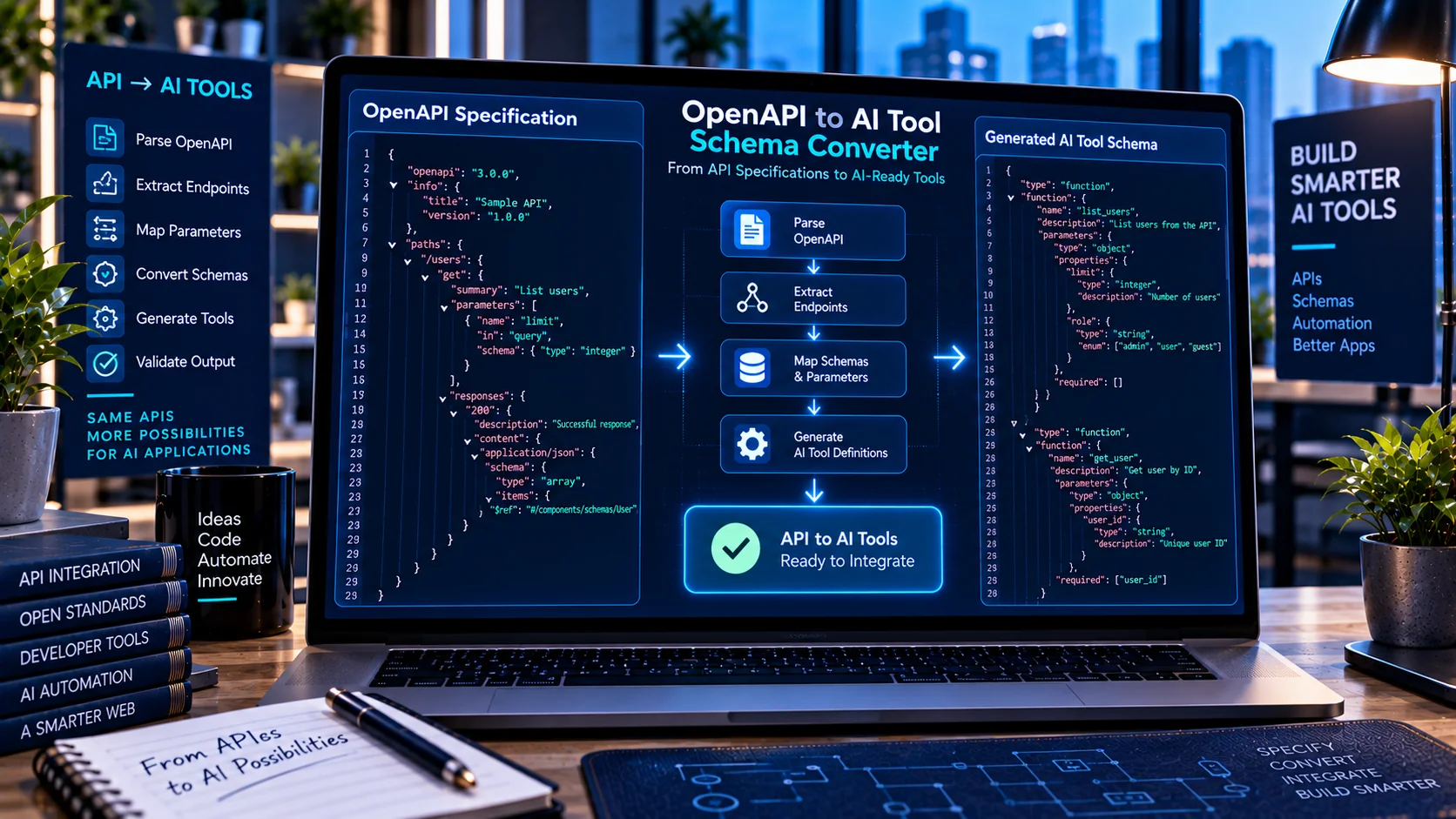
OpenAPI specifications are commonly used to describe APIs, including their endpoints, parameters, request bodies, and data structures. When an API needs to become available as an AI-callable tool, manually converting every OpenAPI operation into a tool definition can be repetitive and error-prone.
The OpenAPI to AI Tool Schema Converter helps developers transform supported OpenAPI 3.0 and 3.1 specifications into structured AI tool definitions. It can discover API operations, map parameters and request-body schemas, resolve references, and generate tool definitions for supported AI formats.
What Is an OpenAPI to AI Tool Schema Converter?
An OpenAPI to AI Tool Schema Converter transforms API operations described in an OpenAPI document into AI-callable tool definitions.
An OpenAPI specification can contain information such as:
- API paths
- HTTP methods
- Operation IDs
- Summaries
- Descriptions
- Query parameters
- Path parameters
- Header parameters
- Request bodies
- JSON schemas
- Nested objects
- Arrays
- Enumerations
- References
The converter uses this information to construct structured tool definitions that can serve as a starting point for AI function-calling workflows.
Why Convert OpenAPI Into AI Tools?
Many existing APIs already have detailed OpenAPI specifications.
Recreating every endpoint manually as an AI tool can require repeating information that is already present in the API specification.
Converting an OpenAPI document can help developers move from:
OpenAPI API Definition → AI Tool Definitions
This can be useful when building AI agents, tool-using assistants, API-connected applications, and function-calling workflows.
Supported OpenAPI Versions
The PKCapra converter supports OpenAPI:
- 3.0
- 3.1
The input can contain multiple API paths and operations, allowing developers to select or process supported operations from a larger specification.
How the OpenAPI to AI Tool Schema Converter Works
A typical workflow is:
- Open the OpenAPI to AI Tool Schema Converter.
- Provide an OpenAPI JSON document.
- Let the converter analyze the specification.
- Review discovered API operations.
- Select the operation or operations to convert.
- Choose the desired AI tool format.
- Generate the tool definitions.
- Review the generated JSON.
- Copy or download the result.
- Test the generated tools with the target AI platform.
The generated output should be reviewed before production use because an OpenAPI specification and an AI tool interface can have different practical requirements.
OpenAPI Operations to AI Tools
Each API operation can potentially become an individual AI tool.
For example, an OpenAPI specification might describe:
GET /usersGET /users/{id}POST /usersPATCH /users/{id}DELETE /users/{id}
The converter can discover these operations and use their available OpenAPI metadata to build corresponding tool definitions.
This can make large API specifications easier to transform into AI-oriented interfaces.
Operation IDs and AI Tool Names
OpenAPI’s operationId provides an important identifier for an API operation.
Where available, the converter can use the operation ID as the basis for the generated AI tool name.
For example:
getUser
can become the tool name associated with the corresponding API operation.
Clear and unique tool names are important when multiple tools are provided to an AI model.
API Descriptions
OpenAPI specifications can contain summaries and descriptions that explain what an endpoint does.
The converter can use available descriptive information when generating AI tool descriptions.
A useful tool description should make the operation’s purpose clear so that developers can review whether the resulting AI tool accurately represents the underlying API operation.
Query Parameters
OpenAPI operations frequently use query parameters for filtering, searching, pagination, sorting, and other options.
The converter can map supported query parameters into the generated tool’s parameter structure.
For example, an endpoint such as:
GET /products?category=books
can expose category as a structured parameter rather than requiring the AI application to manually construct the query string.
Path Parameters
Path parameters are another common OpenAPI feature.
An endpoint such as:
GET /users/{id}
can expose id as a tool parameter.
This helps preserve the relationship between the API operation and the value required to construct its URL.
Header Parameters
OpenAPI operations can also define header parameters.
Where supported by the specification, these can be represented in the generated tool structure.
Developers should review generated header-related parameters carefully because authentication and security headers often require application-specific handling rather than direct exposure to an AI model.
Request Bodies
Many APIs use request bodies for POST, PUT, and PATCH operations.
The converter can inspect supported request-body schemas and use their structure when generating the corresponding AI tool definition.
This can include:
- Objects
- Properties
- Required fields
- Nested objects
- Arrays
- Enumerations
- Common JSON Schema constraints
Nested Request Schemas
Real-world APIs frequently use complex request structures.
For example, an API might accept:
- Customer information
- Billing information
- Shipping information
- Product items
inside one request object.
The converter can preserve supported nested schema structures so that the generated tool definition represents the underlying request more accurately.
Arrays and Object Properties
OpenAPI schemas can describe arrays containing primitive values or objects.
The converter can process supported array structures and object properties when generating the corresponding AI tool schema.
This is particularly useful for APIs that accept lists of products, recipients, records, filters, or other collections.
Enum Values
OpenAPI specifications may restrict a property to a predefined list of values.
For example, a status parameter might allow:
pendingactivecompleted
The converter can preserve supported enum information in the generated schema.
This helps maintain constraints that already exist in the OpenAPI specification.
$ref Resolution
OpenAPI documents commonly reuse schemas through $ref.
Instead of defining the same object repeatedly, a specification may reference a reusable component under components.schemas.
The PKCapra converter supports $ref resolution for supported schema structures so referenced definitions can be incorporated into generated tool schemas.
This is particularly useful for larger OpenAPI specifications containing reusable models.
Combined JSON Schema Structures
Supported schema structures can include combinations such as:
allOfoneOfanyOfnotadditionalProperties
These structures can appear in more advanced OpenAPI specifications.
Because AI tool schemas and OpenAPI schemas are not always identical, generated results should be reviewed when complex schema composition is involved.
Supported AI Tool Formats
The converter can generate several tool representations, including:
- OpenAI tool format
- Anthropic tool format
- Gemini function declaration format
- Generic tool schema
This allows developers to use the generated output as a starting point for different AI development environments.
Always verify the generated structure against the current API or SDK requirements of the target platform.
Converting Multiple OpenAPI Operations
Large OpenAPI specifications may contain dozens or hundreds of operations.
The converter can discover multiple operations and generate multiple AI tool definitions from the selected operations.
This can be useful when exposing a subset of an existing API to an AI agent rather than manually creating each tool definition.
Developers should still be selective about which operations are exposed to an AI system.
OpenAPI to AI Tool Workflow
A practical workflow can be:
OpenAPI Specification → Operation Discovery → Operation Selection → Schema Conversion → Validation → Testing
First inspect the API specification and identify the operations that should be available.
Then convert those operations into AI tool definitions.
After conversion, validate the generated schemas and test the resulting tools before connecting them to a production AI workflow.
OpenAPI to AI Tool Schema Converter vs. JSON to AI Tool Schema Generator
These tools start from different inputs.
The OpenAPI to AI Tool Schema Converter starts with an API specification containing endpoints and operations.
The JSON to AI Tool Schema Generator starts with JSON examples or JSON Schema and generates an AI tool schema from the available structure.
Use OpenAPI conversion when an API specification already exists.
Use JSON-based generation when your starting point is structured JSON rather than a complete API definition.
OpenAPI to AI Tool Schema Converter vs. AI Tool Schema Converter
The OpenAPI to AI Tool Schema Converter creates AI tool definitions from OpenAPI API operations.
The AI Tool Schema Converter works with existing AI tool/function schema representations and converts them between supported formats.
A possible workflow is:
OpenAPI → AI Tool Schema → Different AI Tool Format
OpenAPI Conversion and Schema Validation
Generated tool definitions should be reviewed before they are used in an AI application.
The AI Tool Schema Validator can be used to inspect the resulting tool schema for structural problems and consistency issues.
A practical workflow is:
Convert → Validate → Test → Deploy
This helps separate the conversion process from schema quality checks.
Common OpenAPI Conversion Issues
Missing Operation IDs
Some API operations may not contain an operationId.
These operations may require review before they can be given a clear AI tool name.
Complex References
Large specifications can contain deeply nested or circular references. Review generated output carefully when complex $ref structures are involved.
Provider-Specific Schema Differences
An OpenAPI schema may contain features that do not map perfectly to every AI tool format.
Generated definitions may therefore require manual adjustment.
Authentication Requirements
An OpenAPI specification may describe authentication schemes that should not be exposed directly as model-controlled parameters.
Authentication should generally remain under application-level control.
Large API Specifications
Not every API endpoint should necessarily become an AI tool.
Exposing too many operations can make tool selection more difficult and increase the complexity of an AI workflow.
Complex Request Bodies
Advanced request-body structures may require manual review to ensure that the generated tool interface accurately represents the API’s expected input.
Best Practices for OpenAPI to AI Tool Conversion
For a reliable workflow:
- Keep OpenAPI specifications accurate and up to date.
- Use clear
operationIdvalues. - Write useful endpoint descriptions.
- Review generated tool names.
- Review required parameters.
- Check nested request-body schemas.
- Verify enums and constraints.
- Review
$ref-resolved structures. - Keep authentication under appropriate application control.
- Expose only the API operations an AI application actually needs.
- Validate generated tool schemas.
- Test tool calls against the actual API before production deployment.
Browser-Based OpenAPI Conversion
PKCapra’s OpenAPI to AI Tool Schema Converter is designed for browser-based processing.
This makes it useful for developers who want to inspect an OpenAPI document and quickly generate AI-oriented tool definitions without writing a separate conversion script for basic workflows.
The tool processes the provided specification in the browser and does not require an external AI API for the conversion itself.
For proprietary API specifications, developers should still follow their organization’s security and data-handling requirements.
Limitations
OpenAPI and AI tool schemas are related but are not identical standards.
An OpenAPI operation can contain information that does not have a direct equivalent in an AI function-calling interface. Conversely, an AI platform may impose requirements that are not represented in the original OpenAPI document.
The generated output should therefore be considered a conversion starting point rather than an automatic guarantee of production compatibility.
Authentication, authorization, rate limits, business rules, response handling, and application-specific behavior may require additional implementation outside the generated tool schema.
Frequently Asked Questions
What is an OpenAPI to AI Tool Schema Converter?
It is a tool that transforms supported OpenAPI API operations into structured AI tool definitions.
Which OpenAPI versions are supported?
The PKCapra converter supports OpenAPI 3.0 and 3.1 specifications.
Can it convert multiple API endpoints?
Yes. It can discover multiple operations and generate multiple AI tool definitions.
Does it support GET and POST operations?
Yes. Supported HTTP operations include GET, POST, PUT, PATCH, DELETE, HEAD, OPTIONS, and TRACE.
Can it process path parameters?
Yes. Supported OpenAPI path parameters can be represented in the generated tool structure.
Can it convert request bodies?
Yes. Supported request-body schemas can be converted into structured tool parameters.
Does it support $ref?
Yes. The converter supports $ref resolution for supported OpenAPI schema structures.
Can it preserve enums?
Yes. Supported enum definitions can be carried into the generated schema.
Does it support nested objects and arrays?
Yes. The converter supports nested object structures and arrays in supported schemas.
Can it generate different AI tool formats?
Yes. Supported outputs include OpenAI tool format, Anthropic tool format, Gemini function declaration format, and a generic tool schema.
Is the generated tool automatically production-ready?
No. Generated schemas should be reviewed and tested against the target AI platform and the underlying API before production use.
Does the converter make API calls?
No. The conversion itself is designed to process the supplied OpenAPI specification in the browser.
Convert Your OpenAPI Specification
The PKCapra OpenAPI to AI Tool Schema Converter provides a practical bridge between existing API specifications and AI tool development.
Start with an OpenAPI 3.0 or 3.1 specification, discover the operations you need, generate structured AI tool definitions, validate the output, and test the resulting tools before integrating them into an AI application.