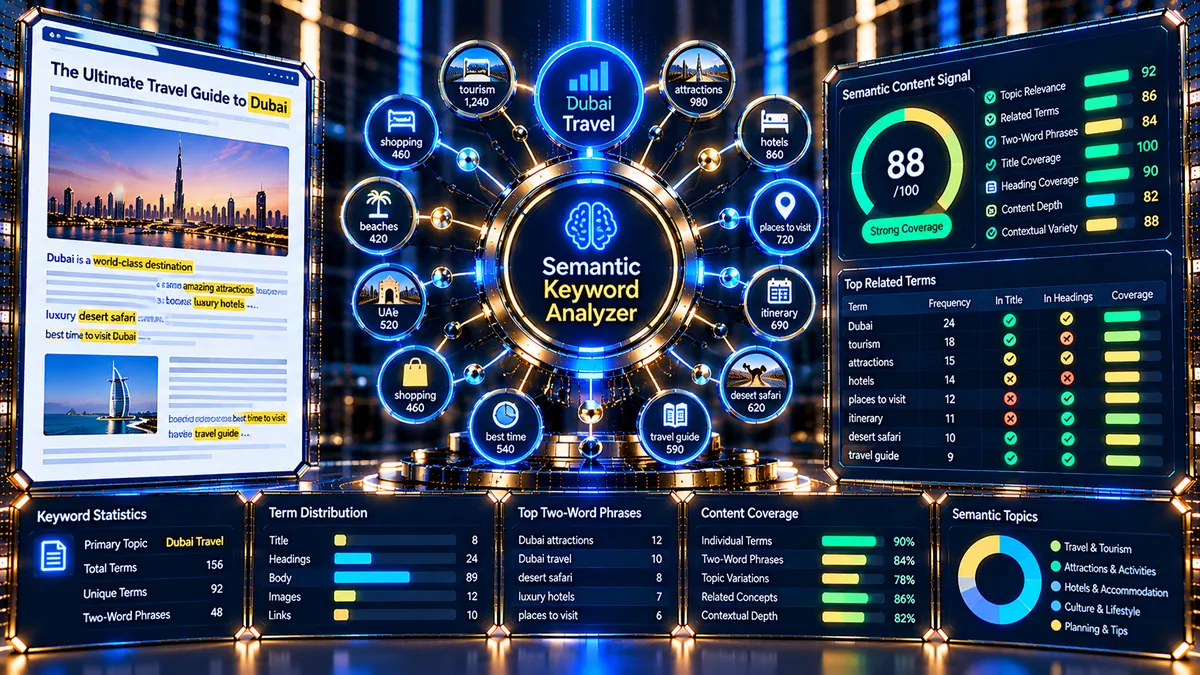
A Semantic Keyword Analyzer helps you understand the important terms and recurring phrase patterns present in a webpage and how they relate to a focus topic. PKCapra analyzes the page’s visible content, extracts meaningful terms and repeated two-word phrases, and reports their frequency, distribution, heading/title presence, and relationship to an optional focus topic.
Semantic Keyword Analyzer
Extract contextually important words and phrases from a webpage or pasted content and see how they are distributed across the page.
| Term | Count | Contexts | Signal |
|---|
| Phrase | Count | Contexts | Signal |
|---|
Semantic terms and phrases are extracted with deterministic text-frequency and structural heuristics. They are not Google's semantic entities, an AI-generated keyword list, or a ranking prediction.
Public URLs are fetched by the PKCapra analysis endpoint. Pasted content is sent to the same endpoint for analysis. Do not submit confidential or sensitive material.
What Is Semantic Keyword Analysis?
Semantic keyword analysis looks beyond a single exact-match keyword and examines the language surrounding a page’s main subject.
For example, a page about technical SEO audits may naturally contain terms such as:
- crawlability
- indexability
- redirects
- canonical
- sitemap
- robots.txt
- HTTP status
- internal links
These terms can help describe the subject and its supporting concepts. The presence of related terminology does not, by itself, prove that a page is comprehensive or that a search engine will rank it for a particular query.
PKCapra’s Semantic Keyword Analyzer provides a deterministic content-level diagnostic. It extracts meaningful terms and repeated two-word phrases from the analyzed webpage and shows how those terms are distributed through the available content.
What Does the Semantic Keyword Analyzer Check?
The current tool analyzes visible webpage content and can optionally compare the extracted language against a focus topic.
Its report includes:
- Meaningful term extraction
- Repeated two-word semantic phrase extraction
- Term frequency
- Context/distribution count
- Title presence signals
- Heading presence signals
- Focus-topic exact matches
- Individual focus-topic term coverage
- Top semantic terms
- Semantic phrase patterns
- Priority findings
- Semantic Content Signal score
- Diagnostic grade
The tool is designed to help identify the language a page actually uses rather than simply checking whether one keyword appears a specified number of times.
Why Semantic Terms Matter
A page normally discusses a subject through more than one word.
Consider a page targeting the concept of an XML sitemap. A useful explanation may naturally mention URLs, crawlers, indexing, sitemap files, XML, status codes, last modification dates and search engines.
Looking only for the exact phrase XML sitemap would not show the full vocabulary used to explain the topic.
Semantic analysis provides another diagnostic layer by showing which meaningful terms and recurring phrase patterns are actually present.
This is useful when reviewing whether a page’s language reflects the subject you intended to cover.
How the Semantic Keyword Analyzer Works
The tool performs a deterministic analysis of the content supplied to it.
1. Provide the webpage or content
The analyzer can work with a public webpage URL or pasted HTML/content, depending on the available input mode.
For a webpage URL, PKCapra retrieves the public HTML and analyzes the page content.
2. Add an optional focus topic
You can optionally enter the main topic or phrase you want to investigate.
For example:
technical SEO audit
The focus topic is used as an additional diagnostic reference. It does not cause the tool to invent related keywords or retrieve suggestions from an external keyword database.
3. Analyze the content
PKCapra extracts meaningful terms from the analyzed content and identifies repeated two-word phrases.
The results then show which terms occur most frequently and how they are distributed through the analyzed content.
4. Review the semantic signals
The report separates individual term and phrase observations from the overall diagnostic signal.
This allows you to inspect the underlying data instead of relying only on one score.
Understanding the Top Semantic Terms
The Top Semantic Terms section shows extracted terms together with their frequency and distribution information.
A term may occur several times in the body while also appearing in a title or heading.
For example:
| Term | Frequency | Distribution |
|---|---|---|
| crawl | 8 | 5 |
| indexing | 6 | 4 |
| sitemap | 5 | 3 |
| canonical | 4 | 3 |
These numbers are diagnostic measurements from the analyzed content.
A high-frequency term is not automatically more important to users or search engines. Common words can occur frequently simply because of the way a page is written.
Understanding Semantic Phrases
The analyzer also identifies repeated two-word phrases.
For example, a technical SEO page might naturally contain phrases such as:
- technical SEO
- crawl budget
- internal links
- XML sitemap
- canonical URL
- HTTP status
Repeated phrases can reveal terminology patterns that a single-keyword check may miss.
The tool does not claim that every extracted phrase is a search-engine-recognized entity, ranking factor, or recommended keyword.
Focus Topic Analysis
When you provide a focus topic, the analyzer adds additional signals around that topic.
It checks:
- Exact focus-topic matches
- Individual focus-topic term coverage
- Presence of focus-related terms in the analyzed content
- Title presence
- Heading presence
This can help distinguish two different situations.
Exact phrase present
The exact focus phrase may occur in the content.
For example:
technical SEO audit
Individual terms present
The page may contain the individual terms technical, SEO, and audit without using the exact phrase together.
This distinction is important because a page can discuss a concept naturally without repeatedly using one exact phrase.
Title and Heading Signals
The analyzer checks whether relevant analyzed terms appear in important structural areas such as the page title and headings.
A page’s headings can help readers understand the structure of the information being presented.
If important terminology appears only deep in the body while the title and headings describe something different, the result may justify a manual content review.
For dedicated heading analysis, use the SEO Heading Analyzer.
Understanding Distribution
Frequency alone does not tell the whole story.
Suppose a term occurs 10 times.
If all 10 occurrences are concentrated in one short paragraph, the term has a different distribution pattern from a term appearing naturally throughout several sections.
The Semantic Keyword Analyzer therefore reports distribution-related information alongside frequency.
Use this as a diagnostic clue rather than as a target to maximize.
Semantic Content Signal
PKCapra produces a Semantic Content Signal on a 0–100 diagnostic scale.
The signal considers the extracted semantic vocabulary, recurring phrase patterns, focus-topic coverage and structural presence signals available to the analyzer.
The score is intended to summarize the tool’s implemented content-analysis heuristics.
It is not:
- A Google ranking score
- A Google semantic relevance score
- An NLP benchmark
- A search-volume score
- A keyword difficulty score
- A guarantee of topical authority
- A prediction of search rankings
A higher diagnostic signal should not be interpreted as proof that a page is better optimized.
How to Interpret the Results
The most useful way to use the report is to investigate the underlying terms and phrases rather than attempting to maximize the score.
Strong semantic coverage
A page may contain a reasonably varied vocabulary around its intended subject, with important terms appearing throughout the content and in useful structural locations.
This can be a good reason to review the page for completeness and clarity.
Limited semantic coverage
A page may use a narrow vocabulary or contain relatively few repeated supporting concepts.
Before changing the page, ask whether the page is actually intended to be narrow.
A short page answering one specific question does not necessarily need a large vocabulary.
Unexpected semantic terms
The analyzer may reveal repeated terms that were not part of your intended topic.
Investigate whether they represent:
- A useful supporting concept
- An unrelated section
- Boilerplate
- Navigation or template text
- Repeated terminology that should be reduced
- A different topic than the one the page was intended to address
Semantic Keywords Are Not a Synonym List
Semantic analysis should not be treated as an instruction to add every related word to a page.
For example, if a page discusses an online sitemap analyzer, you should not automatically insert every extracted term from another page simply because it appears semantically related.
The goal is to make the page more complete and useful where appropriate, not to manufacture a list of keywords.
Google’s current spam policies describe keyword stuffing as filling a page with keywords or numbers in an attempt to manipulate Search, including repeating words or phrases so frequently that the writing becomes unnatural. :contentReference[oaicite:0]{index=0}
Semantic Analysis vs. Keyword Density
These tools answer different questions.
Keyword density asks:
How frequently does a specific keyword or phrase occur?
Semantic analysis asks:
What meaningful terms and recurring phrase patterns are present in the content, and how are they distributed?
For exact keyword frequency and density, use the Keyword Density Checker.
Using both analyses can provide more context than either measurement alone.
Semantic Analysis vs. Keyword Placement
Keyword placement focuses on whether a target phrase appears in locations such as:
- Title
- Meta description
- URL
- H1
- Headings
- Opening content
- Body text
- Image alt text
- Anchor text
The Keyword Placement Checker is designed specifically for that task.
Semantic analysis instead looks at the broader vocabulary and recurring phrase patterns found in the content.
Semantic Analysis vs. Keyword Prominence
Keyword prominence asks how early a target phrase appears within important page elements.
The Keyword Prominence Checker measures the first occurrence position of a target phrase.
Semantic analysis is broader: it does not depend on one exact target phrase being present.
Practical Example
Imagine a page whose focus topic is:
technical SEO audit
The analyzer may find terms such as:
- crawl
- indexing
- canonical
- sitemap
- redirects
- robots
- status
- links
It may also identify recurring phrases such as:
- technical SEO
- crawl budget
- XML sitemap
- canonical URL
This gives you evidence about the vocabulary actually used on the page.
You can then ask:
- Does this vocabulary accurately describe the page?
- Are important supporting concepts missing?
- Are unrelated terms appearing repeatedly?
- Are the important concepts explained clearly?
- Are headings organized around useful reader questions?
- Is the page genuinely comprehensive enough for its intended purpose?
The final decisions should come from the content’s subject, audience and usefulness rather than from the score alone.
How to Improve Semantic Coverage
If the analysis reveals a narrow vocabulary, do not immediately add keywords.
Instead:
Identify missing concepts
Consider what a reader would reasonably need to understand the subject.
For a technical SEO topic, that might include processes, problems, diagnostics, examples and solutions.
Improve explanations
If an important concept is relevant, explain it naturally in the section where it helps the reader.
Improve heading structure
Use headings to organize genuinely useful subtopics rather than creating headings solely to place additional keywords.
Add practical context
Examples, workflows, limitations and troubleshooting information can naturally introduce useful terminology.
Remove unrelated repetition
If an irrelevant term appears repeatedly because of boilerplate or an awkward section, fix the underlying content instead of trying to balance the term frequency artificially.
A Practical Semantic SEO Workflow
Use the analyzer as one part of a broader content-review process:
- Define the page’s primary user question.
- Identify the main topic and important supporting concepts.
- Write the page for the reader rather than a keyword checklist.
- Run the Semantic Keyword Analyzer.
- Review the extracted terms and phrases.
- Check whether important concepts are represented.
- Investigate unexpected or unrelated terminology.
- Review title and heading signals.
- Check exact keyword placement with the Keyword Placement Checker.
- Review frequency with the Keyword Density Checker.
- Review broader page-level signals with the On-Page SEO Checker.
- Improve the content where doing so makes the answer clearer, more complete or more useful.
Common Problems the Analyzer Can Reveal
The page uses only the exact target phrase
A page may focus heavily on one keyword while using little supporting terminology.
Review whether the content actually explains the subject or simply repeats the target phrase.
Supporting terminology is missing
If a topic normally requires several concepts to explain it properly, a narrow vocabulary may indicate that the page needs more useful substance.
This is a content-quality question, not simply a keyword-count problem.
Unrelated terms dominate
Repeated unrelated terminology may indicate boilerplate, excessive navigation text, an incorrectly targeted page or content that has drifted from its intended subject.
Important terms appear only in one section
A concept may be present but poorly integrated into the overall explanation.
Review whether the section structure accurately reflects the user’s questions.
Why You Should Not Chase a Semantic Score
A diagnostic score can help identify areas worth reviewing, but it should not become the objective of the writing process.
Google’s current documentation emphasizes relevant, useful search content and separately warns against practices intended to manipulate Search, including keyword stuffing and large-scale creation of low-value content. :contentReference[oaicite:1]{index=1}
A semantically rich page can still be unhelpful if it fails to answer the user’s question.
Conversely, a focused page can be useful even when it uses a relatively small vocabulary.
The correct goal is meaningful coverage of the subject for the intended reader.
Limitations
The Semantic Keyword Analyzer is a deterministic content-analysis tool rather than a full semantic search or natural-language understanding system.
It does not:
- Query Google’s semantic systems.
- Access Google’s ranking algorithms.
- Retrieve Google’s related-search database.
- Generate authoritative keyword suggestions from search-volume databases.
- Determine search intent automatically.
- Understand every synonym or conceptual relationship.
- Prove topical authority.
- Guarantee rankings.
- Compare your content against Google’s index.
- Crawl an entire website.
- Replace editorial review.
- Determine whether every extracted term is genuinely relevant to the page.
Its semantic signals are based on the content patterns implemented in the PKCapra analyzer.
The extraction of meaningful terms and repeated two-word phrases is therefore best treated as a diagnostic representation of the analyzed text, not as a complete model of human language or search-engine semantics.
Privacy and Processing
When you analyze a public webpage URL, PKCapra retrieves the specified webpage and processes its HTML for the analysis.
The tool does not require a paid keyword database, AI API or external semantic-search service.
When content is supplied directly, the analyzer processes that supplied content for the report.
The analysis is focused on the submitted page/content rather than performing a full-site crawl.
Do not submit private or confidential content unless you understand the implications of processing that content through the service.
Frequently Asked Questions
What is a Semantic Keyword Analyzer?
A Semantic Keyword Analyzer examines the vocabulary and recurring phrase patterns surrounding a page’s subject instead of looking only for one exact keyword.
Does semantic keyword analysis mean using synonyms?
Not necessarily. Semantic analysis can include related terminology, concepts and recurring phrases, but simply replacing keywords with synonyms does not automatically make content more useful.
Does the PKCapra tool use AI?
No. The current analyzer uses deterministic content-analysis logic and does not require an AI API.
Does it use Google’s keyword database?
No. It does not query Google’s keyword database, Search Console data or a commercial keyword database.
Does a higher semantic score mean higher Google rankings?
No. The PKCapra Semantic Content Signal is a diagnostic heuristic and is not a Google ranking score.
Can the tool find related keywords I should definitely add?
No. It shows terminology and phrase patterns found in the analyzed content. It does not claim that every extracted term should be added to the page.
What if my page is intentionally short?
A short page can still be appropriate. Semantic breadth should be judged against the user’s question and the purpose of the page, not against an arbitrary word count or number of extracted terms.
Can I use the tool with a focus topic?
Yes. The optional focus topic provides additional exact-match and individual-term coverage signals.
What is the difference between semantic keywords and keyword density?
Keyword density measures the frequency of a specified keyword or phrase. Semantic analysis examines the broader vocabulary and recurring phrase patterns found in the content.
What should I do after finding missing semantic terms?
First determine whether those concepts are genuinely relevant to the page. If they help answer the user’s question, incorporate them naturally through useful explanations, examples, headings or supporting sections rather than adding isolated keyword lists.
Which PKCapra tools should I use with Semantic Keyword Analyzer?
For a broader on-page workflow, combine it with the Keyword Placement Checker, Keyword Prominence Checker, Keyword Density Checker, SEO Content Score, SEO Heading Analyzer, and On-Page SEO Checker. Use each tool for the specific diagnostic it actually provides.