
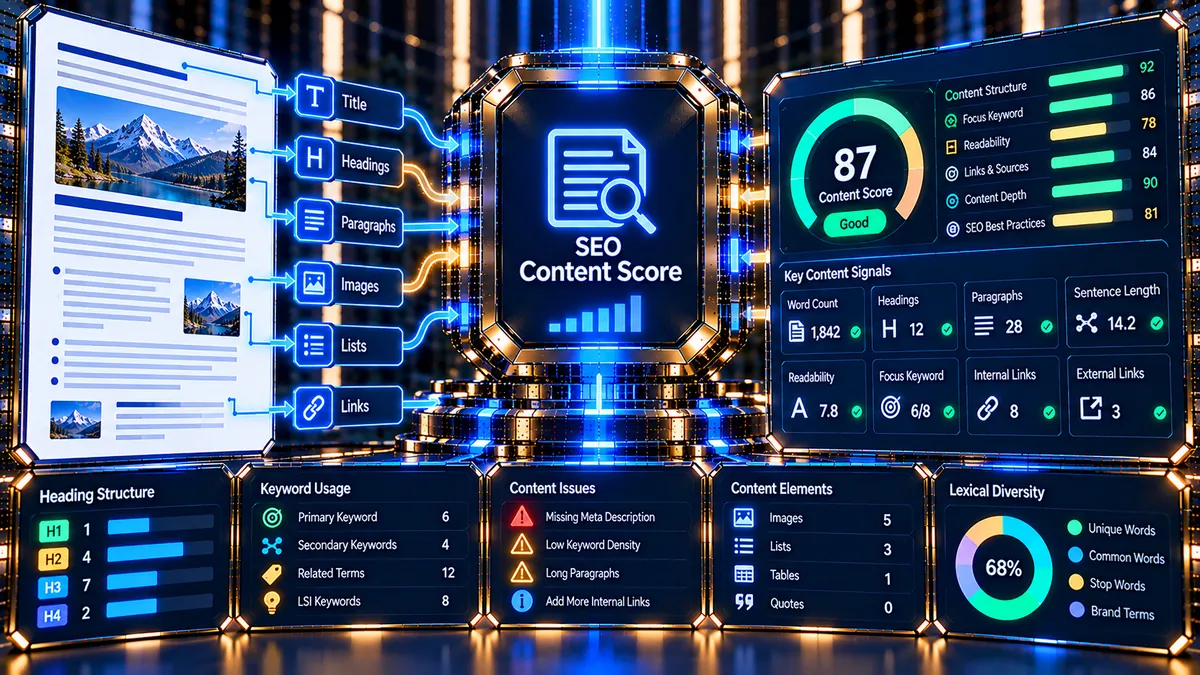
SEO Content Score helps you evaluate pasted webpage content using practical on-page content signals such as content length, heading structure, paragraph structure, sentence length, readability, focus-keyword usage, lists, and links. Enter your content, optionally provide a focus keyword, and PKCapra produces a diagnostic score, grade, signal breakdown, priorities, and supporting content metrics.
SEO Content Score
Analyze pasted webpage content for practical on-page content signals, structure, readability, keyword use, links, and coverage indicators.
The score is a PKCapra diagnostic heuristic based on the supplied content. It is not a Google ranking score and does not predict search performance.
Content is analyzed by the PKCapra tool endpoint you submit to. Do not paste confidential, personal, or sensitive material.
What Is an SEO Content Score?
An SEO Content Score is a diagnostic assessment of content structure and selected on-page signals.
The PKCapra SEO Content Score analyzes content that you paste into the tool and evaluates measurable characteristics including:
- Word count
- Heading structure
- H1 count
- H2 count
- H3 and lower heading count
- Paragraph count
- Sentence count
- Average sentence length
- Very long sentences
- List blocks
- Links
- Focus-keyword occurrences
- Estimated keyword density
- Estimated readability
- Lexical diversity
- Content-structure signals
- Priority findings
The result is a PKCapra diagnostic heuristic. It is not a Google ranking score, does not reproduce Google’s ranking systems, and does not predict whether a page will rank.
Google’s current Search documentation emphasizes creating useful, reliable, people-first content and avoiding practices such as keyword stuffing and content created primarily to manipulate search rankings. Google Search Essentials and spam policies
Why Use an SEO Content Score?
A content audit can become difficult when you are reviewing many pages or long articles.
You may want to know:
- Is the content substantial enough for its intended purpose?
- Does it have a useful heading structure?
- Are sentences becoming unnecessarily long?
- Is the content divided into readable paragraphs?
- Does the supplied focus keyword actually appear?
- Is the keyword being repeated excessively?
- Are there useful lists where appropriate?
- Does the content contain links?
- Is the estimated reading difficulty reasonable?
- Which measurable issues should be reviewed first?
PKCapra turns several of these questions into a repeatable diagnostic report.
The tool is designed to help you identify areas for review. It should not replace editorial judgment, subject-matter expertise, search-intent research, or a complete SEO audit.
What Does the PKCapra SEO Content Score Check?
Content Length
The analyzer counts the words detected in the supplied content.
Content containing at least 300 detected words receives a positive content-length signal in the current heuristic.
Content below 300 words receives a review warning suggesting that you consider whether it adequately answers the intended topic.
This is not a universal minimum word-count requirement.
There is no rule that every useful webpage must contain 300 words. A short page can completely satisfy a specific intent, while a long page can still be unhelpful.
The 300-word threshold is simply one of the transparent diagnostic rules implemented by this PKCapra tool.
Heading Structure
The analyzer detects:
- H1 headings
- H2 headings
- H3 through H6 headings
- Total headings
The report can therefore show whether the supplied content contains a heading hierarchy and whether multiple H1 elements are present.
The current heuristic gives a positive signal when one H1 is detected and a warning when no H1 or multiple H1 elements are detected.
It also checks whether at least one H2 is present.
Heading counts should be interpreted in context. A tool that evaluates pasted content cannot determine whether the page title supplied separately by a CMS already provides the document’s H1.
For example, a WordPress page may have its H1 generated by the theme while the body content intentionally begins with H2 headings.
Paragraph Structure
The analyzer estimates paragraph count from paragraph breaks in the supplied text.
It uses paragraph separation to identify whether the content has multiple readable blocks.
Three or more detected paragraphs receive a positive structure signal in the current heuristic.
A small number of paragraphs does not automatically mean that content is poor. Short content, landing-page sections, lists, and specialized formats can naturally have different structures.
Sentence Count
The tool estimates the number of sentences based on sentence-ending punctuation and surrounding text.
Sentence count is used for several other measurements, including:
- Average sentence length
- Long-sentence detection
- Readability estimation
Because sentence detection is performed programmatically, unusual punctuation, abbreviations, headings, code, and non-standard writing patterns can affect the result.
Average Sentence Length
The analyzer calculates the average number of words per detected sentence.
The current heuristic treats an average sentence length of 24 words or fewer as a positive signal.
Longer averages receive a review warning.
This does not mean every sentence should be short. Technical, legal, academic, and specialist writing may legitimately require longer sentences.
The result is intended to identify passages worth reviewing rather than enforce a fixed writing style.
Long Sentences
The tool counts sentences containing more than 30 detected words.
It then compares the number of long sentences with the overall sentence count.
A small proportion of long sentences receives a positive signal. A higher proportion produces a review finding.
Long sentences are not automatically incorrect. The purpose of the check is to identify areas where a sentence may be difficult to follow and could potentially be split or simplified.
Lists
The analyzer detects unordered and ordered list blocks when they are present in supplied HTML.
It recognizes:
<ul><ol>
A page containing at least one list receives a positive list-structure signal.
If no list is detected, the tool reports that lists are optional and should be used only where they improve clarity.
This distinction is important: every page does not need a list.
Lists are useful when they make information easier to scan, compare, follow, or understand.
Links
The analyzer counts anchor elements in supplied HTML.
For example:
<a href="/seo-tools/">SEO tools</a>
contains one link.
The tool reports the number of detected links but does not crawl those destinations or determine whether every link is relevant.
For detailed anchor-text analysis, use the PKCapra Anchor Text Analyzer.
For broader internal-link and crawl-path analysis, use the PKCapra Internal Links Crawl Path Analyzer.
Focus Keyword
The focus keyword is optional.
For example:
technical SEO audit
The analyzer checks whether the supplied phrase occurs in the normalized content.
The matching is case-insensitive and uses word-boundary conditions so that the phrase is not simply counted as an arbitrary substring inside another word.
If the focus keyword appears, the tool reports:
- Number of occurrences
- Estimated keyword density
If the focus keyword does not appear, the current heuristic generates a warning.
If no focus keyword is supplied, keyword-specific checks are skipped.
Keyword Density
When a focus keyword is supplied, the analyzer estimates density using the number of matching keyword occurrences relative to the detected word count.
For example, if a phrase occurs several times within a 1,000-word document, the tool calculates an estimated percentage based on that occurrence count.
Keyword density should not be treated as a target percentage.
A page should not be rewritten simply to reach a particular density number. Google explicitly identifies unnaturally repeated keywords and phrases as keyword stuffing. Google Search spam policies
The PKCapra density figure is therefore best used as a diagnostic measurement rather than a recommended optimization target.
Readability
The tool calculates an estimated Flesch Reading Ease score when enough sentence and word data is available.
The implementation uses an internal syllable-counting heuristic and sentence/word counts to estimate readability.
The current diagnostic interpretation is:
- 60 or higher: positive readability signal
- 40–59.9: review for dense passages
- Below 40: review sentence and word complexity
Readability scores are estimates, not universal measures of content quality.
A technical guide for experienced developers may appropriately be more difficult to read than a consumer-facing introduction.
Lexical Diversity
The analyzer also calculates an estimated lexical-diversity percentage based on unique normalized words relative to the total detected word count.
This metric can provide additional context about vocabulary variation.
It is not used as a standalone quality verdict.
A lower lexical-diversity value does not automatically mean the content is poor, especially for focused technical topics where important terminology naturally repeats.
How the SEO Content Score Is Calculated
The current PKCapra implementation starts with a score of 100 and applies transparent heuristic deductions when specific review conditions are detected.
Examples include:
| Signal | Diagnostic behavior |
|---|---|
| Content under 300 words | Review warning |
| No H1 | Review warning |
| Multiple H1 headings | Review warning |
| No H2 | Review warning |
| Few paragraph breaks | Review warning |
| Average sentence length above 24 words | Review warning |
| Higher proportion of sentences over 30 words | Review warning |
| No lists | Informational only |
| Focus keyword missing when supplied | Review warning |
| No links | Informational only |
| Lower readability estimate | Review warning |
The tool then limits the final result to a score between 0 and 100.
The grade is currently:
- 90–100: Excellent
- 75–89: Good
- 60–74: Needs Work
- 0–59: Poor
These grades belong to the PKCapra diagnostic system.
They are not Google’s classifications and should not be interpreted as predictions of search rankings.
Why a 100/100 Score Does Not Guarantee Rankings
A content score cannot measure everything that determines whether content is useful or competitive.
For example, the analyzer cannot determine from pasted text alone whether:
- The content satisfies the searcher’s actual intent
- The information is factually accurate
- The author has appropriate first-hand experience
- The content provides original value
- Important topics are missing
- Competitors provide better answers
- The page has earned useful links
- The site is technically crawlable
- The content is properly indexed
- The page has a suitable title and description
- The page provides a good overall experience
Google’s documentation describes many aspects of Search and explicitly warns against treating individual metrics as guarantees of ranking performance. Google Search Central
The PKCapra score should therefore be treated as one diagnostic layer within a larger content and SEO workflow.
How to Use the SEO Content Score
Step 1: Prepare the Content
Copy the article, landing-page content, guide, or other webpage content you want to evaluate.
The tool accepts up to 200,000 characters.
Step 2: Add a Focus Keyword
This field is optional.
If you are checking keyword usage, enter the phrase you are targeting.
For example:
SEO content score
If you leave the field empty, the keyword-specific checks are skipped.
Step 3: Paste the Content
Paste your content into the Content to Analyze field.
The tool can analyze plain text and HTML-containing content.
If you want heading and link detection to work from HTML markup, the corresponding heading and anchor elements need to be present in the supplied content.
Step 4: Click Analyze Content
Select Analyze Content.
PKCapra processes the submitted content and generates the diagnostic report.
Step 5: Review the Score
Start with the overall score and grade, but do not stop there.
The most useful part of the report is often the individual Content Signals and Priorities.
Step 6: Review the Metrics
The report provides:
- Words
- Headings
- Paragraphs
- Sentences
- Lists
- Links
- Keyword uses
- Readability
These numbers help explain the overall result.
Step 7: Review Content Signals
Each signal has a status and supporting explanation.
The statuses indicate whether a particular measurement is positive, needs review, or is informational.
This lets you identify the specific reason behind a finding instead of relying only on the final score.
Step 8: Review Priorities
The tool provides up to eight priority findings.
Use these findings as a checklist for further editorial review.
Step 9: Recheck the Content
After improving the content, paste the revised version and run the analysis again.
A change in score can confirm that the measurable characteristics changed, but it does not prove that the revised content is more useful to readers.
How to Interpret the Results
Excellent
An Excellent result means the supplied content performed well against the implemented PKCapra heuristics.
It does not mean the content is guaranteed to rank or that no editorial improvements are possible.
Good
A Good result indicates that the content meets many of the measured structural signals while still having some areas that may deserve review.
Inspect the individual findings before deciding what to change.
Needs Work
A Needs Work result indicates that several measurable signals triggered review conditions.
Start with the highest-priority findings and determine whether the detected issue is genuinely relevant to the page.
Poor
A Poor result means multiple diagnostic conditions reduced the score.
This should prompt a deeper review of structure, readability, keyword use, and content completeness.
It does not automatically mean that the content is unusable.
Should You Aim for a Specific Word Count?
Not necessarily.
The tool uses 300 words as one diagnostic threshold, but that does not establish a universal SEO word-count requirement.
A concise answer can be more useful than a long article when the search intent is simple.
Conversely, a complex subject may require substantial explanation.
The appropriate length depends on:
- Search intent
- Topic complexity
- User expectations
- Required evidence
- Necessary explanations
- Practical examples
- Important edge cases
Use the word-count signal to ask whether the content is sufficiently developed for its purpose, not whether it has reached an arbitrary SEO target.
Should You Increase Keyword Density?
No.
The tool reports estimated keyword density when a focus keyword is supplied, but it does not define a recommended density target.
Do not repeatedly insert a keyword simply to improve the percentage.
Google’s spam documentation describes keyword stuffing as excessive or unnatural repetition intended to manipulate Search. Google Search spam policies
A better approach is to write naturally and use relevant terminology where it genuinely helps the reader understand the subject.
Why Does the Tool Warn When the Focus Keyword Is Missing?
If you supply a focus keyword, the tool assumes you want to know whether that exact phrase appears in the supplied content.
If the phrase is not found, it generates a diagnostic warning.
This does not mean the content cannot rank.
Search systems can understand topics through many words, entities, concepts, and relationships rather than requiring one exact phrase to appear.
The warning simply tells you that the specific phrase you supplied was not detected.
Why Does the Tool Check for H1 and H2 Headings?
Headings can help organize content into meaningful sections.
The analyzer therefore checks whether H1 and H2 elements are present in supplied HTML.
However, the tool does not know your complete WordPress template.
For example, a WordPress theme may generate the page title as the H1 outside the content you paste into the analyzer.
If you paste only the body content, the tool may correctly report zero H1 elements even though the published page has one.
Always interpret heading results according to what you actually supplied to the analyzer.
Why Does HTML Matter?
Some of the analyzer’s structural checks depend on HTML markup.
For example:
<h2>How It Works</h2>
can be detected as an H2.
Likewise:
<a href="/seo-tools/">SEO tools</a>
can be detected as a link.
And:
<ul><li>First item</li><li>Second item</li></ul>
can be detected as a list block.
If you paste plain text without HTML markup, the tool cannot reconstruct every structural element that existed on the original webpage.
Plain Text vs. HTML Analysis
The tool can process pasted text, but heading and link detection depends on the markup that is actually supplied.
This creates an important distinction.
If you paste:
How to Improve Technical SEO
the analyzer sees text.
If you paste:
<h2>How to Improve Technical SEO</h2>
the analyzer can identify an H2 heading.
The same principle applies to links and list blocks.
For the most complete structural analysis, provide the relevant HTML content rather than only visually copied text when that HTML is available.
What Does the Readability Score Mean?
The Flesch Reading Ease value is an estimate of reading difficulty based primarily on sentence length and estimated syllables.
Higher values generally indicate easier reading, while lower values indicate greater estimated complexity.
However, readability is not synonymous with content quality.
A technically accurate specialist article may intentionally use terminology that produces a lower readability score.
Use the result to locate dense passages that may benefit from clearer wording, not to eliminate necessary technical language.
What Is Lexical Diversity?
Lexical diversity is an estimate of how many unique words occur relative to the total number of detected words.
For example, content using 500 total words with many repeated terms will have a different lexical-diversity percentage from content using a broader vocabulary.
The metric can provide additional descriptive information about the supplied text.
It should not be treated as a direct ranking factor or a target percentage.
Common SEO Content Problems
Very Short Content
The content contains fewer than 300 detected words.
Ask whether the page fully satisfies its intended purpose before adding more text.
Missing H2 Structure
The content contains no H2 headings.
If the subject contains several logical sections, consider whether headings would make the page easier to navigate.
Multiple H1 Headings
The supplied HTML contains more than one H1.
Check whether the page template, content editor, or pasted markup is creating duplicate H1 elements.
No H1 in Supplied Content
The analyzer does not detect an H1.
First determine whether the H1 is supplied elsewhere by the CMS or theme.
Long Sentences
Several sentences contain more than 30 words.
Review whether they can be divided into clearer statements without removing important meaning.
Low Readability Estimate
The estimated Flesch score is relatively low.
Review complex sentences and wording, but retain terminology that is necessary for accuracy.
Missing Focus Keyword
A focus keyword was supplied but was not detected.
Check whether the phrase is genuinely relevant and whether it should naturally appear in the content.
Do not insert it repeatedly simply to remove the warning.
No Links
No anchor elements were detected.
This is informational rather than an automatic failure.
Some pages may not need external or internal links, while other pages benefit from contextual links to useful supporting resources.
A Practical Content Optimization Workflow
1. Start With Search Intent
Before changing the content because of a score, identify what the reader actually wants to accomplish.
A high-scoring article that does not answer the underlying question is still a poor result for the user.
2. Analyze the Existing Content
Run the current version through SEO Content Score.
Record the score and review the signals.
3. Fix Structural Problems
Address genuine issues such as:
- Unclear sectioning
- Excessively long sentences
- Poor paragraph separation
- Missing necessary headings
- Unclear content organization
4. Review Keyword Usage
If a focus keyword is relevant, check whether it appears naturally.
Do not optimize solely for density.
5. Improve the Actual Answer
Expand missing explanations, examples, definitions, limitations, or practical steps when the reader needs them.
6. Reanalyze
Run the improved version through the tool again.
7. Perform a Human Review
Ask:
- Does this answer the user’s question?
- Is it accurate?
- Is it current?
- Does it provide useful detail?
- Is the terminology appropriate?
- Are claims supported?
- Does it provide something useful beyond generic information?
- Are the important limitations explained?
The score should support this review, not replace it.
SEO Content Score vs. Readability Analysis
The PKCapra SEO Content Readability Analyzer focuses more specifically on content readability and related writing signals.
SEO Content Score combines several structural and on-page content measurements into a broader diagnostic score.
These tools can complement each other rather than performing exactly the same job.
SEO Content Score vs. Keyword Density Checker
The PKCapra Keyword Density Checker is focused specifically on keyword frequency and density.
SEO Content Score includes an optional focus-keyword check as one part of a wider content evaluation.
If keyword frequency is the main issue you are investigating, the dedicated Keyword Density Checker provides a more focused analysis.
SEO Content Score vs. SEO Heading Analyzer
The PKCapra SEO Heading Analyzer provides a dedicated analysis of heading structure.
SEO Content Score includes heading counts as one component of its broader score.
Use the dedicated heading tool when you need deeper heading-specific analysis.
SEO Content Score vs. Meta Tags Analysis
The PKCapra Meta Tags Analyzer evaluates metadata rather than the body content itself.
This distinction matters because a page can have strong body content while still having poor metadata, or strong metadata while having weak content.
A broader audit should consider both.
What the Tool Does Not Analyze
SEO Content Score is intentionally limited to the content supplied to it.
It does not:
- Crawl a website
- Fetch a webpage URL
- Analyze competitors
- Perform keyword research
- Determine search intent automatically
- Verify factual claims
- Verify citations
- Judge subject-matter expertise
- Evaluate E-E-A-T automatically
- Determine whether content is original
- Compare content against Google’s index
- Predict rankings
- Check backlinks
- Check canonical tags
- Check robots.txt
- Check XML sitemaps
- Execute JavaScript
- Call an AI API
- Generate rewritten content
- Guarantee that content satisfies a search query
These limitations are important because content quality involves considerably more than measurable text statistics.
Does the Tool Use AI?
No.
The current implementation does not use an AI API to generate or judge the content.
It uses deterministic content-analysis heuristics for the measurements implemented in the tool.
This makes the result repeatable for the same supplied content and focus keyword.
Does the Tool Store My Content?
The current implementation sends the submitted content to the PKCapra WordPress tool endpoint for analysis.
The tool does not require an external AI service for the analysis.
Do not paste confidential, personal, proprietary, or otherwise sensitive material into the analyzer.
If the content is confidential, perform the analysis in an environment appropriate for that material rather than submitting it to a public website tool.
Is the SEO Content Score a Google Score?
No.
The PKCapra score is a proprietary diagnostic heuristic.
It does not reproduce:
- Google’s ranking algorithms
- Google Search Console scoring
- Google’s quality classifications
- Google’s internal content understanding systems
- Google’s ranking probabilities
Google’s own documentation describes Search as using multiple systems and signals rather than a single public content-quality score. Google Search Central
Can a Low Score Mean Good Content?
Yes.
A low score can occur because of a measurable characteristic that is appropriate for the content.
For example, a short emergency contact page may intentionally contain little text.
A specialist technical document may contain long sentences and terminology that reduce a readability estimate.
A navigation page may contain many short links and very little prose.
Always inspect the individual signals and the purpose of the page before changing content.
Can a High Score Mean Bad Content?
Yes.
A page can satisfy many mechanical checks while still failing to answer the reader’s question.
For example, content could contain:
- 1,500 words
- Multiple headings
- Short sentences
- Several lists
- Multiple links
- A focus keyword
and still provide little original value or fail to solve the user’s actual problem.
This is why the score should be treated as a diagnostic aid rather than a final content-quality verdict.
Frequently Asked Questions
What is SEO Content Score?
SEO Content Score is a PKCapra tool that evaluates pasted content using measurable on-page content and structure heuristics and produces a score, grade, signals, metrics, and priorities.
What does SEO Content Score measure?
It measures word count, headings, paragraphs, sentences, sentence length, long sentences, lists, links, optional focus-keyword usage, estimated keyword density, estimated readability, and lexical diversity.
Do I need to enter a focus keyword?
No. The focus keyword field is optional.
If you provide one, the tool performs keyword occurrence and estimated density checks.
What is the maximum content size?
The current tool accepts up to 200,000 characters.
Does it analyze a webpage URL?
No. You paste the content into the tool.
Can I paste HTML?
Yes. HTML can be supplied, and structural elements such as headings, links, and lists can be detected from the markup.
Does plain text contain heading information?
Not reliably. Heading detection depends on actual heading markup such as <h1> and <h2> when HTML is supplied.
Is 300 words the ideal SEO length?
No. The 300-word threshold is a PKCapra diagnostic heuristic, not a universal SEO requirement.
Should I increase keyword density to improve the score?
No. Keyword density should not be treated as a target. Write naturally and use relevant terminology where it genuinely helps the reader.
What readability formula does the tool use?
The tool estimates Flesch Reading Ease using detected sentence and word counts together with an internal English-oriented syllable-counting heuristic.
Is the readability result accurate for every language?
No. The implementation’s syllable-counting logic is designed around English-style word patterns. Treat the readability value cautiously for other languages.
Does the tool check spelling and grammar?
No. It does not perform a full spelling or grammar review.
Does it check whether my content is factually correct?
No. It analyzes measurable content characteristics and cannot independently verify factual accuracy.
Does it check E-E-A-T?
No. It cannot reliably determine experience, expertise, authoritativeness, or trustworthiness from the supplied text alone.
Does it predict Google rankings?
No. The score is a PKCapra diagnostic heuristic and does not predict search rankings.
Does the tool use an AI API?
No. The current implementation uses deterministic content-analysis logic and does not call an AI API.
Can I analyze a 200,000-character document?
Yes. The current maximum input size is 200,000 characters.
Can I export the results?
Yes. The current interface provides Copy JSON and Print / Save PDF options.
Final Takeaway
SEO Content Score is most useful when you treat it as a diagnostic layer rather than an SEO grade that must be maximized.
Use it to quickly inspect:
- Content length
- Heading structure
- Paragraph structure
- Sentence length
- Long sentences
- Lists
- Links
- Focus-keyword usage
- Estimated keyword density
- Estimated readability
- Lexical diversity
- Priority content signals
Then combine those measurements with actual editorial judgment.
A practical workflow is:
Analyze → Understand the signals → Review the content in context → Fix genuine problems → Reanalyze → Perform a human quality and search-intent review.
For a broader PKCapra content audit, combine SEO Content Score with dedicated tools for readability, keyword density, headings, metadata, internal linking, and other technical SEO areas.