
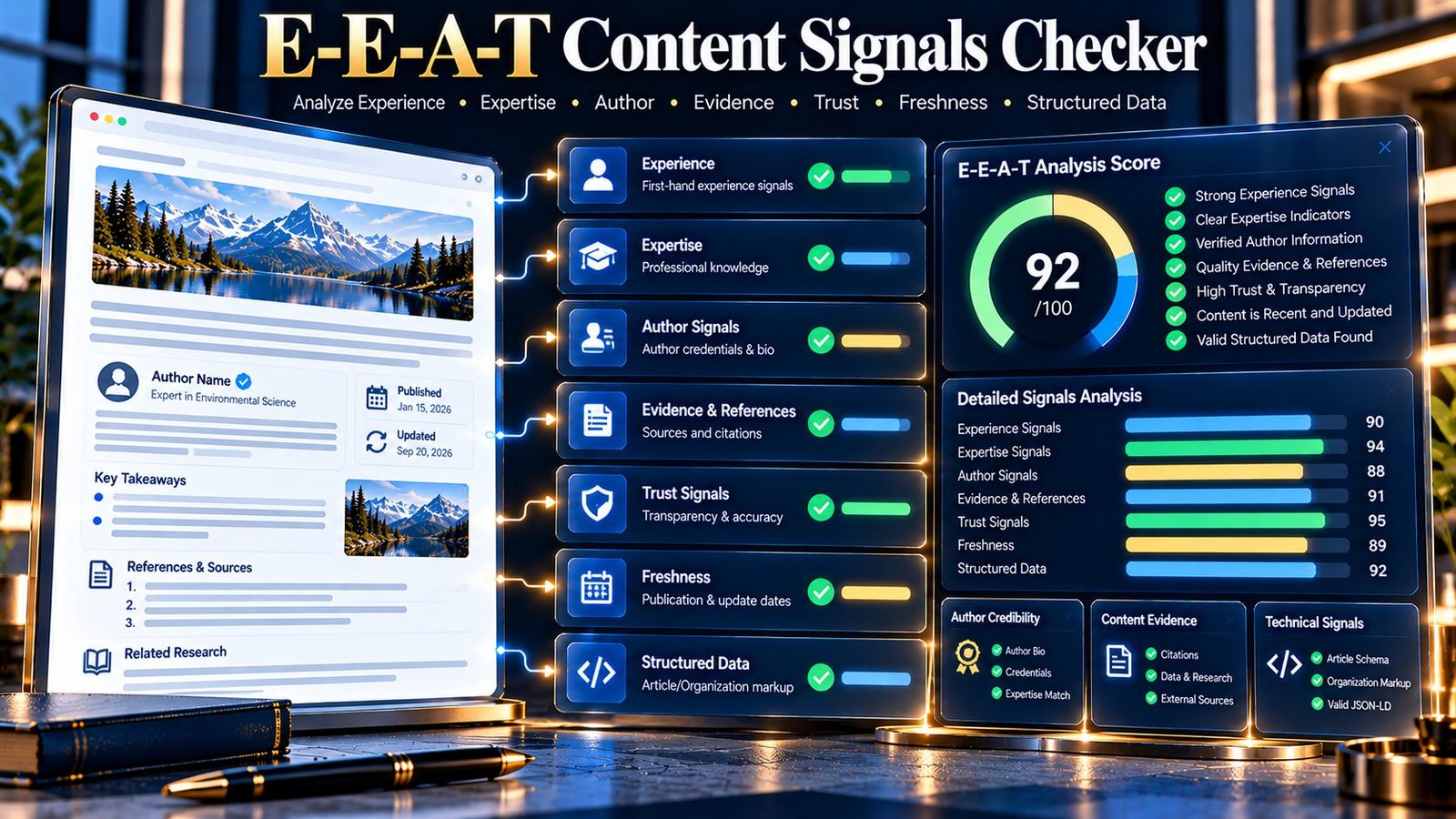
E-E-A-T Content Signals Checker helps you review observable content signals related to Experience, Expertise, Author information, Evidence, Trust, transparency, freshness, and structured data. Enter a public URL or paste HTML/text to identify signals that may strengthen the credibility and transparency of a page.
The analyzer examines the content and source markup available to it and organizes detected signals into practical categories. It does not claim to measure Google’s E-E-A-T systems or predict rankings. Instead, it provides a structured source-level review that can help you identify missing or weak credibility signals.
E-E-A-T Content Signals Checker
Review source-level signals related to experience, expertise, author information, evidence, transparency, and trust.
| Signal | Result | Meaning |
|---|
| Type | Detected | Details |
|---|
This is a PKCapra source-level heuristic. Detected signals do not prove actual experience, expertise, authority, trustworthiness, or how Google evaluates a page.
When a public URL is supplied, the page HTML is fetched by the PKCapra WordPress endpoint for analysis. Pasted content is sent to the same endpoint. Do not submit confidential, personal, or sensitive material.
What Is an E-E-A-T Content Signals Checker?
E-E-A-T stands for Experience, Expertise, Authoritativeness, and Trustworthiness. These concepts are commonly used when evaluating the quality and credibility of online content.
An E-E-A-T review can involve more than checking whether an article contains keywords. Important observable signals can include author information, credentials, first-hand experience, supporting evidence, references, transparency information, publication dates, and relevant structured data.
PKCapra’s E-E-A-T Content Signals Checker focuses on signals that can be detected from the supplied page content and HTML source.
It does not determine whether a page has a particular Google ranking position, and it does not access Google’s internal quality systems.
What Does the E-E-A-T Content Signals Checker Analyze?
The analyzer organizes its review into several signal categories.
Experience Signals
The checker looks for observable language and content patterns that may indicate first-hand experience.
Examples can include:
- First-hand experience statements
- Practical testing or implementation language
- Case-study references
- Descriptions of actual use or testing
- Experience-based explanations
- Practical examples connected to the subject
These signals are treated as content indicators rather than proof that the author actually performed the stated activity.
Expertise Signals
The analyzer looks for visible indicators associated with subject expertise.
Examples include:
- Professional roles
- Credentials
- Qualifications
- Expertise terminology
- Relevant author descriptions
- Job titles
- Expertise-related structured data
The checker reports what it can observe in the supplied source rather than independently verifying credentials.
Author Information
Clear authorship can make content easier for readers to evaluate.
The analyzer checks for signals such as:
- Author names
- Author attribution
- Author descriptions
- Author structured data
- Job titles
- Professional information
- Author-related
sameAsreferences
A page without detectable author information may receive fewer observable author signals, even when the actual publisher has an identifiable author elsewhere.
Evidence and Supporting Sources
The analyzer checks for evidence-related signals that can help readers understand how claims are supported.
It can detect indicators such as:
- Sources
- References
- Citations
- Research or study terminology
- Evidence-related wording
- External supporting links
- Links associated with cited evidence
The presence of a link does not automatically establish that the linked source supports a particular claim. The checker reports detectable signals rather than validating every factual statement.
Trust and Transparency Signals
The analyzer looks for page-level or site-level transparency indicators that may help readers understand who operates the content and what policies apply.
Observable signals can include:
- About information
- Contact information
- Editorial policies
- Corrections policies
- Privacy information
- Terms information
- Disclaimer information
- Disclosure statements
- Publisher or identity information
These signals can help identify areas where additional transparency may be appropriate.
Freshness Signals
The checker looks for detectable date information, including:
- Published dates
- Updated dates
- Modified dates
- Article metadata
- JSON-LD date properties
- Other visible date signals
A detected date does not prove that the underlying information is factually current. The analyzer reports the presence and consistency of freshness signals rather than independently determining whether the content remains accurate.
Structured Data Signals
The analyzer examines detectable structured data for relevant E-E-A-T-related properties.
Examples include:
- Author
- Author description
- Job title
- Publication dates
- Modification dates
- Citation information
sameAsreferences
Structured data can provide machine-readable information, but its presence does not independently verify the accuracy of the information contained within it.
How to Use the E-E-A-T Content Signals Checker
Step 1: Provide a Source
Enter a public webpage URL or paste HTML/text into the analyzer.
Step 2: Run the Analysis
Start the analysis to inspect the supplied content and source-level signals.
Step 3: Review the Signal Categories
Review the detected Experience, Expertise, Author, Evidence, Trust, Freshness, and Structured Data signals.
Step 4: Review Detected Evidence
The analyzer provides detected evidence so you can see which observable elements contributed to the analysis.
Step 5: Review Prioritized Findings
Use the findings to identify areas where additional author information, supporting evidence, transparency, or other observable signals may be useful.
Step 6: Export the Results
The analysis can be copied as JSON or downloaded as a PDF report for further review or documentation.
Example E-E-A-T Signals
Consider a page containing:
- A named author
- A professional job title
- An author description
- First-hand testing statements
- A practical case study
- Links to supporting research
- An editorial policy
- An updated date
- About and Contact information
- Privacy, Terms, and Disclaimer pages
- Relevant Article or author structured data
The checker can identify these as observable signals and organize them into the corresponding categories.
A different page containing only generic informational text with no detectable author, credentials, supporting evidence, transparency information, dates, or relevant structured data may produce fewer observable signals.
The analyzer does not conclude that one page is authoritative or trustworthy simply because more signals are detected. It reports the available evidence so the page can be reviewed more systematically.
E-E-A-T Signal Report
The results can include:
| Report Area | What It Shows |
|---|---|
| Experience | Detectable first-hand experience and practical-use signals |
| Expertise | Credentials, roles, qualifications, and expertise indicators |
| Author | Author attribution and author-related information |
| Evidence | Sources, references, citations, research, and supporting links |
| Trust & Transparency | About, Contact, policies, disclosures, and identity signals |
| Freshness | Published, modified, and updated date signals |
| Structured Data | Author, job title, description, citation, and related properties |
| Score | A heuristic summary of detected signals |
| Grade | Overall signal-level classification |
| Findings | Prioritized areas for further review |
| Evidence Table | Detected source-level evidence |
| JSON | Machine-readable analysis output |
| Downloadable analysis report |
Understanding the Score and Grade
The score is a heuristic representation of the observable signals detected by the analyzer.
It should be used as a diagnostic aid rather than as a Google ranking score or an official E-E-A-T measurement.
A lower score does not automatically mean that the content is inaccurate or untrustworthy. It can indicate that fewer relevant signals were detectable in the supplied source.
Similarly, detecting many signals does not guarantee that the content is accurate, authoritative, or preferred by search engines.
Practical E-E-A-T Review Workflow
For an existing article, you can use the analyzer as part of a broader content review:
- Analyze the published URL.
- Review the detected author and expertise signals.
- Check whether first-hand experience is clearly communicated where appropriate.
- Review supporting evidence and external references.
- Check transparency and publisher information.
- Review published and updated date signals.
- Inspect relevant structured data.
- Review the prioritized findings.
- Improve the page where appropriate.
- Run the analysis again to compare the observable signals.
This approach turns a broad E-E-A-T review into a structured source-level checklist.
E-E-A-T and Content Quality
E-E-A-T signals should be considered together with the actual quality of the content.
A page can contain an author name and structured data while still requiring stronger explanations, evidence, accuracy checks, or practical value.
Likewise, a page may provide useful first-hand information without exposing every possible structured data property.
Use the analyzer to identify observable gaps, then manually review whether the underlying content genuinely supports the signals being presented.
For broader on-page analysis, you can also use the On-Page SEO Checker to review additional page-level SEO signals.
Related PKCapra Tools
Use the SEO Content Readability Analyzer to review readability-related content signals.
Use the SEO Content Score to evaluate additional content-level signals.
Use the Content Structure Analyzer to inspect headings, paragraphs, lists, tables, links, images, and other structural elements.
Use the SEO Introduction Checker to review the opening section of a page.
Use the FAQ Content Analyzer to inspect detectable FAQ questions, answers, and FAQ structured data.
Use the Schema Markup & Structured Data Analyzer to inspect structured data markup.
Use the Meta Tags Analyzer to review important page metadata.
Limitations
The E-E-A-T Content Signals Checker is a source-level diagnostic tool.
It does not:
- Measure Google’s internal E-E-A-T systems.
- Access Google’s private ranking algorithms.
- Determine whether Google considers a page authoritative.
- Independently verify author credentials.
- Verify that an author’s claimed experience is genuine.
- Fact-check every statement on a page.
- Determine whether cited sources actually support every claim.
- Guarantee improved rankings.
- Replace editorial, legal, medical, financial, or subject-matter review.
- Establish factual freshness simply because an updated date exists.
Results depend on the HTML/text supplied to the analyzer and the signals that can be detected from that source.
Privacy and Processing
The analyzer is designed to evaluate the source you provide.
When analyzing a public URL, the tool needs to retrieve the publicly accessible page source required for the analysis. When using pasted content, the supplied HTML or text is processed as the analysis input.
Do not submit confidential, private, or sensitive information unless you are authorized to do so.
Frequently Asked Questions
What does E-E-A-T stand for?
E-E-A-T stands for Experience, Expertise, Authoritativeness, and Trustworthiness. The analyzer focuses on observable content and source-level signals associated with these concepts.
Does this tool measure Google’s E-E-A-T score?
No. There is no claim that the analyzer measures a Google E-E-A-T score. It identifies observable signals in the supplied page source.
Can the checker verify an author’s credentials?
No. It can detect credentials, professional roles, qualifications, and related information that are present in the source, but it does not independently verify them.
Does a higher score guarantee better rankings?
No. The score is a heuristic diagnostic summary and is not a Google ranking score or ranking prediction.
Does the checker verify whether content is factually accurate?
No. The analyzer detects observable evidence and credibility-related signals. It does not independently fact-check every claim.
Can I analyze a URL?
Yes. A publicly accessible URL can be supplied for source-level analysis, subject to the tool’s request and security limitations.
Can I paste HTML or text instead?
Yes. Pasted HTML or text can be used when you want to analyze content without providing a public URL.
Does the tool detect structured data?
Yes. The analyzer can detect relevant structured-data signals such as author information, job titles, descriptions, dates, citations, and sameAs references when they are present in the supplied source.
Can I export the results?
Yes. The analyzer provides JSON output that can be copied and a PDF report that can be downloaded.
Should I rely only on the E-E-A-T score?
No. Treat the score as a diagnostic summary. Review the individual signals and findings, then evaluate the actual quality, accuracy, usefulness, authorship, evidence, and transparency of the content.
Is the tool an official Google E-E-A-T checker?
No. It is an independent PKCapra diagnostic tool that evaluates observable source-level signals.