
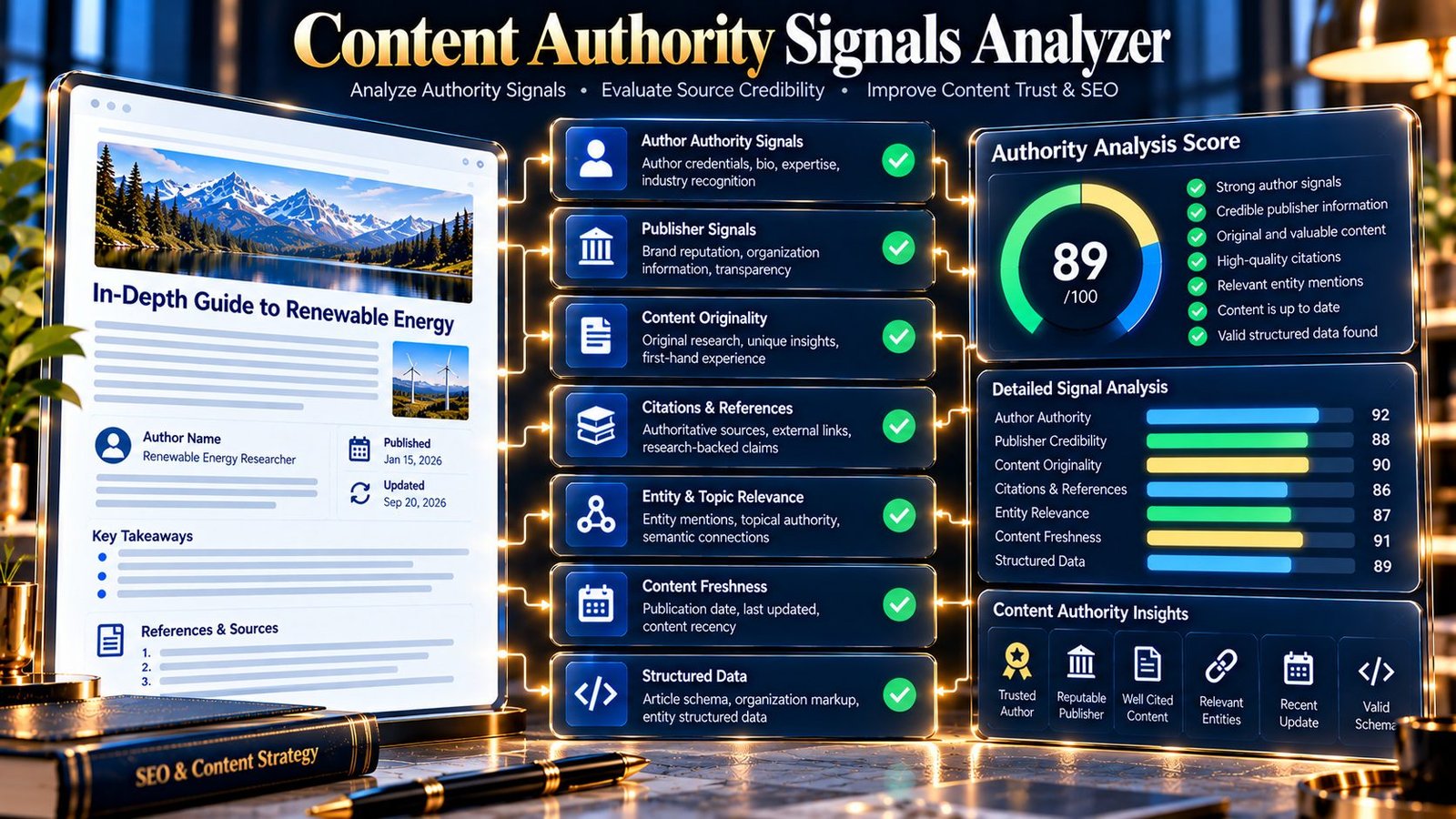
Content Authority Signals Analyzer helps you review observable authority-related signals in a webpage or supplied content. Enter a public URL or paste HTML/text to examine signals such as author information, expertise indicators, original research or testing language, citations and references, transparency, structured data, entity relationships, and content freshness.
The analyzer is designed as a practical source-level diagnostic tool. It identifies signals that are present or detectable in the supplied content and organizes them into a structured report so you can investigate potential authority gaps.
It does not claim to measure Google’s internal authority systems, determine whether a page will rank, or independently verify every credential, claim, citation, or relationship it detects.
Content Authority Signals Analyzer
Review observable signals that can support content authority, attribution, evidence, publisher identity, and editorial transparency.
| Dimension | Result | Observable evidence | Interpretation |
|---|
| Type | Count / Status | Details |
|---|
This is a deterministic source-level diagnostic. Detected signals do not prove that a publisher, author, source, or page is authoritative, and they do not represent Google's internal ranking or quality systems.
When a public URL is supplied, the page HTML is fetched by the PKCapra WordPress endpoint for analysis. Pasted content is sent to the same endpoint. Do not submit confidential, personal, or sensitive material.
What Is a Content Authority Signals Analyzer?
Content authority can be communicated through multiple observable elements rather than a single page attribute.
A page may provide information about its author, publisher, professional expertise, original research, testing, supporting sources, editorial processes, organizational identity, or structured data. Reviewing these elements together can make it easier to identify what authority-related information is clearly communicated and what may be missing.
The Content Authority Signals Analyzer examines these observable signals from the source provided to it.
The result is a diagnostic report rather than an independent determination that a page or publisher is authoritative.
What Does the Content Authority Signals Analyzer Check?
Author and Publisher Signals
The analyzer looks for detectable information that identifies the people or organizations behind the content.
Signals can include:
- Author names
- Publisher information
- Author attribution
- Professional roles
- Author descriptions
- Publisher identity
- Organization information
- Author or publisher structured data
Clear attribution can make it easier for readers to understand who produced the content.
Expertise Signals
The analyzer checks for observable indicators associated with subject-matter expertise.
Examples include:
- Professional roles
- Credentials
- Qualifications
- Expertise-related terminology
- Specialized subject descriptions
- Job titles
- Author expertise information
These are detected signals rather than independently verified credentials. A credential appearing in HTML or structured data does not by itself prove that the credential is genuine.
Experience and Original Work Signals
The analyzer can identify language associated with practical experience and original work.
Examples include:
- First-hand experience statements
- Testing language
- Practical implementation
- Original research
- Case-study terminology
- Experiments
- Documented observations
- Testing or evaluation language
These signals can help identify whether content communicates practical involvement with the subject.
The analyzer does not independently verify that a claimed test, experiment, or experience actually occurred.
Evidence and Citation Signals
Supporting evidence is another observable part of authority-oriented content.
The analyzer looks for signals such as:
- References
- Citations
- Research terminology
- Study references
- Supporting sources
- External evidence links
- Evidence-related language
- Links to recognized technical or research resources
The tool reports detectable evidence signals. It does not determine whether every citation actually supports the claim surrounding it.
Transparency Signals
The analyzer checks for information that can help readers understand the publisher and content process.
Observable signals may include:
- About information
- Contact information
- Editorial information
- Fact-checking or review language
- Correction policies
- Disclosure language
- Publisher identity
- Organizational information
- Transparency-related statements
These signals can be useful when reviewing whether a page clearly communicates who is responsible for the content and how it is maintained.
Freshness Signals
The analyzer checks for detectable date and update information.
Examples include:
- Published dates
- Modified dates
- Updated dates
- Article metadata
- Structured-data dates
- Other detectable freshness indicators
A date alone does not prove that information is factually current. It only provides an observable indication that the content includes freshness-related information.
Structured Authority Signals
The analyzer can inspect relevant structured-data information associated with authority signals.
Examples include:
- Person entities
- Organization entities
- Author information
- Job titles
- Author descriptions
- Publisher information
sameAsrelationships- Citation-related properties
- Publication dates
- Modification dates
Structured data provides machine-readable information, but the analyzer does not independently verify the accuracy of that information.
How to Use the Content Authority Signals Analyzer
Step 1: Enter a Public URL or Paste Content
Provide a publicly accessible webpage URL or paste HTML/text directly into the analyzer.
Step 2: Start the Analysis
Run the analyzer to inspect the supplied source.
Step 3: Review the Authority Signals
Review the detected categories, including author, expertise, experience, evidence, transparency, structured data, and freshness.
Step 4: Inspect the Evidence
Review the detected evidence associated with each signal. This helps you understand why a particular signal was identified.
Step 5: Review the Findings
Use the prioritized findings to identify areas that may require additional investigation or clearer communication.
Step 6: Review the Score and Grade
The analyzer provides a heuristic authority-signal score and grade based on detectable signals.
Treat these as diagnostic indicators rather than as an official search-engine authority score.
Step 7: Export the Report
The analysis can be copied as JSON or downloaded as a PDF report for documentation and further review.
Understanding the Authority Signals
A strong authority-signal profile may contain several different types of evidence rather than relying on one element.
For example, a technical article might identify its author, describe the author’s professional role, explain practical testing, provide supporting references, identify the publisher, include relevant structured data, and show when the article was updated.
Another article might contain useful information but provide little visible information about its author, sources, publisher, or content-maintenance process.
The analyzer helps surface these differences at the source level.
It does not conclude that a page with more detectable signals is automatically more accurate or authoritative.
Authority Signal Report
The results can organize information into areas such as:
| Report Area | What It Shows |
|---|---|
| Author | Detectable author and attribution information |
| Publisher | Organization and publisher identity signals |
| Expertise | Roles, credentials, qualifications, and expertise indicators |
| Experience | First-hand, testing, practical, and original-work signals |
| Evidence | References, citations, research, and supporting links |
| Transparency | Editorial, disclosure, identity, and related signals |
| Freshness | Published, modified, and updated date indicators |
| Structured Data | Author, publisher, entity, job, and related properties |
| Entity Signals | Detectable relationships such as sameAs |
| Score | Heuristic summary of detected authority signals |
| Grade | Diagnostic classification based on detected signals |
| Findings | Prioritized areas requiring review |
| Evidence | Detected source-level evidence |
| JSON | Machine-readable report |
| Downloadable analysis report |
Common Authority Signal Gaps
A page may contain useful information while still exposing limited authority-related information.
Common observable gaps can include:
- No identifiable author
- No author description
- No detectable professional role
- No visible expertise information
- No first-hand experience language
- No research or testing signals
- Few or no supporting references
- Limited publisher information
- No detectable editorial or correction information
- No disclosure information where relevant
- Missing freshness information
- Limited authority-related structured data
- Missing or weak entity relationships
These findings should be investigated in context rather than treated as proof that the underlying content is poor.
How to Investigate Authority Signal Gaps
If the analyzer identifies missing signals, review the actual page before making changes.
For author-related findings, check whether the page clearly identifies who wrote or reviewed the content.
For expertise findings, determine whether relevant professional information is genuinely available and appropriate to disclose.
For experience findings, consider whether the content actually includes first-hand testing, implementation details, observations, or other original experience that can be accurately documented.
For evidence findings, review whether important factual or technical claims have appropriate supporting sources.
For transparency findings, check whether readers can understand who publishes the content and how the content is maintained.
For freshness findings, verify whether publication or update information is accurate and meaningful.
For structured-data findings, inspect whether the machine-readable information accurately represents the visible page.
Practical Content Authority Review Workflow
You can use the analyzer as part of a broader content review process:
- Analyze the published URL.
- Review author and publisher signals.
- Review expertise indicators.
- Check for first-hand experience or original-work signals.
- Review references and supporting evidence.
- Review transparency information.
- Check publication and modification dates.
- Inspect relevant structured data.
- Review the prioritized findings.
- Investigate genuine gaps manually.
- Make appropriate content or transparency improvements.
- Run the analysis again to compare the observable signals.
The purpose of this workflow is to make authority-related content signals easier to inspect systematically.
Score and Grade
The Content Authority Signals Analyzer provides a heuristic score based on the authority-related signals it can detect.
The score should not be interpreted as:
- A Google ranking score
- A Google authority score
- A measure of domain authority
- A measure of PageRank
- A guarantee of search visibility
- A factual accuracy score
- Independent verification of credentials
A lower score can simply mean that fewer relevant signals were detectable in the supplied source.
A higher score also does not prove that the content is accurate, trustworthy, or preferred by a search engine.
The individual findings and detected evidence should therefore be reviewed alongside the overall score.
Content Authority vs. Content Accuracy
Authority signals and factual accuracy are related but are not the same thing.
A page can contain a named expert while still containing inaccurate information.
A page can also contain useful and accurate information while exposing very little author or publisher information.
For this reason, use the analyzer to identify observable authority signals, then manually evaluate the substance of the content and its supporting evidence.
Content Authority vs. E-E-A-T
Content authority overlaps with several concepts associated with Experience, Expertise, Authoritativeness, and Trustworthiness.
The E-E-A-T Content Signals Checker can be used for a broader review of observable E-E-A-T-related signals.
The Content Authority Signals Analyzer is focused specifically on authority-related signals and supporting evidence that can be detected from the supplied source.
Neither tool should be interpreted as reproducing Google’s internal evaluation systems.
Related PKCapra Tools
Use the All Free Online Tools page to explore other available PKCapra tools.
Use the Schema Markup & Structured Data Analyzer to inspect structured data associated with the page.
Use the SEO Content Readability Analyzer to review readability-related content signals.
Use the Content Structure Analyzer when you want to inspect headings, paragraphs, lists, tables, links, images, and other structural elements.
Use the SEO Introduction Checker to review the opening section of content.
Use the FAQ Content Analyzer to examine detectable FAQ content and related structured data.
Limitations
The Content Authority Signals Analyzer is a source-level diagnostic tool.
It does not:
- Measure Google’s internal authority systems.
- Determine whether a page is authoritative in Google’s systems.
- Predict search rankings.
- Independently verify author credentials.
- Independently verify professional qualifications.
- Confirm that claimed first-hand experience actually occurred.
- Fact-check every statement.
- Determine whether a citation genuinely supports every claim.
- Establish the reputation of an author or organization independently.
- Guarantee improved rankings or visibility.
- Replace editorial or subject-matter review.
Results depend on the information available in the supplied URL or pasted source.
A signal being absent from the detected source does not necessarily mean that the information does not exist elsewhere on the website.
Privacy and Processing
When a public URL is analyzed, the tool needs to retrieve the publicly accessible source required for the analysis.
When HTML or text is pasted into the analyzer, that supplied content becomes the analysis input.
Avoid submitting confidential, private, or sensitive information unless you are authorized to process it.
The analyzer should be treated as a diagnostic source-analysis tool rather than a substitute for a broader privacy or security review.
Frequently Asked Questions
What is a Content Authority Signals Analyzer?
It is a diagnostic tool that identifies observable authority-related signals in webpage content or supplied HTML/text, including author, expertise, experience, evidence, transparency, structured data, entity, and freshness signals.
Does the tool measure Google authority?
No. The analyzer does not access Google’s internal authority or ranking systems.
Does a high score mean that a page will rank higher?
No. The score is a heuristic summary of detected authority-related signals and is not a ranking prediction.
Can the analyzer verify an author’s credentials?
No. It can detect credentials, roles, qualifications, and related information present in the source, but it does not independently verify them.
Does the tool verify citations?
It can detect citations, references, supporting links, and evidence-related signals. It does not independently determine whether every citation supports the associated claim.
Can I analyze a webpage URL?
Yes. You can provide a publicly accessible URL for source-level analysis, subject to the tool’s request and security limitations.
Can I paste HTML or text?
Yes. Pasted HTML or text can be analyzed directly.
Does the analyzer detect structured data?
Yes. It can identify relevant structured-data signals associated with authors, publishers, entities, job information, dates, citations, and related authority indicators when detectable in the supplied source.
What does the score represent?
The score represents a heuristic summary of observable authority-related signals detected by the analyzer. It is not an official search-engine authority score.
Can I export the results?
Yes. The analyzer provides JSON output that can be copied and a PDF report that can be downloaded.
Should I rely only on the final grade?
No. Review the individual signals, detected evidence, and findings as well as the overall score.
Can missing signals prove that content lacks authority?
No. The analyzer only reports what it can detect in the supplied source. Information may exist elsewhere on the website or may not be exposed in a form the analyzer can detect.