
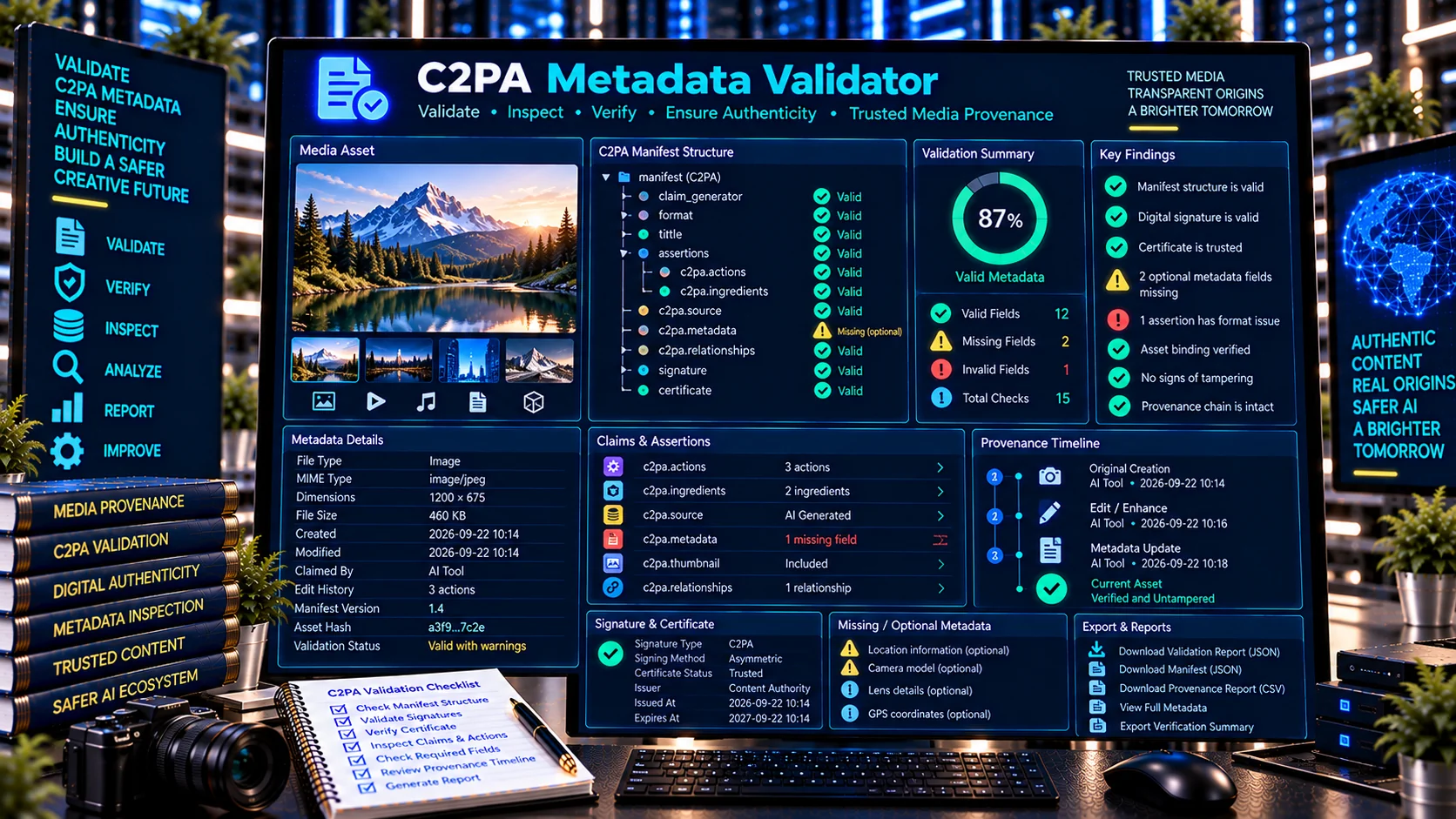
The C2PA Metadata Validator is a browser-based tool for checking detectable C2PA Content Credentials and provenance metadata for structural completeness and consistency. It helps identify manifest information, claims, assertions, actions, ingredients, signature-related fields, certificate information, missing metadata, and structural warnings.
C2PA provides a standardized framework for recording provenance information associated with digital content. Its data model includes manifests, claims, assertions, actions, ingredients, and mechanisms for protecting provenance information with digital signatures.
PKCapra’s C2PA Metadata Validator focuses on the metadata validation layer. It checks the supplied C2PA-related data against recognizable structural expectations and reports findings that may require further review.
Validate C2PA Metadata
Choose an asset to validate detectable C2PA/Content Credentials metadata.
Or Paste C2PA Manifest / Metadata JSON
Validation Findings
Validated Metadata Fields
Validation Summary
JSON Report
What Is a C2PA Metadata Validator?
A C2PA Metadata Validator checks C2PA-related metadata for recognizable structural problems and missing information.
Unlike a general metadata viewer, a validator does more than simply display fields. It examines whether expected C2PA structures are present and identifies fields or relationships that may need attention.
The tool is useful when working with Content Credentials, provenance manifests, AI-generated media workflows, digital publishing systems, and content-authenticity pipelines.
What Does the C2PA Metadata Validator Check?
C2PA Markers
The validator checks for detectable indicators associated with C2PA Content Credentials.
These markers provide an initial signal that C2PA-related provenance data may be present.
Manifest Structure
C2PA provenance information is organized through manifests.
The validator examines recognizable manifest structures and reports structural findings when expected information is missing or arranged unexpectedly.
Claims
Claims form an important part of the C2PA provenance model.
The validator checks for detectable claim information and reports relevant structural findings.
Assertions
Assertions contain structured provenance information associated with a C2PA claim.
The validator identifies available assertions and checks recognizable metadata structures associated with them.
Actions
Actions can describe operations recorded in provenance information.
The validator checks detectable action information and identifies structural issues where applicable.
Ingredients
Ingredients describe relationships between an asset and other content used during creation or transformation.
The validator checks detectable ingredient structures and related metadata.
Signature Fields
C2PA uses digital signatures as part of its provenance integrity model.
The validator can detect signature-related fields in supplied metadata.
The presence of a signature field does not mean that the cryptographic signature has been independently verified.
Certificate Fields
Certificate-related information may appear within C2PA provenance data.
The validator identifies detectable certificate fields and reports their structural presence.
Certificate-field detection should not be confused with certificate trust validation.
Why Validate C2PA Metadata?
Content provenance becomes more useful when its underlying structure can be inspected for consistency.
A C2PA record may contain several interconnected components:
- Manifest information
- Claims
- Assertions
- Actions
- Ingredients
- Digital-source information
- Claim-generator information
- Signature information
- Certificate information
A structural problem in one part of the record can make provenance information harder to interpret.
Validation provides an early diagnostic layer before deeper provenance verification.
C2PA Metadata Validation vs C2PA Inspection
The C2PA Content Credentials Inspector is designed primarily to expose and examine recognizable provenance information.
The C2PA Metadata Validator goes one step further by checking detectable structures against validation rules and reporting findings.
A useful workflow is:
Inspect → Validate → Verify
Use the C2PA Content Credentials Inspector to understand what provenance information is present.
Then use the C2PA Metadata Validator to review its structural consistency.
C2PA Metadata Validation vs Cryptographic Verification
Metadata validation and cryptographic verification are separate processes.
A metadata validator can determine whether recognizable fields and structures are present and whether they satisfy defined structural checks.
Cryptographic verification can involve checking digital signatures, certificates, content bindings, and applicable trust relationships.
C2PA defines mechanisms for signed provenance information and verification within its technical framework.
Therefore, a metadata validation result should not automatically be interpreted as proof that a signature is valid or that an identity is trusted.
What Can a C2PA Validation Finding Mean?
A validation finding can indicate different types of conditions.
Valid Structure
The supplied metadata contains the expected recognizable structure for the particular check.
Warning
The metadata contains information that may be incomplete, unusual, or worthy of additional review.
Missing Information
An expected or commonly useful field may not be present.
Structural Problem
A detectable field or object does not match the expected structure used by the validator.
These findings are diagnostic signals and should be interpreted according to the actual C2PA implementation and asset workflow.
C2PA Metadata and Content Provenance
C2PA is designed to provide structured provenance information for digital content.
Provenance can describe aspects of how content was created, modified, or assembled.
For example, an asset may contain information describing:
- Creation activity
- Editing activity
- Transformations
- Related source assets
- Software or claim-generator information
- Digital-source information
- Signed provenance data
The exact information depends on the implementation and what provenance was recorded and preserved.
C2PA Metadata for AI-Generated Content
C2PA is increasingly relevant to AI-assisted and AI-generated media workflows.
Compatible systems can record provenance information that provides context about the creation or modification of digital content.
Digital-source-type or related provenance assertions may provide information about the nature of recorded content creation.
However, metadata validation alone cannot determine whether every provenance statement is truthful.
It also cannot conclude that an asset is human-created simply because no AI-related metadata is detected.
C2PA Metadata and Digital Media Workflows
Content can move through many applications before publication.
For example:
Create → Edit → Transform → Export → Publish
Each stage can potentially affect metadata and provenance.
A validation check can help identify whether recognizable C2PA metadata remains structurally available after a workflow.
This is particularly useful for teams working with content pipelines where provenance information is expected to survive transformations.
Common C2PA Metadata Problems
Missing Manifest Information
Expected manifest-related information may not be detectable.
Missing Claims
A provenance structure may not contain recognizable claim information where one is expected.
Incomplete Assertions
Assertions may be present but contain incomplete or unexpected structures.
Missing Actions
An implementation may provide provenance information without the expected action details.
Incomplete Ingredients
Ingredient relationships may be missing or structurally incomplete.
Signature Information Without Verification
Signature-related fields can exist without proving that the signature has been successfully verified.
Certificate Information Without Trust Validation
Certificate fields can be present without establishing that the certificate or identity is trusted.
Incomplete Provenance
A record can contain some provenance information while omitting other details.
This does not automatically mean that the asset is manipulated; it indicates that the available provenance record is incomplete for the checks being performed.
C2PA Metadata Validation for AI Media
AI media workflows can benefit from structured provenance validation because content may pass through several generation and editing systems.
A validation workflow can help teams determine whether expected C2PA-related metadata is present after:
- AI image generation
- AI video generation
- Image editing
- Video editing
- Content conversion
- Asset export
- Publishing
- Content management workflows
This provides a practical metadata-quality checkpoint before deeper authenticity or provenance analysis.
C2PA Metadata Validation for Publishers
Digital publishers can use C2PA metadata validation when preparing content for publication.
Possible checks include:
- Manifest presence
- Assertion structure
- Action information
- Ingredient relationships
- Claim-generator data
- Digital-source information
- Signature-related metadata
The goal is to identify structural issues before content enters a larger publishing workflow.
C2PA Metadata Validation for Developers
Developers implementing provenance workflows can use metadata validation during development and QA.
For example, a developer can inspect whether generated provenance data contains expected structural components before integrating it into a production pipeline.
The validator can therefore act as a lightweight diagnostic checkpoint during implementation.
Browser-Based C2PA Metadata Validation
PKCapra’s C2PA Metadata Validator is designed for browser-side processing.
It does not require an external AI API for the core metadata validation workflow.
This makes it suitable for initial provenance-structure checks without requiring the data to be processed by an external AI service.
Users should still follow their own privacy and security requirements when working with sensitive assets or provenance information.
C2PA Metadata Validation vs AI Authenticity Detection
These technologies answer different questions.
C2PA metadata validation asks:
Does the supplied provenance metadata contain recognizable and structurally consistent C2PA information?
AI authenticity detection asks a different question:
Does the content itself contain signals associated with synthetic or manipulated generation?
A valid C2PA metadata structure does not automatically prove that the media is authentic in every sense.
Likewise, missing C2PA metadata does not prove that media is synthetic or manipulated.
C2PA Metadata Validation vs Ordinary Metadata Checking
Ordinary metadata checking may examine:
- File type
- File dimensions
- Timestamps
- Software
- Camera information
- Location information
- File properties
C2PA validation focuses on provenance-specific structures such as manifests, claims, assertions, actions, ingredients, and related signature information.
Both approaches can be useful in a broader digital-media inspection workflow.
Recommended C2PA Workflow
A practical provenance workflow can be:
- Inspect the asset for Content Credentials.
- Examine the detected manifest.
- Validate recognizable C2PA metadata.
- Review claims and assertions.
- Review actions and ingredients.
- Examine signature and certificate information.
- Perform cryptographic verification where required.
- Review applicable trust relationships.
- Assess the provenance information in context.
This keeps structural validation separate from deeper authenticity and trust decisions.
What C2PA Metadata Validation Does Not Prove
A validation result does not automatically prove that:
- The content is factually accurate
- The creator is trustworthy
- The asset has never been manipulated
- Every provenance statement is true
- A digital signature is cryptographically valid
- A certificate is trusted
- The provenance record is complete
- Missing metadata means the content is fake
- Present metadata means the content is authentic in every sense
These distinctions are important when using provenance technology for content-authenticity workflows.
Frequently Asked Questions
What is a C2PA Metadata Validator?
It is a tool for checking recognizable C2PA Content Credentials and provenance metadata for structural completeness, expected fields, and detectable validation issues.
What is the difference between a C2PA Inspector and Validator?
An inspector focuses on examining and exposing available provenance information. A validator applies structural checks and reports potential issues.
Does the validator verify C2PA signatures?
It can detect signature-related metadata, but metadata validation should not be interpreted as independent cryptographic signature verification.
Does it validate certificates?
It can identify detectable certificate-related fields. This is different from validating certificate chains or establishing trust.
Can it validate C2PA manifests?
Yes. The tool checks detectable manifest structures and related metadata fields.
Can it check C2PA assertions?
Yes. Detectable assertion structures can be inspected and validated against the tool’s structural checks.
Can it check C2PA actions and ingredients?
Yes. The validator checks recognizable action and ingredient information where present.
Does valid C2PA metadata prove an image is authentic?
No. Metadata validation is a structural diagnostic step. Authenticity can require cryptographic verification, trust evaluation, source analysis, and contextual review.
Does missing C2PA metadata mean an image is fake?
No. An asset can exist without Content Credentials. Missing provenance information should not automatically be interpreted as evidence of manipulation.
Can it validate AI-generated media provenance?
It can validate detectable C2PA-related metadata associated with AI-media provenance workflows. It does not independently determine whether media was generated by AI.
Does the tool use an AI API?
No external AI API is required for its core browser-based metadata validation.
Build a Stronger C2PA Provenance Workflow
A reliable provenance workflow benefits from separating discovery, structural validation, and cryptographic verification.
A practical PKCapra workflow is:
Inspect → Validate Metadata → Verify Signatures → Review Trust → Assess Provenance
The C2PA Metadata Validator provides the structural validation layer.
It helps users identify missing or unusual C2PA metadata before moving to deeper verification and content-authenticity analysis.