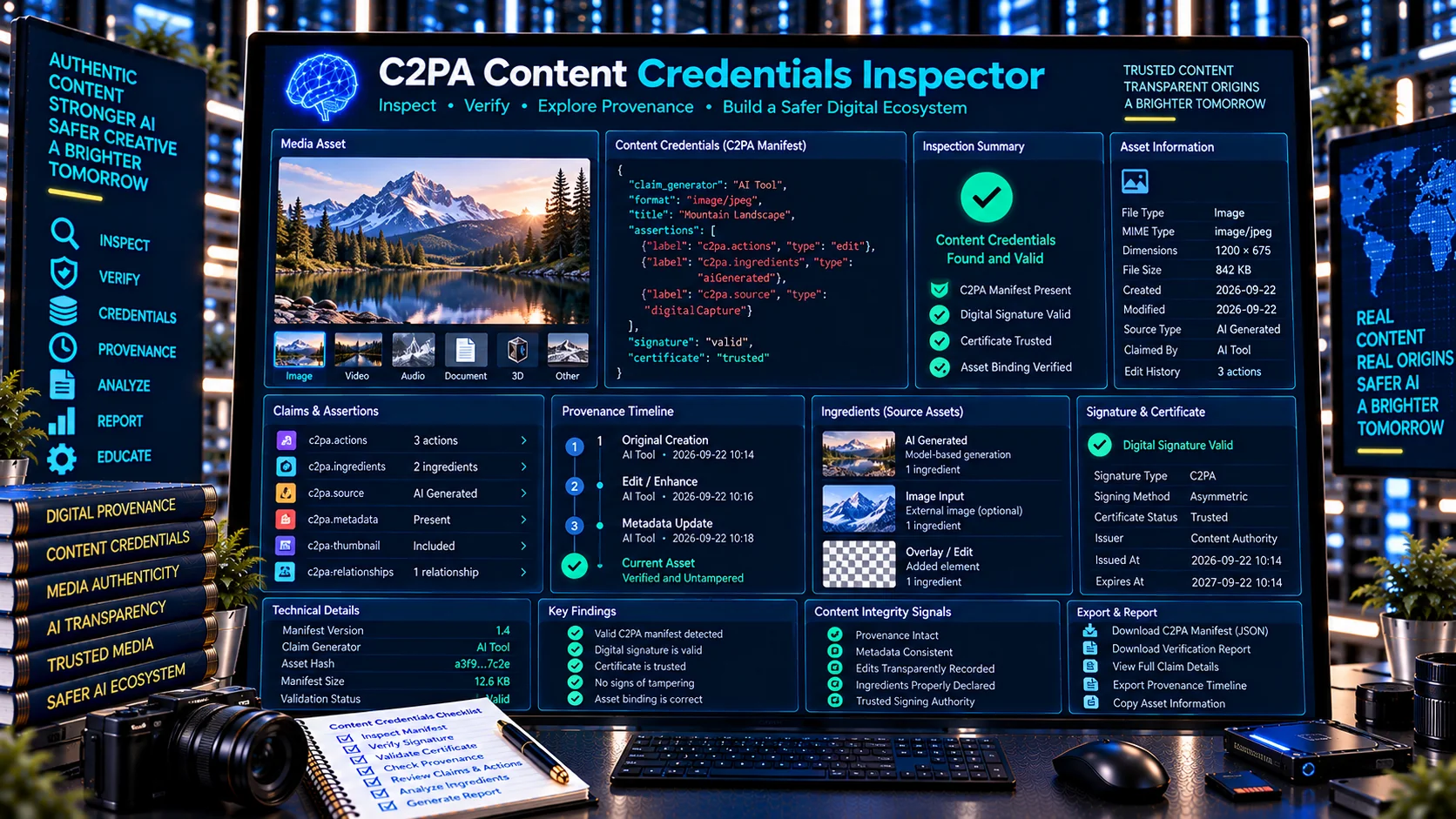
The C2PA Content Credentials Inspector is a browser-based tool for examining digital assets and identifying detectable Content Credentials, C2PA manifest structures, provenance information, assertions, actions, ingredients, claim-generator details, and related metadata.
Content Credentials are designed to provide provenance information about digital content. The C2PA specification describes a structured system involving manifests, claims, assertions, and cryptographic signatures that can help communicate how an asset was created or modified.
PKCapra’s C2PA Content Credentials Inspector provides an initial inspection layer for understanding whether an asset or supplied manifest contains recognizable C2PA-related information.
Inspect an Asset
Choose an asset to inspect its detectable C2PA/Content Credentials markers.
Or Paste a Manifest / Credential
Inspection Findings
Detected Provenance Signals
Manifest Summary
JSON Report
What Is a C2PA Content Credentials Inspector?
A C2PA Content Credentials Inspector helps users examine digital content for detectable provenance information associated with the Coalition for Content Provenance and Authenticity (C2PA) standard.
Content Credentials can contain information about an asset’s provenance, including actions performed on the content, relationships to ingredients, assertions, and information about the software or system that generated a claim.
The PKCapra inspector is designed to make these structures easier to review without requiring users to manually inspect complex metadata or manifest representations.
What Are C2PA Content Credentials?
C2PA is a technical standard for describing the provenance and authenticity-related information associated with digital content.
A C2PA manifest can contain structured information describing claims, assertions, actions, ingredients, and other provenance-related data. The C2PA specification also defines mechanisms for cryptographic signing and binding provenance information to content.
Content Credentials are therefore more than ordinary file metadata. They are part of a structured provenance framework intended to make information about digital content more transparent and verifiable.
What Does the C2PA Content Credentials Inspector Check?
C2PA Marker Detection
The inspector looks for detectable indicators associated with C2PA or Content Credentials.
This provides an initial signal that an asset or supplied data may contain provenance information.
Manifest Structures
C2PA provenance information is organized through manifests.
The inspector can identify and expose recognizable manifest-like structures so users can examine the information contained within them.
Assertions
Assertions provide structured information associated with a C2PA claim.
The inspector identifies detectable assertions and helps users understand what types of provenance information are present.
Actions
C2PA actions can describe activities performed on an asset.
For example, provenance information may describe creation, editing, transformation, or other documented actions.
The inspector can identify available action information within detectable provenance structures.
Ingredients
C2PA manifests can describe relationships between an asset and other content used in its creation.
These related assets can be represented as ingredients.
The inspector helps expose detectable ingredient information so users can investigate content relationships.
Claim Generator Information
C2PA provenance can include information about the software, application, or system responsible for generating a claim.
The inspector can identify available claim-generator information in the inspected provenance data.
Digital Source Type
Digital-source-type information can provide additional context about the type or origin of content represented in a C2PA assertion.
The inspector surfaces detectable values when they are present.
Signature and Certificate Fields
C2PA manifests can contain information associated with digital signatures and certificates.
The inspector can identify relevant signature or certificate fields present in the supplied provenance structure.
These fields are inspected as data; their presence alone does not mean that a signature has been independently validated or that a certificate is trusted.
Binding Signals
Content Credentials can use mechanisms to associate provenance information with the corresponding content.
The inspector identifies detectable binding-related information when it is exposed in the inspected data.
Why Inspect Content Credentials?
Digital content increasingly moves through multiple creation, editing, publishing, and distribution stages.
An asset may be:
- Created by a camera
- Edited in an image application
- Enhanced by an AI system
- Converted into another format
- Combined with other assets
- Published online
- Reused in another production workflow
Provenance information can help document some of these stages when supported and preserved by the relevant tools and workflows.
An inspector provides a convenient first step for examining what provenance information is actually present.
C2PA Inspection vs Ordinary Metadata Inspection
Traditional metadata can contain information such as:
- File type
- Dimensions
- Creation timestamps
- Software information
- Camera information
- Location information
- File properties
C2PA Content Credentials use a different provenance-oriented structure.
They can describe claims, assertions, actions, ingredients, and cryptographic relationships in a standardized framework.
Therefore, ordinary metadata inspection and C2PA inspection can complement one another.
C2PA Content Credentials and Digital Provenance
Digital provenance describes information about where content came from and what happened to it.
C2PA provides a standardized technical framework for recording provenance information in a way that can be associated with digital assets.
This can be particularly useful when content passes through multiple applications or organizations.
A provenance record can provide additional context that is not obvious from the visible pixels, audio, or text of an asset.
C2PA for AI-Generated Content
AI-generated and AI-assisted media have increased interest in content provenance.
C2PA can be used to record provenance-related information when compatible creation or editing systems generate and preserve Content Credentials.
For example, provenance information may help document that content was generated or modified by a particular type of software or workflow.
However, the absence of C2PA credentials does not by itself prove that content was created by a human, created by AI, or manipulated maliciously.
Likewise, the presence of credentials does not automatically establish that every statement about an asset is true.
The provenance record must be interpreted within the context of its signatures, trust relationships, assertions, and verification status.
C2PA Inspector vs C2PA Metadata Validator
The C2PA Content Credentials Inspector and C2PA Metadata Validator serve different purposes.
The inspector is designed to expose and explain detectable C2PA-related structures.
A validator can go further by checking whether expected metadata fields or structures satisfy defined validation rules.
A practical workflow can therefore be:
Inspect → Identify → Validate → Verify
The inspector is the discovery and examination layer.
C2PA Inspector vs AI Media Authenticity Detection
C2PA provenance inspection and AI-media detection are not the same thing.
A C2PA inspector examines provenance information associated with an asset.
An authenticity detector may attempt to analyze the media itself for signals associated with synthetic or manipulated content.
An asset can have valid provenance information without proving that every visible or audible aspect of the content is authentic in the everyday sense.
Likewise, an asset without Content Credentials is not automatically fake.
These technologies answer different questions.
What Information Can Content Credentials Contain?
Depending on the implementation and available provenance data, C2PA information can include:
- Manifest information
- Claims
- Assertions
- Actions
- Ingredients
- Claim-generator details
- Digital-source information
- Signature information
- Certificate information
- Content-binding information
The exact information depends on the asset, creation workflow, software implementation, and preserved provenance data.
C2PA Manifest and Claim Structure
A C2PA manifest represents a structured provenance package associated with an asset.
The claim describes provenance-related information, while assertions provide structured statements associated with that claim.
Digital signatures are used within the C2PA architecture to provide cryptographic protection for signed provenance information.
The inspector exposes recognizable structures so users can review what is actually contained in the supplied data.
C2PA Ingredients and Asset Relationships
An asset can be created using other digital assets.
For example, an image may incorporate another image, a video may contain imported media, or a creative workflow may transform an existing asset.
C2PA can represent these relationships through ingredient information.
Inspecting ingredients can therefore help users understand whether a provenance record describes relationships between the current asset and other content.
C2PA Actions and Editing History
Actions can provide information about operations recorded in provenance.
Depending on the implementation, an action can describe an activity such as creation, editing, transformation, or other processing.
Reviewing actions can help users understand the documented lifecycle of an asset.
However, the documented history should not automatically be interpreted as a complete history of everything that has ever happened to the file.
C2PA Digital Signatures
Digital signatures are an important part of C2PA’s authenticity and integrity model.
The C2PA specification defines mechanisms for signing manifests and protecting their integrity.
A signature field appearing in inspected data is not the same as independently verifying the cryptographic signature.
For that reason, PKCapra’s Inspector focuses on inspection and exposure of available fields rather than presenting the mere presence of signature-related data as proof of trust.
Trust and Verification
A crucial distinction in Content Credentials is the difference between having provenance data and verifying that provenance data can be trusted.
Verification can involve cryptographic signature validation and certificate or trust-list considerations.
The C2PA ecosystem includes mechanisms intended to support verification of signed provenance information and trusted identities.
Therefore, an inspection result should be treated as an information and diagnostic layer unless cryptographic and trust verification has actually been performed.
Privacy-Friendly Content Credentials Inspection
PKCapra’s C2PA Content Credentials Inspector is designed around browser-side inspection.
The tool does not require an external AI API to inspect the supplied data.
This can be useful for users who want to examine provenance information without automatically sending the content to an AI service.
Users should still follow their own privacy and security requirements when inspecting confidential or sensitive files.
Who Can Use a C2PA Content Credentials Inspector?
The tool can be useful for:
- AI researchers
- Content creators
- Photographers
- Video professionals
- Digital publishers
- Journalists
- Media organizations
- AI developers
- Developers working with provenance systems
- Digital-forensics teams
- Content authenticity researchers
- Web publishers
- Technical teams
It can serve as an initial diagnostic tool when investigating whether recognizable Content Credentials or provenance structures are available.
C2PA Inspection Workflow
A practical workflow can be:
- Select or provide the digital asset or provenance data.
- Inspect for C2PA-related markers.
- Examine available manifest information.
- Review claims and assertions.
- Inspect actions.
- Review ingredients and asset relationships.
- Examine claim-generator information.
- Review digital-source information.
- Inspect signature and certificate fields.
- Generate the inspection report.
- Perform deeper cryptographic or trust verification where required.
This separates inspection from verification, which is important when interpreting provenance results.
Common C2PA Inspection Findings
No Detectable Credentials
An asset may contain no recognizable C2PA information.
This does not establish that the asset is fake or manipulated.
Partial Provenance
Some provenance information may be available while other information is absent.
This can happen because provenance may not be preserved across every workflow or transformation.
Available Assertions
Assertions can reveal additional information about how provenance is represented within a manifest.
Ingredient Relationships
Ingredients can show that an asset has documented relationships with other content.
Signature Information Present
Signature-related fields may be visible in the inspected data.
This should not automatically be interpreted as successful cryptographic verification.
Claim Generator Identified
The provenance information may identify software or a system associated with claim generation.
This can provide useful context about the recorded provenance.
What C2PA Inspection Does Not Prove
A C2PA inspection result should not automatically be interpreted as proof that:
- The content is factually true
- The content is free from manipulation
- Every provenance statement is correct
- The creator is trustworthy
- A signature is cryptographically valid
- A certificate is trusted
- The asset has a complete historical record
- An asset without C2PA credentials is fake
- An asset with C2PA credentials is automatically authentic in every sense
These distinctions are important because provenance is a technical record, while authenticity can involve broader questions of identity, trust, context, and evidence.
Frequently Asked Questions
What is a C2PA Content Credentials Inspector?
It is a tool for examining digital assets or supplied provenance data for recognizable C2PA Content Credentials structures, manifests, assertions, actions, ingredients, signatures, and related information.
What are Content Credentials?
Content Credentials are provenance information associated with digital content using the C2PA technical framework.
Can the inspector detect C2PA metadata?
It can identify detectable C2PA-related markers and provenance structures available in the inspected input.
Does the inspector verify C2PA signatures?
The inspector exposes detectable signature and certificate information, but inspection alone should not be interpreted as independent cryptographic verification.
Does C2PA prove that an image is real?
No. C2PA provides a provenance and authenticity-related technical framework. It does not automatically prove every factual property of an image or guarantee that all provenance information represents reality.
Does missing C2PA metadata mean an image is fake?
No. An asset can exist without C2PA Content Credentials. Missing provenance information should not automatically be interpreted as evidence of manipulation.
Can C2PA show whether AI created an image?
Depending on the provenance implementation, Content Credentials can contain digital-source or software-related information that provides context about how content was created or modified. This information must be interpreted within the actual provenance record.
What are C2PA ingredients?
Ingredients represent relationships between an asset and other content used in its creation or transformation.
What are C2PA actions?
Actions describe operations recorded in the provenance information, such as creation, editing, or transformation.
Is the C2PA Content Credentials Inspector an AI detector?
No. It is a provenance inspection tool. It does not independently determine whether an asset was generated by AI based solely on visual or media analysis.
Is the tool useful for digital media workflows?
Yes. It can provide an initial inspection layer for images, video, audio, documents, and other digital content when C2PA-related information is available.
Build a Stronger Content Provenance Workflow
Content provenance is most useful when inspection, validation, and verification are treated as separate stages.
A practical PKCapra workflow can be:
Inspect → Validate Metadata → Verify Provenance → Review Trust → Assess Content
The C2PA Content Credentials Inspector provides the first stage by helping users understand what provenance information is present and how it is structured.
For deeper workflows, the next stage is validation of the detected C2PA metadata and provenance fields.