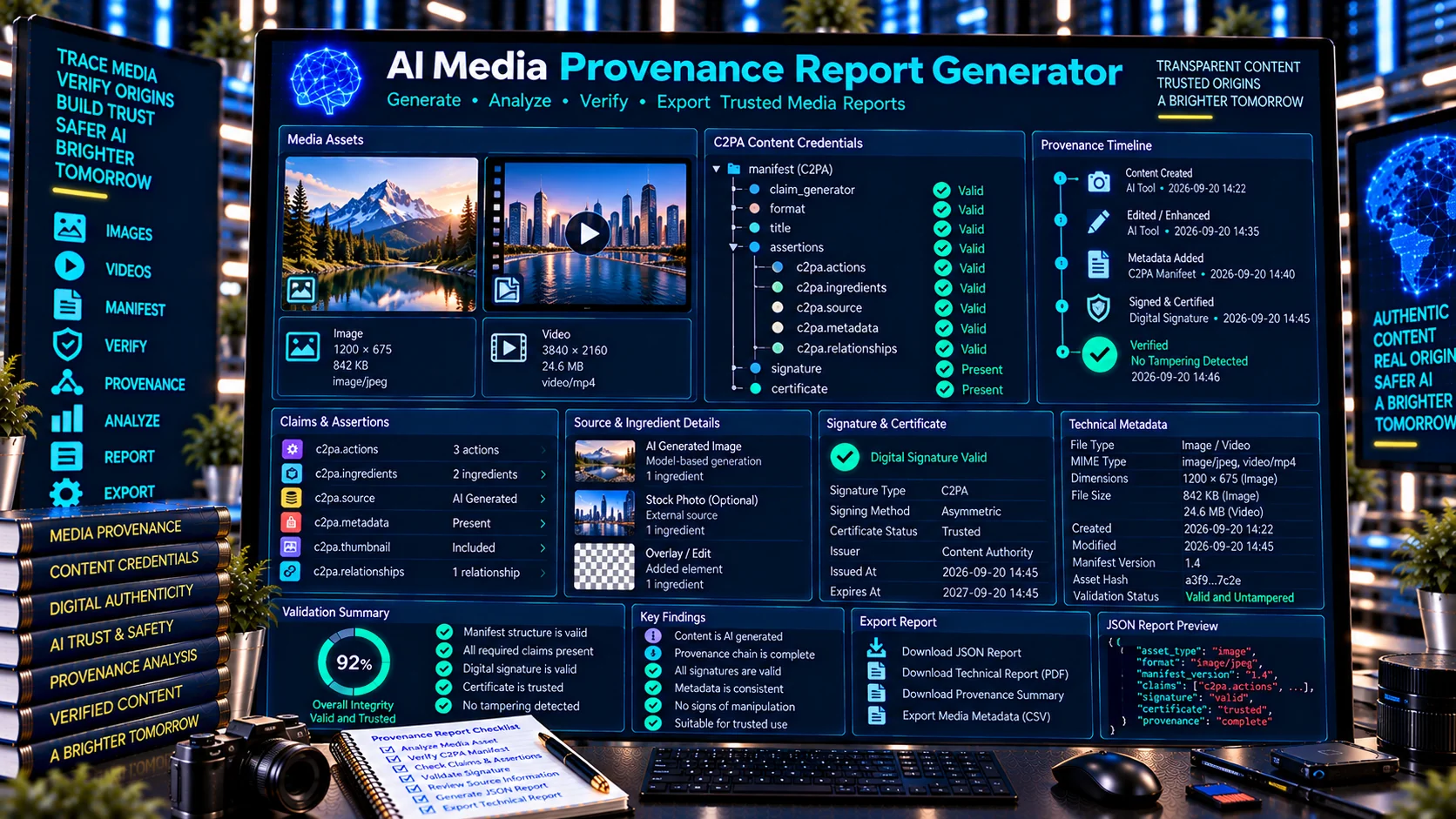
The AI Media Provenance Report Generator is a browser-based tool for organizing and summarizing detectable provenance information from digital media and C2PA Content Credentials. It can identify available manifests, claims, assertions, actions, ingredients, claim-generator information, digital-source information, signature-related fields, and certificate-related fields, then turn those findings into a structured provenance report.
The tool is designed for AI-generated media workflows, digital publishing, content authenticity research, media QA, provenance analysis, and technical documentation. It provides a report-generation layer after provenance information has been inspected or extracted.
Inspect a Media Asset
Choose an asset to extract available provenance signals.
Or Paste Provenance / Manifest JSON
Provenance Findings
Generated Provenance Summary
Detected Provenance Fields
JSON Report
What Is an AI Media Provenance Report Generator?
An AI Media Provenance Report Generator creates a structured report from detectable provenance information associated with digital media.
Modern digital content can pass through multiple creation, editing, transformation, and publishing stages. When provenance information is available, it can provide additional context about the asset and its documented history.
C2PA provides a technical framework for recording provenance information through structures such as manifests, claims, assertions, actions, and ingredients.
PKCapra’s AI Media Provenance Report Generator organizes available provenance signals into a readable report so users can review the information more efficiently.
What Does the AI Media Provenance Report Generator Include?
Media Asset Information
The report can organize available information about the inspected media asset and its detectable provenance structures.
This provides a starting point for understanding what information is associated with the asset.
C2PA and Content Credentials Signals
The generator can identify recognizable C2PA or Content Credentials information when it is available in the supplied input.
These signals are incorporated into the resulting provenance report.
Manifest Information
C2PA provenance information can be organized through manifests.
The report generator extracts detectable manifest-related information and presents it in a structured format.
Claims
Claims are an important part of the C2PA provenance model.
The report can identify available claim information and include it in the generated provenance summary.
Assertions
Assertions provide structured information associated with provenance claims.
The generator extracts detectable assertions and organizes them for easier review.
Actions
Actions can describe operations recorded in a provenance workflow.
The generated report can include available action information, helping users review documented creation or transformation activities.
Ingredients
Ingredients can represent relationships between an asset and other content used in its creation or transformation.
The provenance report organizes detectable ingredient information and associated relationships.
Claim Generator Information
C2PA provenance can include information about the software, application, or system associated with generating a claim.
The report can surface available claim-generator information when present.
Digital Source Information
Digital-source information can provide additional context about the recorded origin or nature of content.
The generator includes detectable digital-source information in the structured report.
Signature and Certificate Information
C2PA provenance structures can contain information related to digital signatures and certificates.
The report generator can organize these fields for inspection.
The presence of signature or certificate information in a report does not independently prove cryptographic validity or trust.
Why Generate a Media Provenance Report?
Raw provenance data can be difficult to review, especially when an asset contains multiple manifests, assertions, actions, or related content records.
A structured report can make it easier to:
- Review provenance information
- Document media findings
- Compare assets
- Record content-creation signals
- Investigate AI-media workflows
- Share technical findings
- Preserve an inspection summary
- Support internal QA
- Prepare provenance documentation
The report turns complex detectable information into a more practical review format.
AI Media Provenance and Content Credentials
AI-generated and AI-assisted media have increased the importance of understanding digital provenance.
Compatible systems can attach provenance information to media using C2PA Content Credentials.
This information may describe aspects of creation, editing, transformation, or relationships with other digital assets.
The presence and completeness of provenance information depend on the tools and workflows involved.
The report generator does not create provenance claims for the asset. It organizes provenance information that is actually detectable in the supplied input.
AI Media Provenance Report vs C2PA Content Credentials Inspector
The C2PA Content Credentials Inspector is primarily an inspection tool.
It helps users examine detectable C2PA structures, manifests, assertions, actions, ingredients, and related fields.
The AI Media Provenance Report Generator focuses on turning those detectable findings into a structured report.
A practical workflow is:
Inspect → Organize → Report
Use the C2PA Content Credentials Inspector when the main goal is to inspect available Content Credentials.
Use the AI Media Provenance Report Generator when the goal is to create a structured provenance summary.
AI Media Provenance Report vs C2PA Metadata Validator
The C2PA Metadata Validator focuses on structural validation.
It checks recognizable C2PA metadata structures and identifies missing or unusual fields.
The AI Media Provenance Report Generator focuses on documenting and organizing the information that is available.
A useful workflow is:
Inspect → Validate → Generate Report
This keeps metadata quality checking separate from provenance documentation.
What Can a Provenance Report Show?
Depending on the available asset information, a report can contain:
- Asset information
- C2PA markers
- Manifest data
- Claims
- Assertions
- Actions
- Ingredients
- Claim-generator information
- Digital-source information
- Signature-related fields
- Certificate-related fields
- Provenance findings
- Structured JSON data
The exact contents depend on what provenance information is present and detectable.
Provenance Reports for AI-Generated Images
AI-generated images can move through several applications before publication.
A provenance report can help document available information about:
- Generation workflows
- Editing operations
- Related assets
- Claim-generator software
- Digital-source information
- Recorded provenance actions
The report does not independently determine whether an image was generated by AI if such information is not present in the provenance data.
Likewise, absence of provenance information does not establish that an image was created by a human or manipulated.
Provenance Reports for AI Video
Video workflows can contain multiple stages such as:
Generation → Editing → Transformation → Export → Publication
When provenance information is available, a report can help organize the documented information associated with those stages.
This can be useful for media teams that need a readable record of available provenance data.
Provenance Reports for Digital Publishing
Publishers can use provenance reports as part of content QA and documentation workflows.
For example, a media organization may want to record available provenance information before publishing an image, video, or other digital asset.
The generated report can provide a structured snapshot of the information detected during the review.
Provenance Reports for Media QA
Media QA teams can use provenance reporting to document the results of content inspections.
Potential workflows include:
- Pre-publication checks
- Asset review
- AI-content documentation
- Content-library auditing
- Provenance research
- Digital-media investigations
- Internal compliance workflows
- Technical QA
The report can act as a repeatable documentation layer within these processes.
Provenance Reports for Developers
Developers building C2PA or Content Credentials workflows can use reports during development and testing.
A structured report can help developers review whether expected provenance information is being generated and preserved through an application workflow.
For example:
Create Asset → Generate Provenance → Inspect → Validate → Generate Report
This makes provenance data easier to review during development.
Provenance Reports for Researchers
Researchers studying AI-generated content, digital provenance, or content authenticity can use structured reports to document available provenance information.
Reports can help organize findings across multiple assets without requiring researchers to manually rewrite every detectable field.
The generated report should still be treated as a record of detected information rather than an independent determination of authenticity.
Browser-Based Provenance Reporting
PKCapra’s AI Media Provenance Report Generator is designed around browser-side processing.
The core workflow does not require an external AI API.
This provides a convenient way to generate an initial provenance report without automatically sending the asset to an external AI service.
Users should still follow their own privacy, security, and organizational data-handling requirements.
Structured JSON Provenance Reports
The tool can generate a structured JSON report containing the detected provenance information and findings.
JSON is useful when provenance results need to be:
- Archived
- Processed programmatically
- Shared with developers
- Compared between assets
- Added to internal workflows
- Stored as technical documentation
A structured report can therefore serve both human-readable and machine-readable workflows.
Provenance Documentation vs Authenticity Verification
A provenance report documents information that is available in the asset or supplied provenance data.
It does not automatically verify every aspect of authenticity.
For example, a report may contain signature-related information, but that does not necessarily mean the signature has been cryptographically validated.
Similarly, a report may identify a claim generator, but that does not independently prove that every recorded statement is accurate.
For deeper verification, provenance data may need to be evaluated using appropriate cryptographic and trust mechanisms.
What a Provenance Report Does Not Prove
A generated report does not automatically prove that:
- The media is factually accurate
- The creator is trustworthy
- The asset has never been manipulated
- Every provenance statement is true
- A digital signature is valid
- A certificate is trusted
- The provenance history is complete
- Missing credentials mean the asset is fake
- Present credentials prove authenticity in every sense
- AI was or was not used when provenance data does not establish it
These limitations are important when using provenance reports in content-authenticity workflows.
Common Provenance Reporting Use Cases
AI Content Documentation
Record available provenance information for AI-generated or AI-assisted media.
Digital Asset Review
Create structured reports during asset-quality workflows.
Publishing QA
Document provenance information before content publication.
Media Research
Organize provenance findings for research projects.
Development Testing
Review whether provenance information survives application workflows.
Internal Documentation
Create machine-readable provenance records for internal archives.
Content Authenticity Workflows
Use provenance reports as one layer in a larger authenticity-review process.
Recommended AI Media Provenance Workflow
A practical workflow can be:
- Inspect the digital asset.
- Identify available Content Credentials.
- Validate detectable C2PA metadata.
- Generate a structured provenance report.
- Review claims and assertions.
- Review actions and ingredients.
- Examine signature and certificate information.
- Perform cryptographic verification where required.
- Evaluate trust and provenance context.
- Document the final findings.
This separates report generation from deeper verification.
Frequently Asked Questions
What is an AI Media Provenance Report Generator?
It is a tool that organizes detectable provenance information from digital media and C2PA Content Credentials into a structured report.
What information can the report contain?
Depending on the supplied data, it can contain manifests, claims, assertions, actions, ingredients, claim-generator information, digital-source information, signature fields, certificate fields, and provenance findings.
Does the tool create C2PA Content Credentials?
No. It reports detectable provenance information; it does not create or sign new C2PA credentials.
Does it verify C2PA signatures?
No. Signature-related fields can be reported, but the report itself is not a substitute for independent cryptographic verification.
Can it identify AI-generated content?
It can report available provenance signals that may describe content creation or digital-source information. It cannot independently determine that media is AI-generated when the provenance data does not establish this.
Can it generate JSON reports?
Yes. The tool can generate a structured JSON provenance report.
Is the report useful for developers?
Yes. Developers can use structured reports when testing provenance implementations and reviewing whether expected information is being generated or preserved.
Is the tool useful for publishers?
Yes. Publishers can use provenance reports as part of content QA and pre-publication documentation workflows.
Does the tool use an external AI API?
No external AI API is required for the core browser-based report-generation workflow.
Does a provenance report prove authenticity?
No. A provenance report documents detected information. Authenticity and trust may require cryptographic verification, certificate validation, trust evaluation, and contextual review.
Build a Stronger AI Media Provenance Workflow
A practical provenance workflow can combine the PKCapra tools into separate stages:
Inspect → Validate → Report → Verify → Review
The C2PA Content Credentials Inspector helps discover available provenance information.
The C2PA Metadata Validator checks detectable metadata structures.
The AI Media Provenance Report Generator turns the available findings into a structured report for documentation, analysis, and downstream workflows.
Together, these stages provide a more organized approach to reviewing provenance information associated with digital media.