
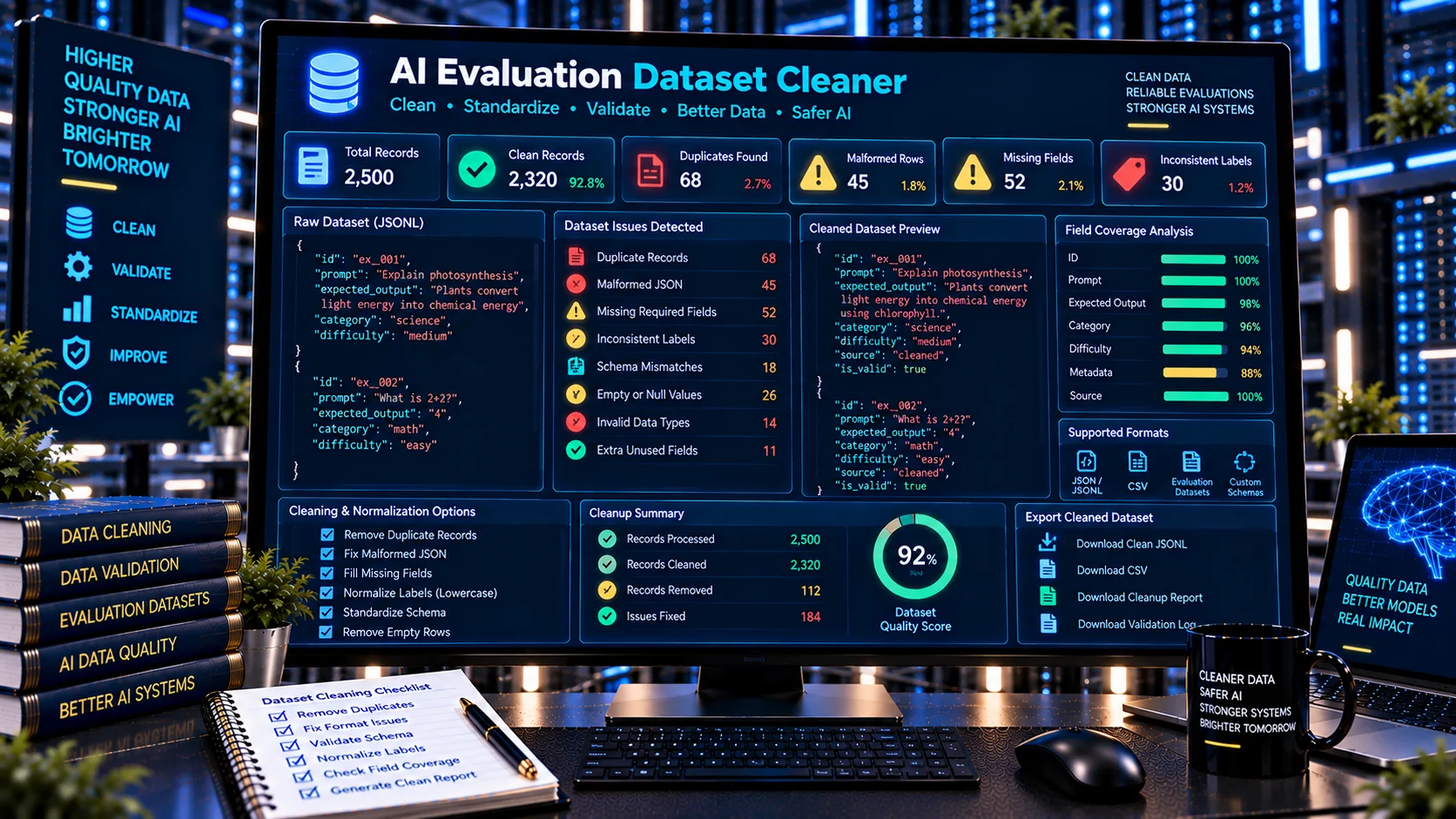
AI evaluation datasets can become difficult to maintain as test cases, labels, expected outputs, metadata, and evaluation records grow. The AI Evaluation Dataset Cleaner helps identify common dataset-quality problems such as malformed records, duplicate entries, missing fields, inconsistent structures, and inconsistent labels before the dataset is used for LLM evaluation.
The tool is designed for practical dataset cleanup and quality review across JSON, JSONL, and CSV evaluation data. It provides structured findings and can generate a cleaned dataset without requiring an external AI API.
AI Evaluation Dataset Cleaner
Detect and safely clean common quality problems in LLM evaluation datasets, including malformed records, blank rows, duplicate cases, missing fields, inconsistent keys, and inconsistent label formatting. Review proposed changes before exporting a cleaned dataset.
Dataset Quality Findings
Field Coverage
Cleaned Dataset Preview
Cleanup Report
What Is an AI Evaluation Dataset Cleaner?
An AI Evaluation Dataset Cleaner is a utility for reviewing and cleaning datasets used to test or evaluate artificial intelligence and large language model systems.
Evaluation datasets commonly contain structured test cases with identifiers, prompts or inputs, expected answers, labels, metadata, reference values, model outputs, or scoring information. Public evaluation datasets frequently use JSONL, with one structured evaluation record stored per line.
As these datasets evolve, simple data-quality problems can affect downstream evaluation. Duplicate records can unintentionally increase the weight of a test case, missing fields can make an evaluation incomplete, and inconsistent labels can make results harder to interpret.
PKCapra’s AI Evaluation Dataset Cleaner focuses on these practical data-cleaning problems.
What Does the AI Evaluation Dataset Cleaner Check?
Malformed Dataset Records
The cleaner checks whether records can be interpreted as valid structured data and identifies malformed or unusable entries.
This is particularly useful for JSONL evaluation files where each line is expected to represent an individual JSON object. Public evaluation repositories commonly organize datasets this way for instance-level evaluation.
Duplicate Records
Duplicate detection helps identify repeated evaluation cases that may unintentionally distort a dataset.
The cleaner can identify duplicate identifiers and exact duplicate records so they can be reviewed before evaluation.
Missing Fields
Evaluation records often depend on important fields such as:
- ID
- Prompt or input
- Expected output
- Reference answer
- Label
- Metadata
- Evaluation information
The cleaner identifies missing or empty fields that may reduce the usefulness or consistency of an evaluation record.
Inconsistent Record Structures
A dataset can contain records with different field structures even when they are intended to represent the same type of evaluation case.
The cleaner reviews field coverage and identifies structural inconsistencies that deserve attention.
Inconsistent Labels
Labels are frequently used to represent evaluation categories, outcomes, classifications, or expected behavior.
For example, a dataset might unintentionally contain variations such as different capitalization, spacing, or formatting for what should be the same label.
The cleaner can identify label-format inconsistencies and provide normalization options where appropriate.
Field Coverage
Field coverage analysis helps show which fields appear consistently across the dataset and which fields are missing from some records.
This can be useful when maintaining evaluation datasets that have grown through multiple collection or annotation processes.
Exact Duplicate Content
Records can sometimes be duplicated even when their identifiers differ.
Exact duplicate detection helps surface repeated dataset content that may otherwise remain unnoticed.
Why Clean an LLM Evaluation Dataset?
A clean evaluation dataset makes it easier to understand what an evaluation actually measures.
Modern evaluation datasets can contain structured prompts, reference answers, scores, metadata, interaction types, and model outputs. Some evaluation repositories maintain formal schemas for aggregate results and separate schemas for individual JSONL evaluation samples.
Cleaning helps reduce avoidable data-quality problems before they reach the evaluation stage.
Common reasons include:
- removing accidental duplicate test cases
- finding incomplete records
- identifying inconsistent labels
- detecting malformed JSONL rows
- reviewing inconsistent field structures
- improving dataset consistency
- preparing cleaner benchmark inputs
- making evaluation datasets easier to maintain
Cleaning does not determine whether an evaluation case is scientifically valid or whether its ground truth is correct. It is a data-quality step that helps make the underlying dataset more consistent.
AI Evaluation Dataset Cleaner Workflow
1. Prepare Your Dataset
Prepare the JSON, JSONL, or CSV evaluation dataset you want to review.
Depending on the evaluation framework, records may contain prompts, questions, expected answers, labels, metadata, model responses, scores, or other evaluation-specific information.
2. Load the Dataset
Open the AI Evaluation Dataset Cleaner and provide the dataset for analysis.
The tool examines the dataset structure and evaluates records for common quality problems.
3. Review Cleaning Findings
Review the reported findings for issues such as:
- malformed records
- duplicate IDs
- duplicate content
- missing fields
- empty values
- inconsistent structures
- inconsistent labels
- field coverage problems
4. Apply Safe Cleanup
Where supported, cleanup operations can normalize selected dataset problems, including duplicate removal and label-format normalization.
The original dataset should still be retained separately so that changes can be reviewed or reversed when necessary.
5. Review the Cleaned Dataset
Inspect the cleaned dataset before using it for model evaluation.
This is especially important when evaluation records contain expected outputs, reference answers, scoring information, or other manually curated material.
6. Download the Cleaned Dataset
After reviewing the results, download the cleaned dataset for use in your evaluation workflow.
The tool also provides a structured cleanup report for documenting detected issues.
Common LLM Evaluation Dataset Problems
Duplicate Evaluation Cases
The same evaluation case can accidentally appear more than once, particularly when datasets are merged from multiple sources.
Duplicate detection helps identify these records before they influence evaluation results.
Missing Prompts or Inputs
An evaluation case without its intended input may not be usable for testing a model.
Missing input fields should therefore be reviewed before running the dataset.
Missing Expected Outputs
Many evaluation workflows depend on a reference answer, expected value, target label, or another form of ground truth.
A missing reference field can make an otherwise valid-looking test case incomplete.
Inconsistent Record Structures
Different records may gradually acquire different fields as an evaluation dataset evolves.
Structural review helps identify these inconsistencies.
Inconsistent Labels
Manually maintained datasets can accumulate variations in label spelling, capitalization, spacing, or representation.
Normalization can help make labels more consistent when those variations are known to represent the same category.
Exact Duplicate Rows
Two records can be identical even when their identifiers differ.
Exact duplicate detection provides another layer of dataset-quality review beyond ID-based duplicate checking.
JSON vs JSONL for Evaluation Datasets
JSON and JSONL can both be useful for AI evaluation workflows.
JSON can represent an entire structured dataset as one document, while JSONL stores individual JSON objects on separate lines.
Instance-level evaluation repositories commonly use JSONL because individual evaluation samples can be stored, processed, and validated independently. For example, public evaluation datastores can maintain aggregate JSON results alongside per-sample JSONL files with explicit schemas.
When working with JSONL, malformed individual lines can therefore become an important quality-control concern.
AI Evaluation Dataset Cleaner vs LLM Evaluation Dataset Validator
The two tools address related but different stages of dataset quality.
The LLM Evaluation Dataset Validator focuses primarily on validating whether evaluation records satisfy expected structural and evaluation-field requirements.
The AI Evaluation Dataset Cleaner focuses more directly on identifying and cleaning dataset-quality problems such as duplicates, malformed records, missing values, inconsistent structures, and label-format inconsistencies.
A practical workflow can use validation and cleaning together:
Clean → Review → Validate → Recheck
This separation keeps data cleanup distinct from formal dataset validation.
AI Evaluation Dataset Cleaner vs AI Structured Output Validator
An evaluation dataset contains test records used to assess AI behavior, while structured output validation focuses on whether generated data follows a defined structure.
PKCapra’s AI Structured Output Validator is therefore useful when the problem is validating structured AI output, while the AI Evaluation Dataset Cleaner is focused on maintaining the dataset used by an evaluation workflow.
These tasks can complement each other without being the same operation.
What Should a Clean Evaluation Dataset Contain?
The exact fields depend on the evaluation methodology.
A structured evaluation record may contain an identifier, input or prompt, expected/reference information, evaluation metadata, and scoring information. Current public evaluation datasets demonstrate several variations of this model, including records containing stable IDs, task information, expected values, labels, metadata, model outputs, and scores.
The important principle is consistency: records intended to represent the same evaluation type should follow a predictable structure.
Cleaning Does Not Replace Evaluation Design
Dataset cleaning is not the same as deciding whether an evaluation benchmark is good.
A cleaner can identify structural and consistency problems, but it cannot independently determine whether:
- a reference answer is factually correct
- a label represents the intended concept
- a benchmark measures the right capability
- a test case is representative
- an evaluation methodology is statistically appropriate
- a human annotation is substantively correct
Those questions require appropriate dataset documentation, domain review, evaluation methodology, or human judgment.
Privacy-Friendly Dataset Cleaning
The PKCapra AI Evaluation Dataset Cleaner is designed for browser-side dataset processing rather than requiring an external AI service to analyze the dataset.
This is useful when working with development datasets that should not be unnecessarily sent to third-party AI APIs.
However, users should still follow their own organization’s data-handling requirements and avoid placing sensitive information into tools unless the applicable privacy and security requirements permit it.
Who Can Use an AI Evaluation Dataset Cleaner?
The tool can be useful for:
- AI engineers
- LLM developers
- ML engineers
- evaluation engineers
- benchmark developers
- dataset curators
- QA teams
- AI researchers
- RAG developers
- agent developers
- teams maintaining automated evaluation pipelines
It can be especially useful when an evaluation dataset is frequently updated or assembled from multiple sources.
Frequently Asked Questions
What is an AI Evaluation Dataset Cleaner?
It is a dataset-quality tool for identifying and cleaning common problems in AI and LLM evaluation datasets, including malformed records, duplicates, missing fields, inconsistent structures, and label inconsistencies.
What formats does the tool support?
The PKCapra tool supports JSON, JSONL, and CSV evaluation datasets.
Can it detect duplicate evaluation records?
Yes. It can identify duplicate IDs and exact duplicate records.
Can it find missing fields?
Yes. The cleaner checks records for missing or empty fields and reports relevant findings.
Can it detect inconsistent labels?
Yes. It can identify label-format inconsistencies and provides normalization options where applicable.
Can it clean JSONL datasets?
Yes. JSONL is supported, making the tool suitable for datasets where each line represents an individual evaluation record.
Does the cleaner verify that an expected answer is correct?
No. It can check whether expected/reference information is present and structurally usable, but it does not independently establish whether the underlying answer is factually correct.
Does it use an external AI API?
No external AI API is required for the dataset-cleaning analysis.
Can I download the cleaned dataset?
Yes. After reviewing the cleanup results, the cleaned dataset can be downloaded.
Can I generate a cleanup report?
Yes. The tool provides a structured JSON cleanup report that can be copied or downloaded.
Build a Cleaner LLM Evaluation Workflow
Reliable AI evaluation depends on more than running models against a collection of prompts. The quality and consistency of the evaluation data itself also matter.
Public evaluation datasets demonstrate the importance of structured records, stable identifiers, reference or expected values, schemas, labels, metadata, and instance-level evaluation data.
PKCapra’s AI Evaluation Dataset Cleaner provides a practical cleanup layer for finding common dataset-quality problems before they become evaluation problems.
Use it to clean the dataset, review the findings, validate the resulting structure, and then move the cleaned data into the broader LLM evaluation workflow.