
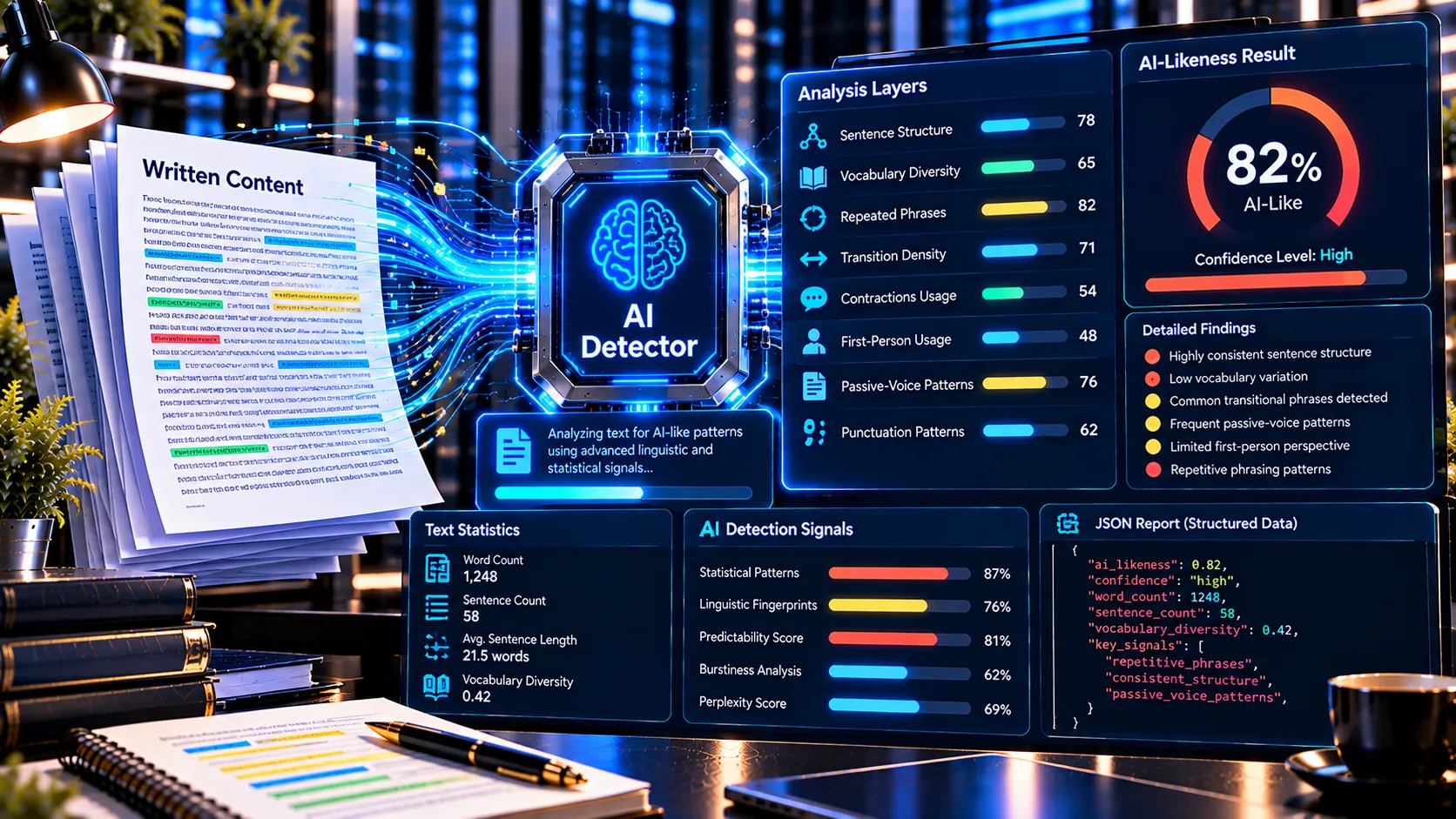
Analyze text for patterns commonly associated with AI-generated or AI-assisted writing using PKCapra’s browser-based General AI Detector. Review AI-likeness signals across sentence structure, vocabulary diversity, repeated phrases, transitions, contractions, first-person usage, passive-voice patterns, punctuation, and other writing characteristics.
Paste Text to Analyze
Choose a detection profile and analyze a text sample.
Detection Profile
Profiles adjust the interpretation of linguistic signals. The result is a heuristic signal, not proof of AI authorship.
- Sentence-length variation
- Vocabulary diversity
- Repeated phrase patterns
- Transition and connective density
- Contraction and first-person usage
- Punctuation and structural regularity
General AI Detection Signal
Signal Findings
Detailed Metrics
JSON Report
What Is a General AI Detector?
A General AI Detector analyzes writing for patterns that may be associated with AI-generated or AI-assisted text.
AI detection is not the same as proving who or what created a piece of writing. Writing characteristics can overlap between human-written and AI-assisted content, so detection results should be treated as signals for further review rather than definitive proof of authorship.
PKCapra’s General AI Detector evaluates multiple characteristics of the supplied text and combines them into an AI-likeness analysis.
How the General AI Detector Works
PKCapra analyzes the text directly in the browser and evaluates a range of linguistic and structural signals.
The analysis can include:
- Sentence-length variation
- Vocabulary diversity
- Repeated phrase patterns
- Transition and connective-word density
- Contraction usage
- First-person usage
- Passive-voice patterns
- Punctuation patterns
- Overall writing structure
The tool combines these signals into an AI-likeness result and provides supporting metrics so users can understand what contributed to the analysis.
AI-Likeness Score
The General AI Detector provides an AI-likeness score on a 0–100 scale.
The score represents the strength of the patterns detected by the tool. A higher score indicates that more of the evaluated characteristics align with patterns the detector associates with AI-like writing.
The score should not be interpreted as:
- A percentage of AI-generated content
- Proof that AI created the text
- Proof that a human wrote the text
- A plagiarism result
- A universal AI-detection probability
It is a signal generated from the characteristics evaluated by PKCapra.
Detection Confidence
Along with the AI-likeness signal, PKCapra provides a detection-confidence indicator.
Confidence helps communicate how much supporting evidence is available from the analyzed writing characteristics.
Very short or highly unusual text may provide fewer useful signals, so confidence should always be considered together with the underlying metrics and findings.
Sentence Structure Analysis
AI-assisted writing can sometimes display particular sentence-structure characteristics.
PKCapra examines sentence-length patterns and variation within the supplied text.
The analysis can identify characteristics such as:
- Average sentence length
- Sentence-length variation
- Very short sentences
- Very long sentences
- Structural consistency
Sentence structure is only one component of the overall analysis and should not be used independently to determine authorship.
Vocabulary Diversity
Vocabulary diversity measures how varied the words are within a piece of writing.
PKCapra examines vocabulary characteristics to determine whether the text contains:
- Repeated vocabulary
- Diverse word usage
- Limited lexical variation
- Consistent word patterns
Vocabulary diversity can vary naturally depending on the subject, audience, writing style, and type of content.
Repeated Phrase Patterns
Repeated phrases can provide useful information about writing structure.
The General AI Detector checks for repeated wording and recurring phrase patterns within the submitted text.
This can help identify writing that relies heavily on recurring expressions or highly consistent language structures.
Repeated phrases alone do not establish whether text was written by AI.
Transition and Connective Density
Transitions and connective expressions help organize written content.
PKCapra evaluates the density of transition and connective patterns within the analyzed text.
The analysis can identify frequent use of expressions that connect:
- Ideas
- Sentences
- Paragraphs
- Arguments
- Explanations
This is one of several signals considered by the detector.
Contraction Usage
Natural writing styles differ in their use of contractions.
PKCapra examines contraction patterns as part of the broader writing-style analysis.
For example, the detector may consider whether the text uses contractions such as:
- don’t
- can’t
- won’t
- it’s
- they’re
- we’ve
The presence or absence of contractions is not itself evidence of AI authorship.
First-Person Usage
First-person language can provide another writing-style signal.
PKCapra checks for first-person patterns such as:
- I
- me
- my
- we
- our
- us
The resulting metric contributes to the overall analysis rather than acting as an independent AI detector.
Passive-Voice Patterns
Passive constructions can affect the style and structure of writing.
PKCapra analyzes passive-voice patterns as part of its broader linguistic analysis.
A high or low level of passive voice does not indicate authorship by itself because passive constructions are common in academic, technical, scientific, legal, and professional writing.
Punctuation Patterns
The detector also examines punctuation characteristics.
Depending on the submitted text, the analysis can consider:
- Comma usage
- Sentence-ending punctuation
- Repeated punctuation patterns
- Punctuation consistency
- Structural punctuation behavior
These characteristics contribute to the overall pattern analysis.
Detailed Detection Findings
After analyzing the text, PKCapra provides detailed findings explaining the signals detected in the submitted content.
These findings can help users understand why particular characteristics contributed to the overall AI-likeness analysis.
Instead of relying only on a single score, users can review the underlying signals and metrics before deciding what the result means for their particular text.
Multiple Detection Profiles
The General AI Detector supports different analysis profiles for different types of writing.
General Text
Designed for general-purpose writing and everyday text analysis.
Academic / Professional
Designed for academic, technical, business, and professional writing where sentence structure and formal language may naturally differ from casual writing.
Marketing / SEO
Designed for content such as marketing copy, SEO articles, landing-page text, product content, and promotional writing.
AI Assistant Response
Designed for text that resembles responses commonly produced by AI assistants.
Different writing contexts can naturally produce different linguistic patterns, so selecting an appropriate profile can provide more relevant analysis.
Browser-Based AI Detection
PKCapra’s General AI Detector processes the supplied text in the browser.
The tool does not require an external AI API for its analysis.
This provides a straightforward way to evaluate text without sending the submitted content to a separate generative-AI service through PKCapra.
JSON Detection Report
After completing an analysis, users can generate a structured JSON report.
The report can contain information such as:
- Detection profile
- AI-likeness signal
- Confidence
- Text statistics
- Linguistic metrics
- Detection findings
- Analysis information
The JSON report can be copied or downloaded for documentation and further processing.
Who Can Use a General AI Detector?
The tool can be useful for:
- Writers
- Students
- Teachers
- Editors
- Researchers
- SEO professionals
- Content marketers
- Publishers
- Website owners
- AI developers
- Content-review teams
It can be used as an additional writing-analysis signal when reviewing content that may have been produced or assisted by generative AI.
Important Limitations
AI detection is inherently uncertain.
PKCapra’s General AI Detector does not establish authorship and should not be treated as definitive evidence that a person or AI system created the text.
Possible limitations include:
- False positives
- False negatives
- Short-text limitations
- Style variation between writers
- Subject-specific language
- Academic or technical writing patterns
- Editing or paraphrasing effects
- Mixed human and AI writing
A human-written text can contain characteristics associated with AI-generated writing, while AI-generated text can also avoid some of those characteristics.
For important academic, employment, legal, publishing, or disciplinary decisions, detection results should therefore be considered alongside appropriate human review and other available evidence.
Frequently Asked Questions
What does an AI detector do?
An AI detector analyzes writing characteristics and looks for patterns that may be associated with AI-generated or AI-assisted text.
Is the General AI Detector 100% accurate?
No AI detector should be treated as universally 100% accurate. PKCapra’s result is a pattern-based signal and can produce false positives or false negatives.
Does the score prove that AI wrote the text?
No. The AI-likeness score does not prove authorship or establish that AI created the submitted content.
Can human-written content receive a high AI-likeness score?
Yes. Human writing can naturally contain patterns that overlap with characteristics associated with AI-generated writing.
Can AI-generated content receive a low AI-likeness score?
Yes. AI-generated or AI-assisted content can contain enough variation or editing to produce fewer detectable signals.
Does the tool use an external AI API?
No. The General AI Detector performs its supported analysis in the browser and does not require an external AI API.
What types of text can I analyze?
You can analyze general writing, academic or professional content, marketing and SEO content, and AI-assistant-style responses using the available detection profiles.
Can I export the results?
Yes. PKCapra provides a structured JSON report that can be copied or downloaded.
Should I use an AI detector to make an academic or employment decision?
Detection results should not be used as the sole basis for significant decisions. Because AI detection can produce false positives and false negatives, important decisions require appropriate human review and additional evidence.