
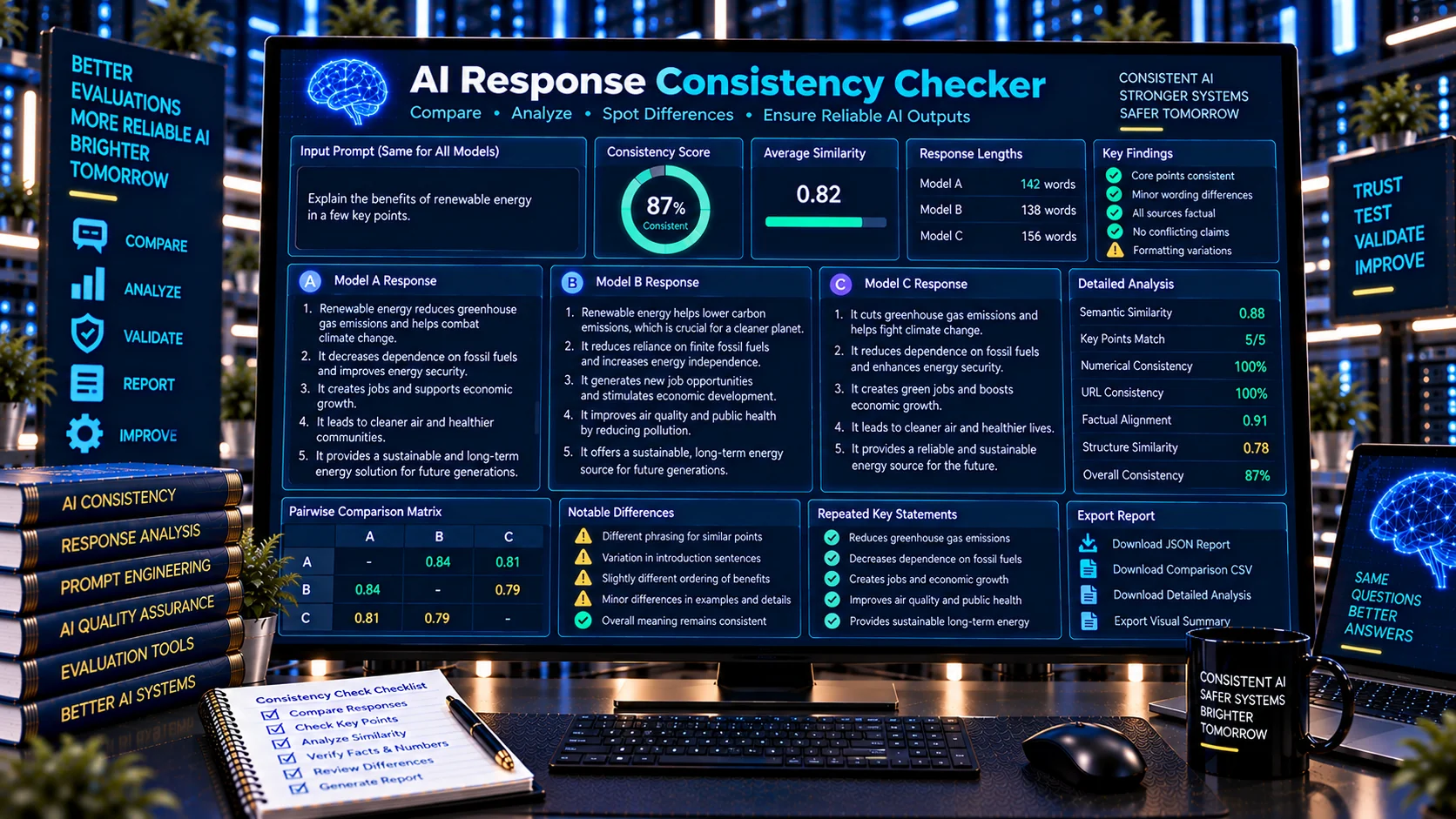
AI systems can produce different responses to the same or equivalent input. Some variation is expected, but large differences in wording, length, structure, claims, numbers, or links can make an AI workflow harder to evaluate and maintain.
The AI Response Consistency Checker helps compare multiple AI responses and identify measurable consistency signals across the responses. It provides similarity analysis, response statistics, structural checks, claim-like statement comparisons, number and percentage checks, and URL consistency signals.
The tool runs in the browser and does not require an external AI API for the comparison process.
AI Response Consistency Checker
Compare multiple AI-generated answers to the same prompt and identify consistency signals across wording, length, structure, repeated claims, numbers, URLs, and response format. Analysis runs entirely in your browser.
Consistency Findings
Response Comparison
Pairwise Similarity
Consistency Report
What Is an AI Response Consistency Checker?
An AI Response Consistency Checker is a tool for comparing multiple AI-generated responses to determine how consistently they follow a comparable response pattern.
When an AI application is tested repeatedly, responses can vary in:
- wording
- length
- structure
- repeated statements
- numerical information
- percentages
- URLs
- formatting
- overall similarity
Some variation can be normal. The purpose of consistency analysis is to make those differences visible so developers, QA teams, and AI engineers can investigate them.
PKCapra’s AI Response Consistency Checker provides quantitative and structural signals rather than claiming that two responses are factually identical.
What Does the AI Response Consistency Checker Analyze?
Response Similarity
The tool compares responses and calculates similarity signals based on normalized text.
Normalization can account for selected differences such as case, punctuation, and common stop words, allowing comparisons to focus more on substantive textual overlap.
Pairwise Response Comparison
When multiple responses are provided, the tool can compare response pairs and present pairwise similarity information.
This helps identify which responses are relatively similar and which show greater variation.
Consistency Score
The checker provides an overall consistency score based on the implemented comparison signals.
The score should be interpreted as a text and response-pattern consistency indicator rather than a measure of factual accuracy.
Response Length Variation
Response length can vary significantly even when an AI system receives similar inputs.
The tool examines response length using word and character statistics so unusually large variations can be identified.
Structural Consistency
Responses can differ in their general structure even when they discuss similar subjects.
The checker provides structural consistency signals that can help identify meaningful differences between responses.
Repeated Claim-Like Statements
The tool identifies repeated claim-like statements across responses so recurring content can be compared.
This can help reveal which statements remain stable and which appear only in individual responses.
Number and Percentage Checks
Numbers and percentages can be particularly important in AI-generated content.
The checker compares detected numerical information across responses and highlights differences that may require review.
URL Consistency
AI-generated responses may contain links or URLs that change between runs.
The checker examines URL consistency so developers can identify responses that reference different destinations.
Word and Character Statistics
The tool provides response-level statistics including word and character counts.
These measurements can help establish a basic baseline for response variation.
Why Check AI Response Consistency?
Consistency matters when AI responses are part of repeatable workflows.
For example, a developer may run the same prompt several times and observe substantial differences in:
- answer structure
- response length
- numerical values
- URLs
- repeated claims
- terminology
- content overlap
These differences do not automatically mean that an AI system is incorrect. However, they can indicate areas that deserve additional testing.
Consistency analysis can help with:
- regression testing
- prompt testing
- AI quality assurance
- model comparison
- output monitoring
- benchmark development
- agent testing
- response auditing
- evaluation dataset development
AI Response Consistency Checking Workflow
1. Collect Comparable Responses
Collect multiple AI responses generated from the same or equivalent input conditions.
The more comparable the source responses are, the more meaningful the consistency analysis can be.
2. Load the Responses
Provide the responses to the AI Response Consistency Checker.
Responses can be supplied using the supported input formats, including structured response arrays or separated plain-text responses.
3. Configure Normalization
Select the available normalization options according to the type of comparison you want to perform.
Options can include case normalization, punctuation normalization, and stop-word handling.
4. Review Pairwise Similarity
Review the similarity results for individual response pairs.
Large differences can identify responses that require additional investigation.
5. Review Variation Signals
Examine response length, structure, repeated claim-like statements, numbers, percentages, and URLs.
This provides multiple perspectives instead of relying only on one similarity number.
6. Export the Consistency Report
The tool provides a structured JSON report that can be copied or downloaded for documentation, QA records, or further analysis.
Common AI Response Consistency Problems
Large Wording Differences
Two responses may communicate similar information using substantially different wording.
Similarity analysis can help quantify the amount of textual overlap while still requiring human or semantic review for meaning.
Large Response-Length Differences
One response may be substantially longer than another even when both are generated from comparable inputs.
Length variation can be useful as a regression signal.
Structural Differences
Responses may use different organizational patterns, sections, or formatting.
Structural variation can be monitored when a consistent output format is expected.
Inconsistent Numbers
An AI system may generate different numerical values across responses.
Numerical differences should be reviewed carefully when the values represent factual, financial, scientific, or operational information.
Inconsistent Percentages
Percentages can change between responses even when the underlying question is unchanged.
The checker highlights these differences as review signals.
Inconsistent URLs
Different runs may produce different URLs for what appears to be the same informational task.
URL consistency checks can help identify this variation.
Repeated Claims That Change
A statement may appear consistently across several responses while its wording or associated details change.
Comparing repeated claim-like statements provides another way to identify response variation.
AI Response Consistency vs Factual Accuracy
Consistency and factual accuracy are different concepts.
An AI system can consistently produce the same incorrect statement.
Conversely, two responses can use different wording while both accurately communicate the same information.
Therefore, a consistency checker should not be interpreted as a factuality checker.
The PKCapra tool focuses on measurable response variation and consistency signals. Factual verification requires separate evidence-based checking.
AI Response Consistency vs Semantic Equivalence
Textual similarity does not necessarily equal semantic equivalence.
Two responses can contain different words but communicate the same meaning. Likewise, responses can share many words while containing different numerical or factual details.
The AI Response Consistency Checker therefore provides comparison signals rather than claiming complete semantic understanding.
This distinction is particularly important for LLM evaluation and quality assurance.
AI Response Consistency Checker vs LLM Test Case Formatter
The LLM Test Case Formatter prepares test cases by standardizing fields and structures.
The AI Response Consistency Checker examines the resulting AI responses for variation and consistency signals.
A testing workflow can therefore use both:
Format test cases → Run the model → Collect responses → Check consistency
AI Response Consistency Checker vs LLM Evaluation Dataset Validator
The LLM Evaluation Dataset Validator focuses on validating evaluation dataset structure and fields.
The AI Response Consistency Checker focuses on comparing AI-generated responses.
These are different stages of an evaluation workflow.
Dataset validation ensures that the evaluation records are structurally usable, while response consistency analysis examines the outputs generated during testing.
AI Response Consistency Checker vs AI Evaluation Dataset Cleaner
The AI Evaluation Dataset Cleaner focuses on problems inside evaluation datasets, such as duplicates, malformed records, missing fields, and inconsistent labels.
The AI Response Consistency Checker focuses on variation between AI responses.
A broader workflow can use:
Clean dataset → Format test cases → Validate dataset → Generate responses → Check response consistency
Testing Repeated LLM Responses
Repeated-response testing can be useful when evaluating an AI system under comparable conditions.
Developers may collect several outputs and compare them for:
- textual similarity
- length
- structure
- numerical consistency
- percentage consistency
- URL consistency
- recurring statements
The results can then be reviewed alongside the actual model configuration, prompt, temperature or sampling settings, model version, and evaluation methodology.
Using Consistency Checks for Regression Testing
AI applications can change when prompts, models, system instructions, retrieval data, or application code are modified.
A response consistency checker can provide an additional regression-testing signal by comparing outputs generated before and after a change.
Large differences do not automatically indicate a regression. They identify a difference that should be investigated against the expected behavior of the application.
Using Consistency Checks for AI Agents
AI agents can generate different outputs across repeated runs because their workflows may involve multiple steps, tools, retrieved information, or changing execution paths.
Consistency analysis can help identify recurring differences in:
- final responses
- response length
- numerical information
- URLs
- repeated statements
- response structure
For agent workflows, consistency should be evaluated alongside tool calls, retrieved context, execution state, and other relevant variables.
Privacy-Friendly Response Comparison
The PKCapra AI Response Consistency Checker performs its comparison process in the browser and does not require an external AI API.
This can be useful when developers want to compare responses without sending the response dataset to another AI service.
Organizations should still follow their own privacy, security, and data-handling requirements when working with sensitive AI outputs.
Who Can Use an AI Response Consistency Checker?
The tool can be useful for:
- AI engineers
- LLM developers
- ML engineers
- QA engineers
- evaluation engineers
- prompt engineers
- AI researchers
- benchmark developers
- AI application developers
- agent developers
- software testing teams
It can be particularly useful when repeated AI outputs need to be compared during development or regression testing.
Frequently Asked Questions
What is an AI Response Consistency Checker?
It is a tool for comparing multiple AI responses and identifying consistency signals across wording, length, structure, repeated statements, numbers, percentages, and URLs.
Does the tool check factual accuracy?
No. It identifies consistency and variation signals. It does not independently verify whether the responses are factually correct.
Does a high consistency score mean the AI is accurate?
No. Consistency and accuracy are different properties. A system can repeatedly generate the same incorrect information.
Can the tool compare multiple responses?
Yes. It supports multiple-response comparison and pairwise similarity analysis.
Can it compare response lengths?
Yes. The checker provides word and character statistics and identifies response-length variation.
Can it detect inconsistent numbers?
Yes. Detected numerical information can be compared across responses as a consistency signal.
Can it compare percentages?
Yes. Percentage values are included in the implemented consistency checks.
Can it check URLs?
Yes. The tool examines URLs appearing in responses and provides URL consistency signals.
Can I configure text normalization?
Yes. Available normalization options include case, punctuation, and stop-word handling.
Does it use an external AI API?
No. The consistency analysis runs without requiring an external AI API.
Can I export the results?
Yes. The checker provides a JSON consistency report that can be copied or downloaded.
Build a More Reliable AI Testing Workflow
AI output variation is not always a problem, but unexplained variation can make testing and quality assurance more difficult.
The AI Response Consistency Checker gives developers a practical way to compare multiple responses and examine similarity, response length, structure, recurring statements, numerical values, percentages, and URLs.
For a broader LLM testing workflow, PKCapra tools can be used in sequence:
Clean evaluation data → Format test cases → Validate the dataset → Generate AI responses → Check response consistency
The resulting consistency report provides measurable signals for further investigation while leaving factual and semantic judgment to the appropriate evaluation process.