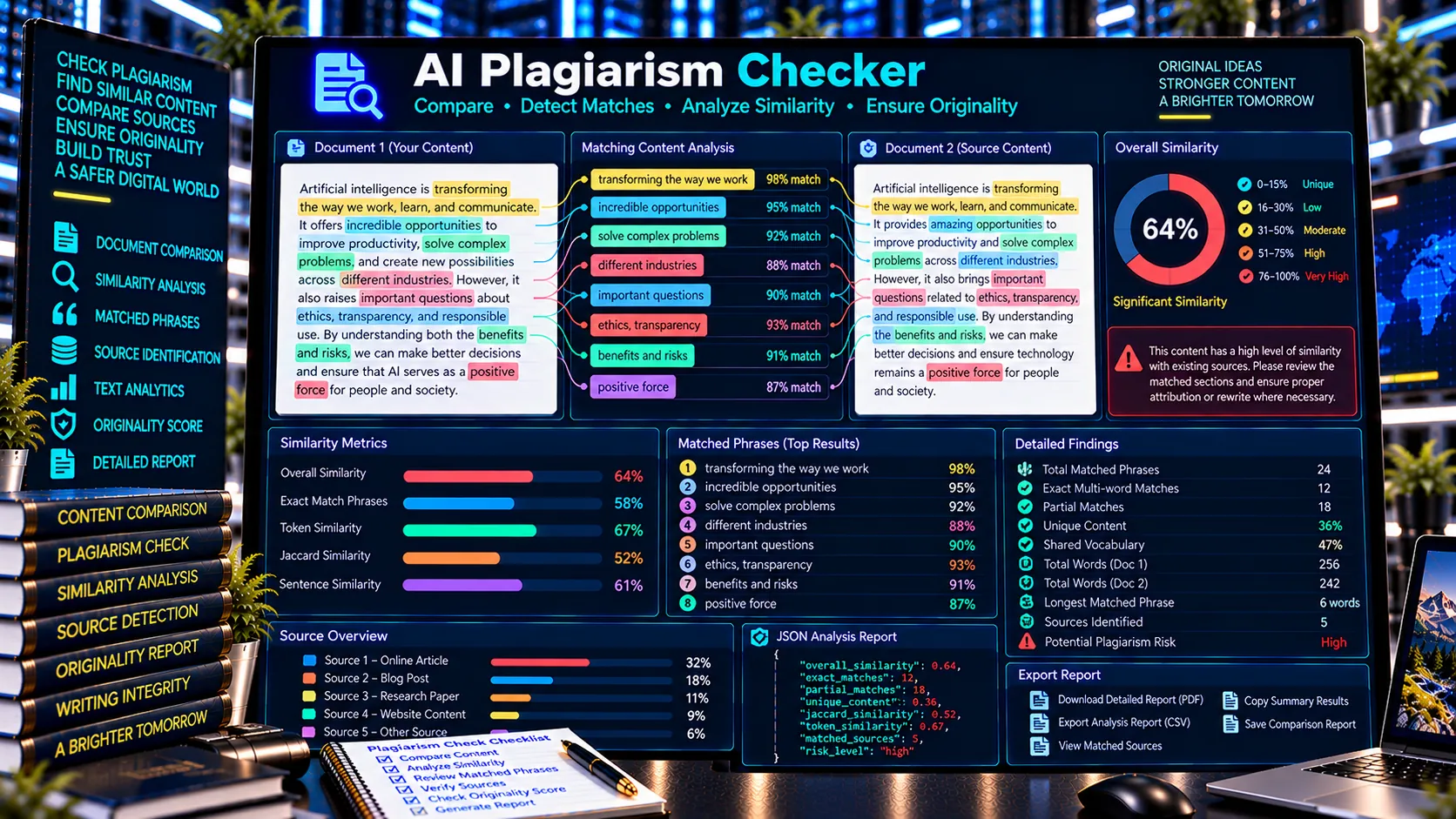
PKCapra’s AI Plagiarism Checker is a browser-based text similarity tool for comparing two pieces of text and identifying overlapping phrases, shared vocabulary, and measurable similarity signals. It uses deterministic comparison methods to highlight matching content without relying on an external AI API or remote plagiarism database.
Text to Check
Add text and a comparison source to check for matching phrases.
Comparison Source
This browser-based checker compares the two supplied texts. It does not search the web or access external plagiarism databases.
Similarity Assessment
Matching Phrase Findings
Comparison Metrics
JSON Report
What Is an AI Plagiarism Checker?
An AI Plagiarism Checker compares submitted text against a user-provided comparison text or reference corpus to identify similarities between the two.
PKCapra focuses on observable overlap rather than claiming to determine plagiarism from similarity alone.
The tool can identify exact matching phrases, shared words, token-level similarity, and other measurable overlap signals, helping users investigate whether two passages contain substantial common wording.
What Does the AI Plagiarism Checker Check?
Exact Phrase Matching
The checker identifies matching sequences of words between the primary text and comparison text.
It uses exact multi-word phrase matching to highlight sections where the same wording appears in both texts.
This can be useful for quickly identifying repeated passages or copied wording.
Matching Phrase Detection
Detected matching phrases are presented as individual findings so users can review the specific wording that contributes to the overall overlap.
This makes the result more transparent than providing only a single similarity percentage.
Shared Vocabulary
The checker compares the unique vocabulary used in the two texts.
Shared vocabulary can indicate that both passages discuss the same subject or use similar terminology, so it should not automatically be interpreted as evidence of copying.
Token Similarity
PKCapra calculates token-level similarity between the submitted texts.
This provides a quantitative signal showing how much of the normalized token set overlaps between the two passages.
Jaccard Similarity
The checker uses a set-based similarity calculation to measure the relationship between the unique tokens appearing in the two texts.
A higher similarity value means that the compared texts share more of their normalized vocabulary.
This is a mathematical similarity measure, not a legal or academic plagiarism determination.
How Does the AI Plagiarism Checker Work?
The comparison workflow is designed to be straightforward:
- Enter the primary text.
- Enter the comparison or reference text.
- Start the analysis.
- Review matching phrases.
- Examine shared vocabulary and similarity metrics.
- Review the detailed findings.
- Copy or download the JSON report if required.
The analysis is performed directly in the browser.
What Does the Similarity Score Mean?
PKCapra provides an overlap or similarity signal based on measurable similarities between the supplied texts.
The score should be interpreted as an indication of textual overlap rather than proof of plagiarism.
Two documents can legitimately have high similarity because they:
- Discuss the same topic
- Use common technical terminology
- Quote the same source
- Follow the same template
- Contain required phrases
- Describe standardized procedures
Similarly, paraphrased or substantially altered copied content may have a lower exact-word overlap.
AI Plagiarism Checker vs Traditional Plagiarism Databases
PKCapra’s tool works differently from commercial plagiarism services that maintain large collections of indexed web pages, publications, academic papers, or previously submitted documents.
The PKCapra checker compares the text supplied by the user.
It does not automatically search the internet or query a remote plagiarism database.
This makes it useful for controlled text-to-text comparisons, reference-corpus checks, draft comparisons, and internal content review.
What Can You Compare?
The tool can be useful for comparing:
- Two article drafts
- Original and revised content
- Student work against a supplied reference
- AI-generated text against source material
- Multiple versions of website copy
- Marketing drafts
- Research passages
- Internal documents
- Reference text and rewritten content
The comparison is based on the text provided to the tool.
AI Plagiarism Checker for AI-Generated Content
AI-generated text can sometimes reproduce wording from source material or independently produce similar language.
PKCapra’s checker can compare an AI-generated passage with a supplied reference passage and identify measurable overlap.
However, similarity does not establish whether the text was generated by AI, copied from a source, or independently written.
AI detection and plagiarism detection are separate analytical tasks.
AI Plagiarism Checker for Content Review
Content teams can use the tool to compare drafts before publication.
For example, an editor may compare:
- A new article against an older article
- A rewritten page against the original
- Multiple versions of the same content
- A contributor submission against supplied source material
The matching phrase findings can make it easier to investigate substantial overlap.
Browser-Based Text Similarity Analysis
PKCapra’s AI Plagiarism Checker processes the supplied text directly in the browser.
The tool does not require an external AI API and does not automatically send the text to a remote plagiarism database.
This can be useful when users need a private, controlled comparison between two pieces of text.
Detailed Comparison Report
The checker can produce structured findings including:
- Similarity or overlap signal
- Exact matching phrases
- Shared vocabulary
- Token similarity
- Jaccard similarity
- Comparison metrics
- Detailed findings
- JSON report
The report can be copied or downloaded for documentation and further analysis.
Limitations of the AI Plagiarism Checker
Text similarity should not be confused with plagiarism.
The tool does not independently determine:
- Who originally wrote the text
- Whether a source was cited correctly
- Whether copying violated an academic policy
- Whether similarity is legally significant
- Whether text was copied from the internet
- Whether a document is globally unique
It compares the supplied texts and reports measurable overlap.
A human reviewer should consider context, attribution, quotations, common terminology, source requirements, and applicable institutional or legal standards.
AI Plagiarism Checker vs AI Content Detector
The two tools answer different questions.
An AI Content Detector examines linguistic and structural patterns that may be associated with AI-assisted or highly formulaic writing.
An AI Plagiarism Checker compares supplied texts for measurable overlap.
A document can therefore:
- Show low AI-likeness but high textual overlap
- Show high AI-likeness but little overlap with the supplied reference
- Show both high AI-likeness and high overlap
- Show neither
These are separate signals and should not be treated as interchangeable.
Who Can Use an AI Plagiarism Checker?
The tool can be useful for:
- Writers
- Editors
- Students
- Teachers
- Researchers
- SEO professionals
- Publishers
- Content agencies
- Marketing teams
- Website owners
- AI-assisted content teams
It is particularly useful when users have a specific reference text or corpus they want to compare against.
Frequently Asked Questions
Does the AI Plagiarism Checker search Google?
No. PKCapra’s checker compares the text supplied by the user and does not automatically perform an internet-wide search.
Does it use a plagiarism database?
No. The tool does not rely on a remote plagiarism database. It performs browser-based comparison between the supplied texts.
Does a high similarity score prove plagiarism?
No. Similarity is an overlap signal. It does not by itself establish plagiarism.
Can two original texts have high similarity?
Yes. Common terminology, templates, quotations, standardized language, and shared subject matter can produce substantial overlap.
Can copied text have low similarity?
Yes. Extensive paraphrasing, rewriting, synonym replacement, or structural changes can reduce exact word overlap.
Does the tool detect AI-generated text?
No. Text similarity and AI authorship detection are different tasks. The checker focuses on overlap between supplied texts.
Is my text uploaded to an external service?
The tool is designed for browser-side comparison and does not require an external AI API or remote plagiarism database.
Can I download the comparison report?
Yes. The tool provides a structured JSON report that can be copied or downloaded for further review.
Compare Text Similarity With PKCapra
Use PKCapra’s AI Plagiarism Checker to compare supplied texts, identify matching phrases, measure shared vocabulary and token similarity, and review transparent overlap signals before making a deeper plagiarism assessment.