
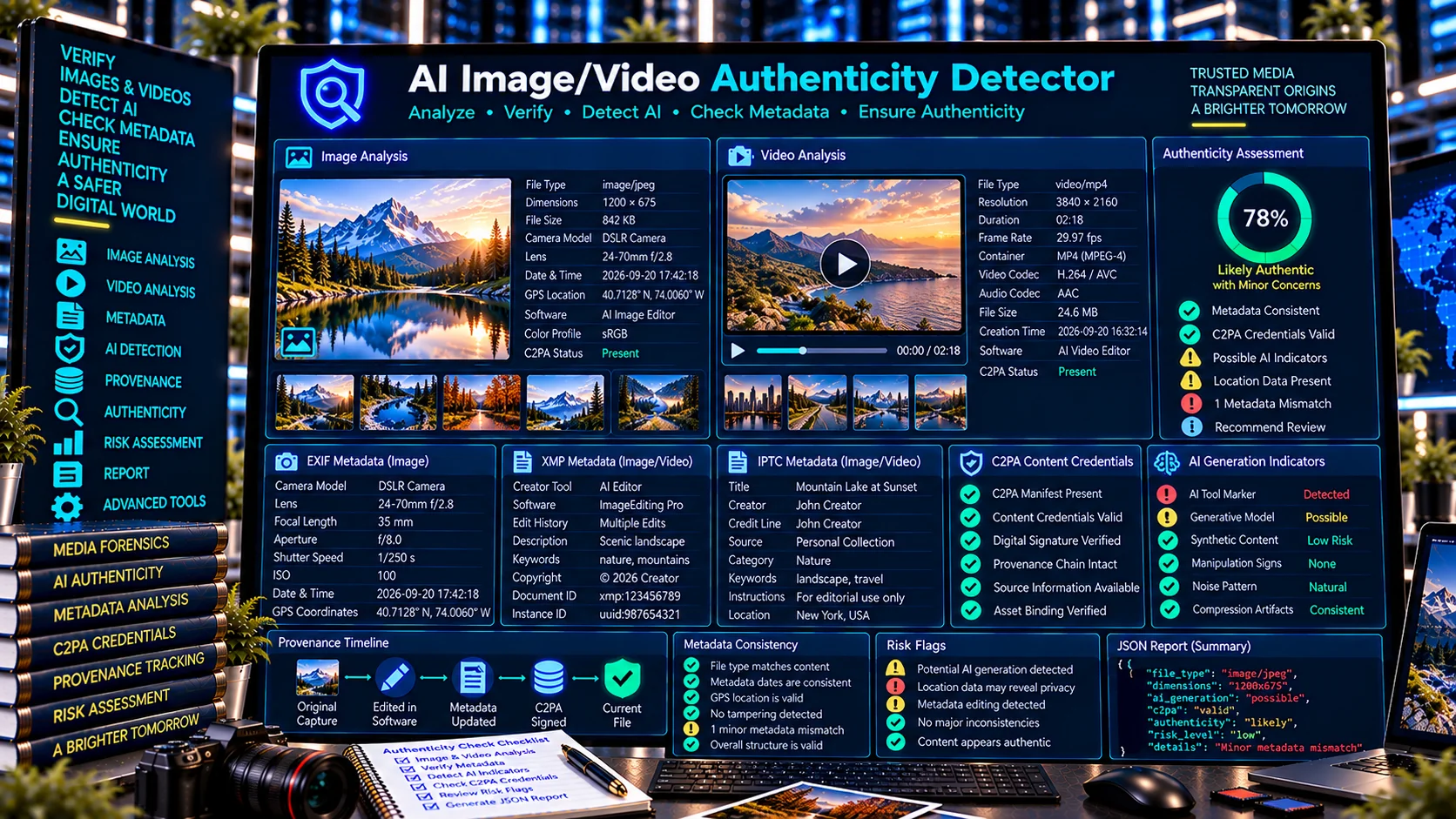
PKCapra’s AI Image/Video Authenticity Detector is a browser-based media analysis tool for reviewing images and videos for available authenticity-related signals, metadata indicators, editing markers, C2PA Content Credentials, and other signs that may help with media provenance assessment. The tool combines multiple file-level signals into a structured heuristic assessment without requiring an external AI API.
Inspect an Image or Video
Choose an image or video to review authenticity-related file, metadata, provenance, and consistency signals.
What This Detector Checks
PKCapra combines browser-readable media properties with detectable metadata and provenance markers to produce a structured authenticity signal report.
- File type and MIME consistency
- Dimensions and duration
- Encoder, software, and editing markers
- AI-generation and synthetic-media markers
- C2PA / Content Credentials signals
- GPS, XMP, IPTC, and creation-time signals
- Metadata contradictions and missing-signal warnings
Authenticity Signal Summary
Findings
Detected Signals
Media Summary
JSON Report
What Is an AI Image/Video Authenticity Detector?
An AI Image/Video Authenticity Detector examines digital media for technical and metadata signals that can provide context about how an image or video was created, processed, or exported.
Instead of relying on a single metadata field, PKCapra reviews multiple available indicators, including file properties, software markers, provenance information, C2PA signals, metadata consistency, and other authenticity-related clues.
The result is a structured assessment designed to help users investigate a media file before treating it as authentic, edited, AI-generated, or otherwise suspicious.
What Does the AI Image/Video Authenticity Detector Check?
Image and Video File Information
The detector first examines basic properties available from the submitted media file, including:
- File type
- MIME type
- File-size information
- Image dimensions
- Video dimensions
- Video duration
- File-format consistency
These signals provide basic technical context for the media asset.
AI and Synthetic-Media Signals
The tool looks for available metadata and file-level indicators associated with AI-generated or synthetic media workflows.
These may include:
- AI-related software markers
- Generator or editing application information
- Synthetic-media metadata
- Provenance-related fields
- AI-generation indicators
- Conflicting metadata signals
The presence of an AI-related marker can be useful evidence, but it should not automatically be interpreted as definitive proof of AI generation.
Editing and Software Markers
Digital media may contain information identifying software or processing applications.
The detector reviews available software and editing markers that can indicate whether the asset has passed through an image editor, video editor, encoder, conversion process, or other media workflow.
Such markers can provide useful context but do not independently establish whether a particular edit was legitimate or deceptive.
EXIF, XMP, and IPTC Signals
For supported image metadata, the detector examines available EXIF, XMP, and IPTC-related signals.
These may provide information about:
- Camera or capture information
- Software
- Creator information
- Dates and timestamps
- Copyright information
- Descriptive metadata
- Other embedded fields
Metadata availability varies by file format and by the applications used to create or export the media.
GPS and Location Signals
The detector checks for available geographic or GPS-related metadata.
Location information can be useful when investigating media provenance, but it can also expose sensitive information. Reviewing these signals before publishing a media file can therefore be useful for privacy assessment.
C2PA and Content Credentials
The detector checks for available C2PA and Content Credentials signals.
C2PA-compatible provenance information can provide structured information about declared media history, actions, ingredients, and other provenance details.
PKCapra’s detector identifies these signals as part of its broader authenticity assessment. It does not replace a dedicated cryptographic C2PA verification system.
How the Authenticity Assessment Works
The detector evaluates multiple available signals rather than treating one metadata field as conclusive.
The assessment can consider:
- File and format consistency
- Available technical properties
- Metadata indicators
- Software and editing markers
- AI-related metadata
- C2PA and provenance signals
- Metadata contradictions
- Other authenticity-related findings
These signals are combined into a heuristic authenticity assessment.
A heuristic result should be treated as an investigative signal, not as a definitive forensic conclusion.
What Does the Authenticity Score Mean?
The tool can produce an authenticity-related heuristic score based on the signals it identifies.
The score is intended to help users organize and prioritize findings.
It does not mean that PKCapra has mathematically proven that an image or video is genuine, manipulated, AI-generated, or fake.
For high-stakes investigations, authenticity decisions should be supported by additional evidence and appropriate forensic analysis.
Why Use Multiple Authenticity Signals?
Digital media can be modified, transcoded, stripped of metadata, or exported through different software applications.
For that reason, relying on one signal can produce misleading conclusions.
For example:
- Missing metadata does not prove manipulation.
- Editing software metadata does not prove malicious editing.
- AI-related metadata does not necessarily prove the entire asset was AI-generated.
- C2PA metadata can provide provenance information but should be interpreted within its verification context.
- A clean metadata profile does not prove that media is authentic.
A multi-signal approach provides more useful context than a single-field check.
AI Image/Video Authenticity Detector for Content Verification
The tool can help users investigate media before sharing, publishing, archiving, or using it as evidence.
Potential workflows include:
- Reviewing suspicious images
- Checking videos received from unknown sources
- Investigating possible AI-generated media
- Examining editing and software markers
- Reviewing provenance information
- Checking C2PA-related signals
- Identifying metadata contradictions
- Preparing media for further forensic review
AI Authenticity Detection vs Metadata Inspection
PKCapra’s AI Image/Video Authenticity Detector and metadata inspection tools serve different purposes.
The authenticity detector combines multiple available signals into a broader heuristic assessment.
The AI Image Metadata Inspector focuses specifically on examining image metadata such as EXIF, XMP, IPTC, GPS, software, and C2PA-related signals.
The AI Video Metadata Inspector focuses on video file properties and available video metadata and provenance signals.
Using these tools together can provide a more detailed view of a media asset.
AI Authenticity Detection vs C2PA Verification
C2PA and Content Credentials can provide structured provenance information when present.
However, detecting the existence of C2PA-related metadata is different from independently verifying cryptographic signatures, certificates, trust relationships, and content bindings.
The AI Image/Video Authenticity Detector therefore treats C2PA information as one part of the overall signal set rather than presenting its presence or absence as a complete authenticity verdict.
Privacy-Friendly Media Analysis
PKCapra’s detector is designed for browser-based processing.
The tool does not require an external AI API to perform its file-level assessment. This allows users to review media without depending on a remote AI analysis service.
Users should still avoid sharing sensitive media unnecessarily and should understand that metadata itself may contain private information such as location or creator details.
Common Findings the Detector May Identify
Depending on the media file, the detector may report findings such as:
- File-type mismatch
- Technical metadata signals
- Software or editing markers
- AI-related metadata
- C2PA or Content Credentials signals
- GPS/location information
- Missing metadata
- Conflicting metadata
- Provenance indicators
- Suspicious or unusual file-level signals
Not every finding indicates manipulation or fraud. Each signal should be interpreted in context.
Who Can Use an AI Image/Video Authenticity Detector?
The tool can be useful for:
- Journalists
- Researchers
- Content creators
- Social media teams
- Digital investigators
- Media organizations
- AI researchers
- Fact-checking workflows
- Digital asset managers
- Privacy-conscious users
- Developers working with media pipelines
Frequently Asked Questions
Can this tool definitively tell whether an image is AI-generated?
No. The tool provides a heuristic assessment based on available file, metadata, provenance, and other signals. It should not be treated as definitive proof of AI generation.
Can it detect deepfakes?
The tool can identify available authenticity-related and metadata signals, but it is not a pixel-level deepfake forensic system. A lack of suspicious metadata does not prove that a video or image is genuine.
Does a high authenticity score prove that media is real?
No. The score is heuristic and should be interpreted as an assessment of the available signals, not as a definitive authenticity certificate.
Does missing metadata mean an image or video is fake?
No. Metadata can be removed during editing, compression, export, platform processing, or file conversion.
Can editing software metadata prove manipulation?
No. Software metadata can indicate that a file passed through an application, but it does not establish what changes were made or why.
Does C2PA prove authenticity?
C2PA can provide important provenance information, but detecting C2PA metadata is not the same as independently verifying every cryptographic and trust-related aspect of a Content Credentials chain.
Does the tool upload my media?
The detector is designed for browser-side processing and does not require an external AI API for its assessment.
Review Media Authenticity Signals Before You Trust a File
Use PKCapra’s AI Image/Video Authenticity Detector to examine available technical, metadata, software, provenance, C2PA, and AI-related signals and generate a structured heuristic assessment for further investigation.